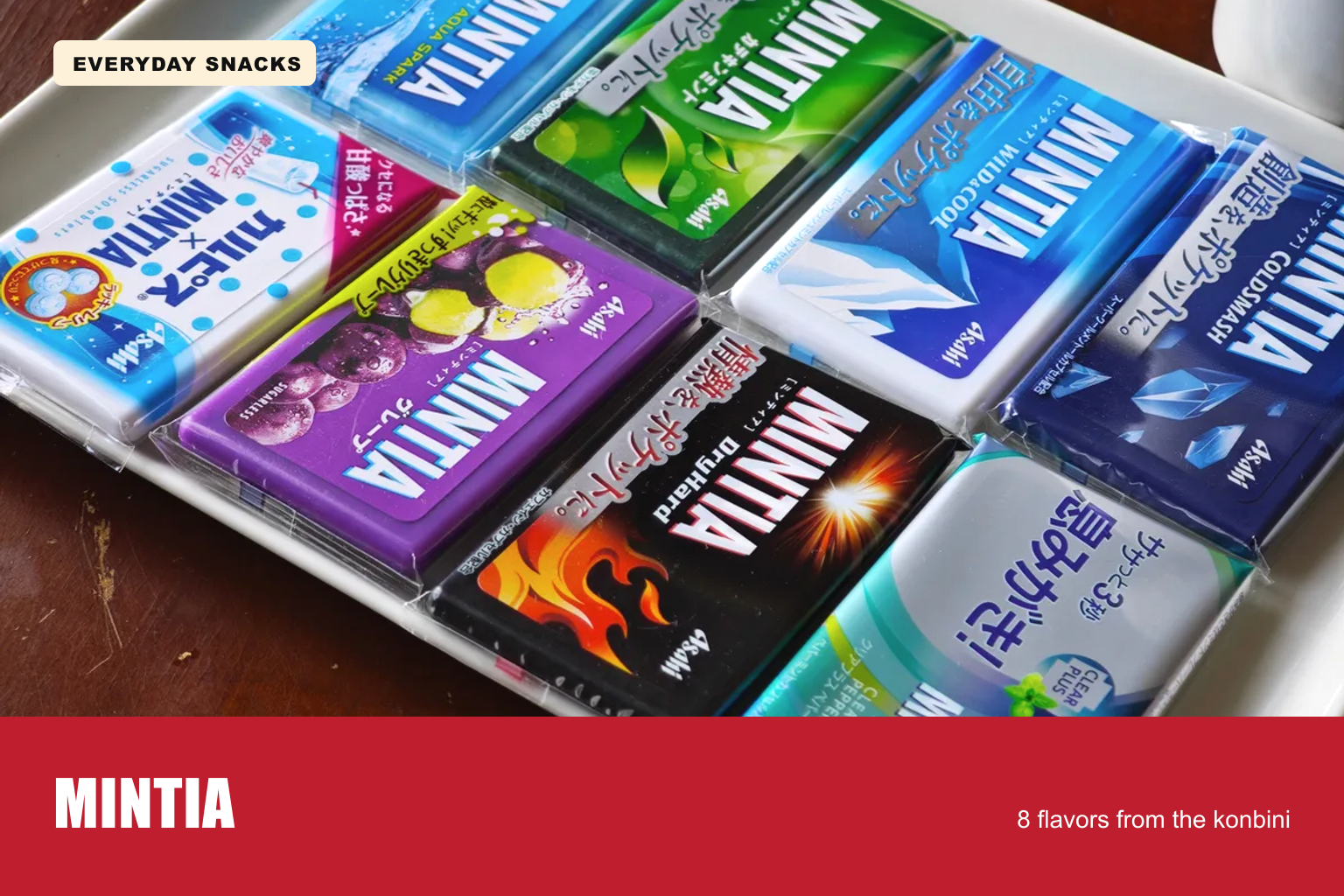
Walk into any Japanese convenience store and look at the counter, not the snack aisle. Somewhere near the register there is a rack of flat plastic cards in eight colors. That is MINTIA (ミンティア), and it is the best-selling tablet candy in Japan.
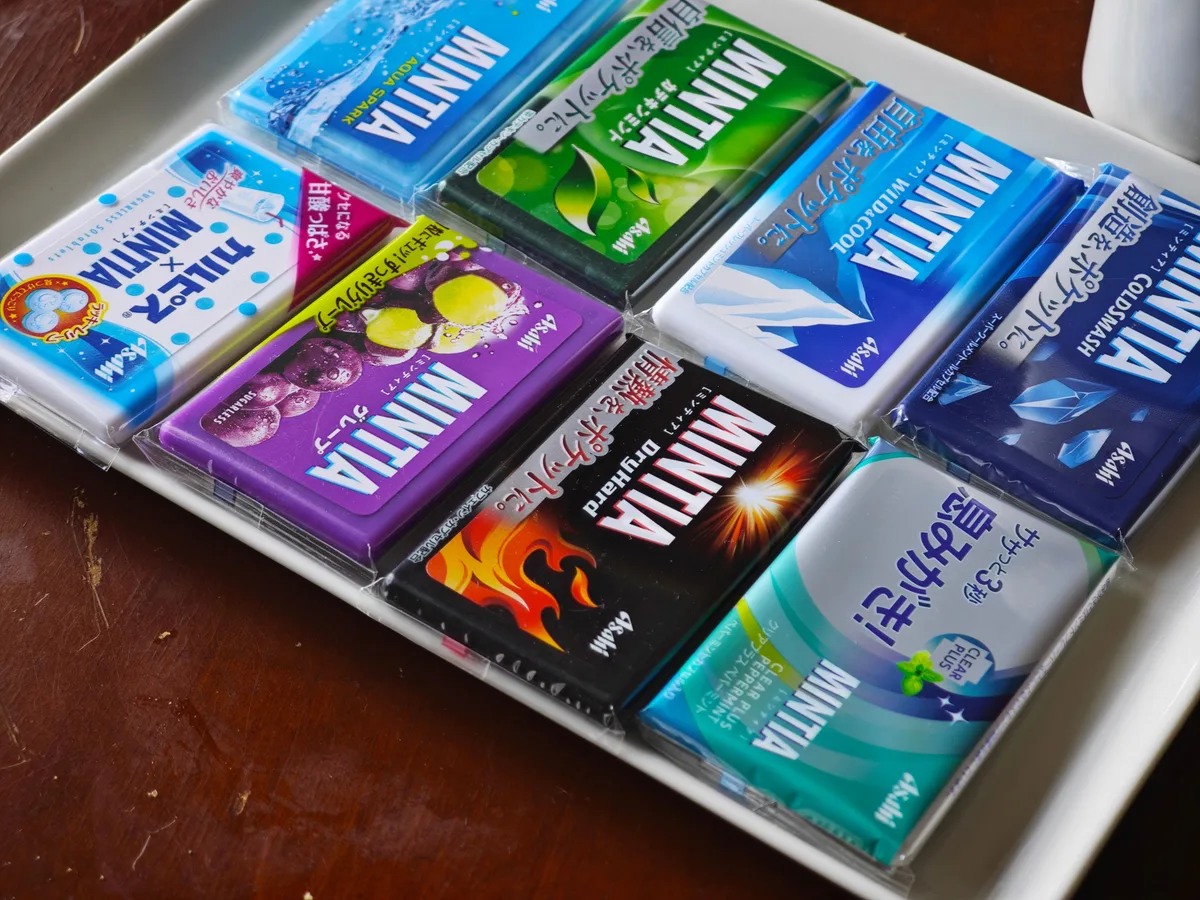
I bought every one I could find in a single konbini run. Eight cases: five mints and three that are frankly just sweets. Each holds 50 tablets in 7 g, costs about the same as a canned coffee, and weighs nothing.
This guide covers all eight — how they actually taste, what the labels say, the brand’s odd origin story, the hidden tablets in the Calpis case, and a short section at the end where I ate all eight at once and briefly stopped being a person.
Quick choice: Dry Hard if you smoke or drive. Cold Smash if you want your mouth to go arctic. Clear Plus Peppermint if you want breath care without the jolt. Grape or Calpis if you are not here for mint at all.
Quick picker
- Compare all eight regular flavors
- Choose among the five mints
- Explore the soda, grape, and Calpis side
- Look for Calpis lucky tablets
- Read the all-eight experiment
- See where to buy MINTIA
MINTIA in 30 seconds
- Maker: Asahi Group Foods
- Launched: 1996 — but not by Asahi
- Content: 50 tablets, 7 g, per card case
- Calories: 22–25 kcal for the entire case
- Sugar: sugarless, 0 g sugars, across the regular line
- Rank: No.1 in Japan’s tablet-candy category by sales value, continuously since May 2007
- 2025 sales: ¥26.1 billion, an all-time record
- Products released in 30 years: more than 350
- Where: convenience stores, supermarkets, drugstores, airports, station kiosks
A cosmetics company invented it, and a beer company inherited it
Most Japanese people cannot tell you where MINTIA came from. The answer is genuinely strange.
MINTIA was launched in 1996 by Pola Foods, the food subsidiary of Pola, a cosmetics company. It sold in the Tokyo area only, in two flavors: Peppermint and Cassis Mint. Its one radical idea was price. Tablet candy in Japan cost ¥200 at the time; MINTIA arrived at ¥100 in a slim case built to live in a pocket. Asahi’s own corporate history credits that decision with expanding the entire category.
Wild & Cool followed in 1997 and Dry Hard in 1998. The vertical case was replaced by the flat, horizontal card shape everyone recognizes in 2002.
Then the beer company arrived. Asahi Beer Pharmaceuticals acquired Pola Foods in 2002, and after a round of mergers, Asahi Food & Healthcare formally inherited MINTIA in 2003. That business was reorganized into Asahi Group Foods between 2015 and 2017, where the brand sits today.
If you know Asahi only from Super Dry, the pairing looks arbitrary. It is not. Asahi has run a food and healthcare business since the 1990s, and its lineage goes back further than the beer most tourists drink: a pharmacy from 1906, Japan’s first domestic infant formula in 1917, and Ebios, a supplement launched in 1930 made from brewer’s yeast at the Ebisu brewery. Turning yeast into a health product and turning mint into a ¥100 tablet come from the same corporate instinct.
There is also real engineering behind it. Asahi Group Holdings publishes an R&D note saying roughly 30 new or improved MINTIA formulations are developed each year, with blend ratios adjusted in steps finer than 0.1% of a tablet’s weight. This is a lot of science for something that costs less than a train fare.
From breath care to flavor
For years MINTIA sold one promise: your breath, fixed. Asahi’s 2015 announcements still talked about refreshing your breath, with packs printed 「瞬感息キレイ!」 — instantly clean breath.
Read the brand’s current messaging and the vocabulary has moved. Asahi now describes MINTIA in terms of taste, texture, and packaging, and positions it as refreshment rather than damage control. Breath care has not disappeared; it has shrunk into one specific product, Clear Plus Peppermint, which is the only case in this lineup that leads with etiquette.
The clearest evidence is Asahi’s own coolness scale (爽快レベル), published on the brand site. It runs from 0.25 to 6, and half of the eight cases I bought sit at the bottom of it.
| Flavor | Coolness level | kcal per case | Character | | — | — | — | — | | Dry Hard | 5 | 23 | sharp, stinging, caffeinated | | Cold Smash | 5 | 22 | deep freeze | | Wild & Cool | 4 | 23 | balanced classic mint | | Catechin Mint | 4 | 23 | tea-based, buzzing | | Clear Plus Peppermint | 2.5 | 22 | soft peppermint veil | | Aqua Spark | 0.5 | 24 | soda-lemon ramune | | Grape | 0.25 | 25 | Kyoho grape ramune | | Calpis × MINTIA | 0.25 | 25 | lactic drink candy |
A brand born to hide the smell of lunch now sells grape candy at coolness 0.25. That is the whole story in one table.
Why travelers should care
Three practical reasons.
You will find it. MINTIA is stocked at essentially every convenience store, supermarket, drugstore, Don Quijote, airport shop, and station kiosk in the country. You do not need to plan a trip around it — you will pass twenty of them today.
It solves a real travel problem. Japanese food is fragrant. Ramen with garlic, gyoza, grilled fish, yakiniku, natto at the hotel breakfast. If you are about to sit close to somebody on a train, in a taxi, or across a small counter, a tablet is the socially fluent move. Japan cares about not imposing on the people around you, and this is one of the cheapest ways to participate in that.
If you smoke, it is equipment. I smoke, and Dry Hard lives in my pocket. A cigarette outside a station followed by a tablet before you go back inside is a completely normal Japanese sequence. Smoking areas in Japan are strictly separated, and the tablet is the transition ritual between them.
One honest caveat: the mint masks odor with flavor. Asahi’s own footnote on the Clear Plus page says the breath-cleaning claim refers to a masking effect from the mint. It is a candy, not a treatment.
The five mints
These are the breath-care core, from the strongest down.
Dry Hard — the one in my pocket
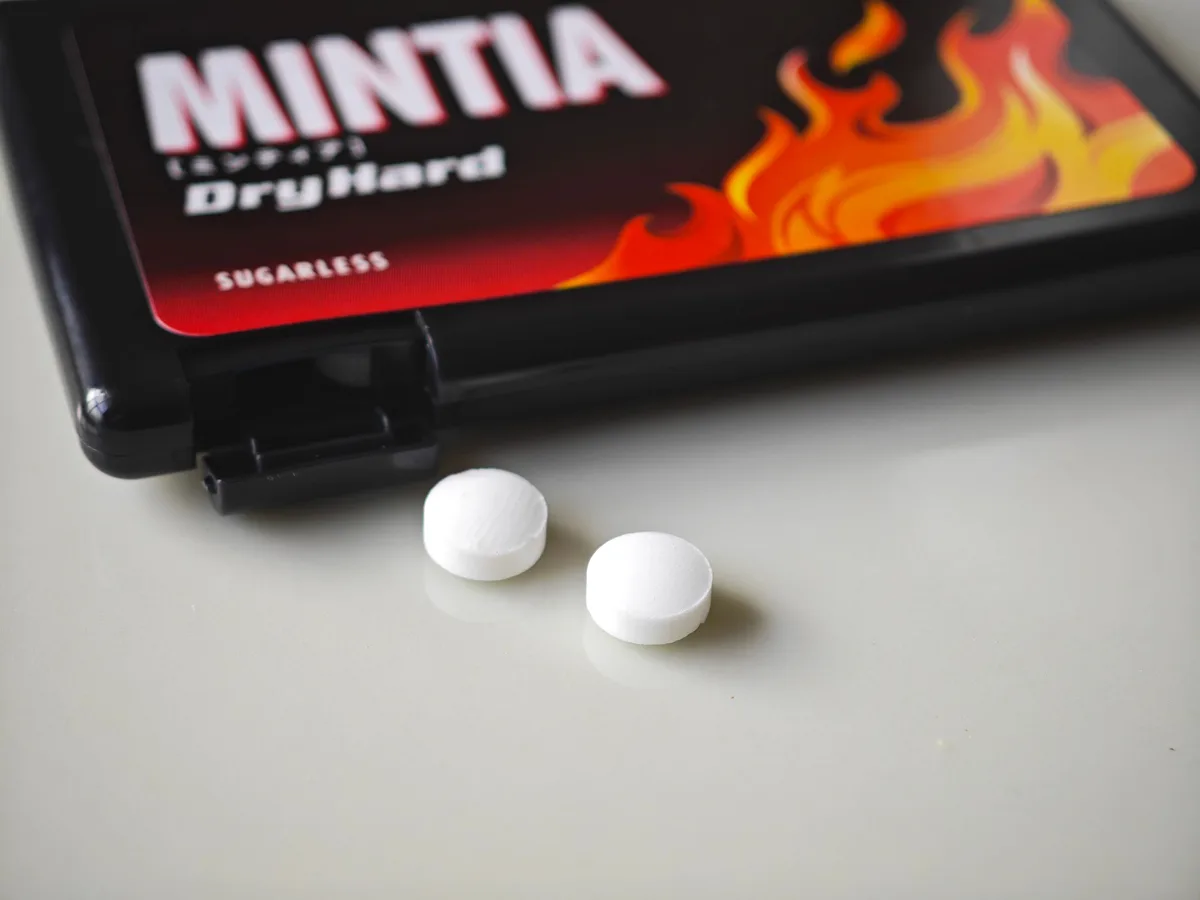
This is my regular. I eat it after meals and after cigarettes, and it does the job. The sting is piri-piri — tight and prickling rather than cold — and it is well judged: strong enough to reset your mouth, not so strong that you regret it. The caffeine and the sting together make it the one I reach for on long drives and in meetings where staying awake is a professional obligation.
If you buy exactly one MINTIA in Japan, buy this. The black-and-flames case also happens to look like something a delinquent would carry, which I enjoy more than I should.
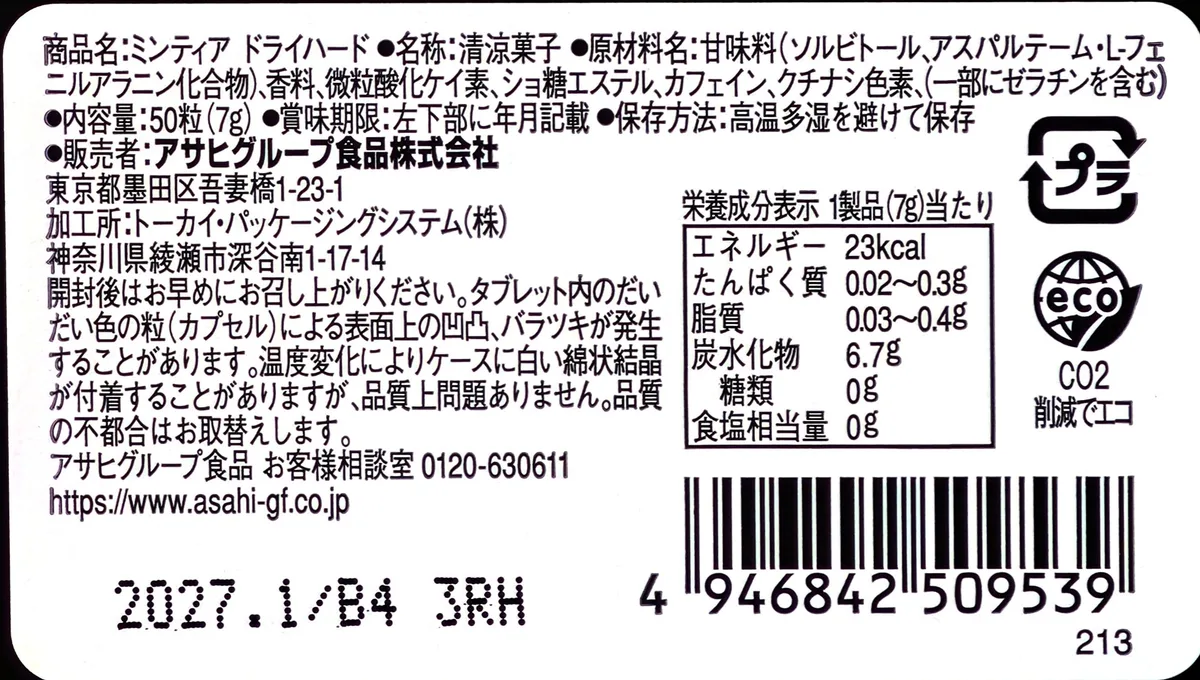
Read the ingredient list and one word stands out that appears on no other case here: caffeine. The case is 23 kcal total, sugarless, and the tablets carry orange capsules that can leave a slightly uneven surface — Asahi says so on the label rather than pretending the tablets are flawless.
Cold Smash — arctic
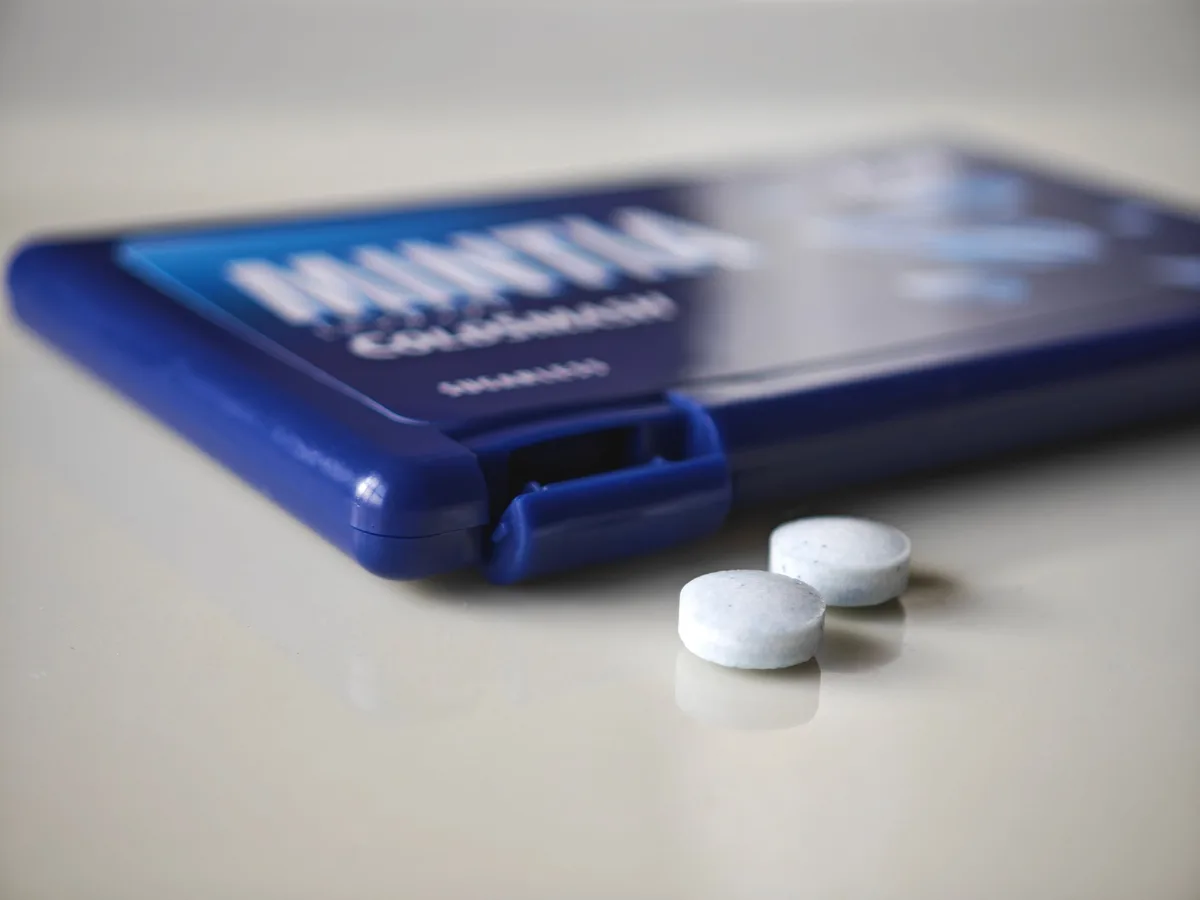
The mint here is enormous. Your whole mouth goes cold, as if you had inhaled through it in winter. If you are the kind of person who likes chocolate mint — that specific blue, almost synthetic chill — this is the best choice in the lineup. Where Dry Hard stings, Cold Smash chills. Two different level 5s.
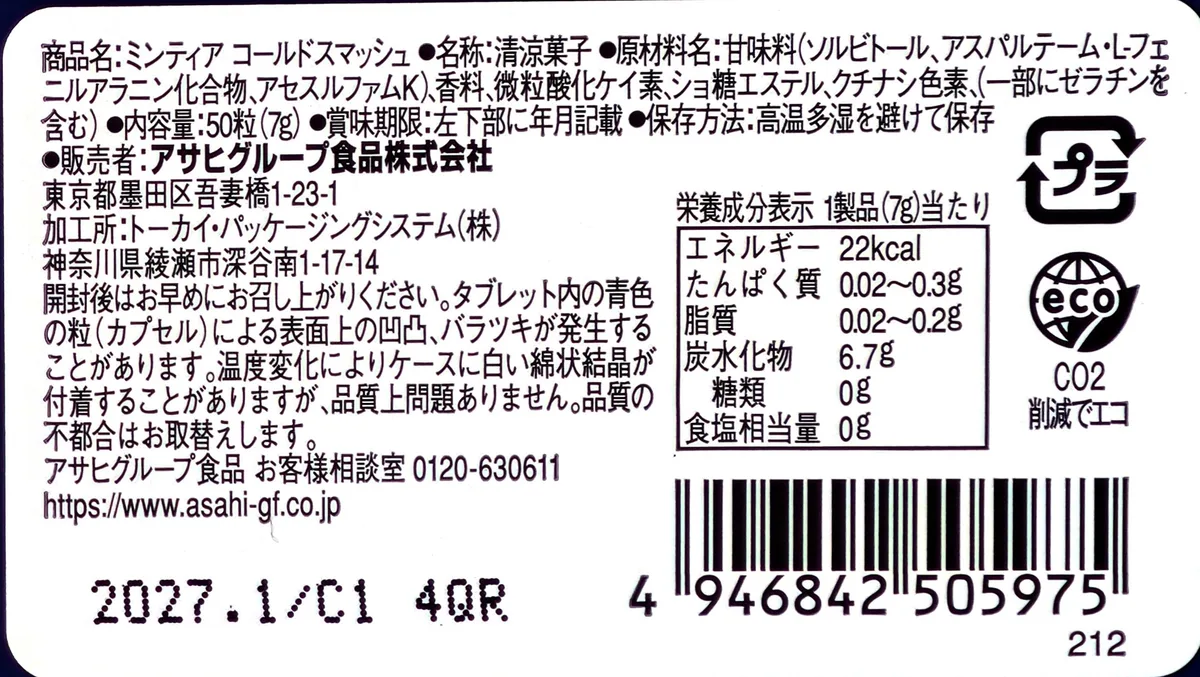
Level 5, 22 kcal, blue capsules inside the tablet. The deep blue case is telling the truth.
Wild & Cool — the balanced classic
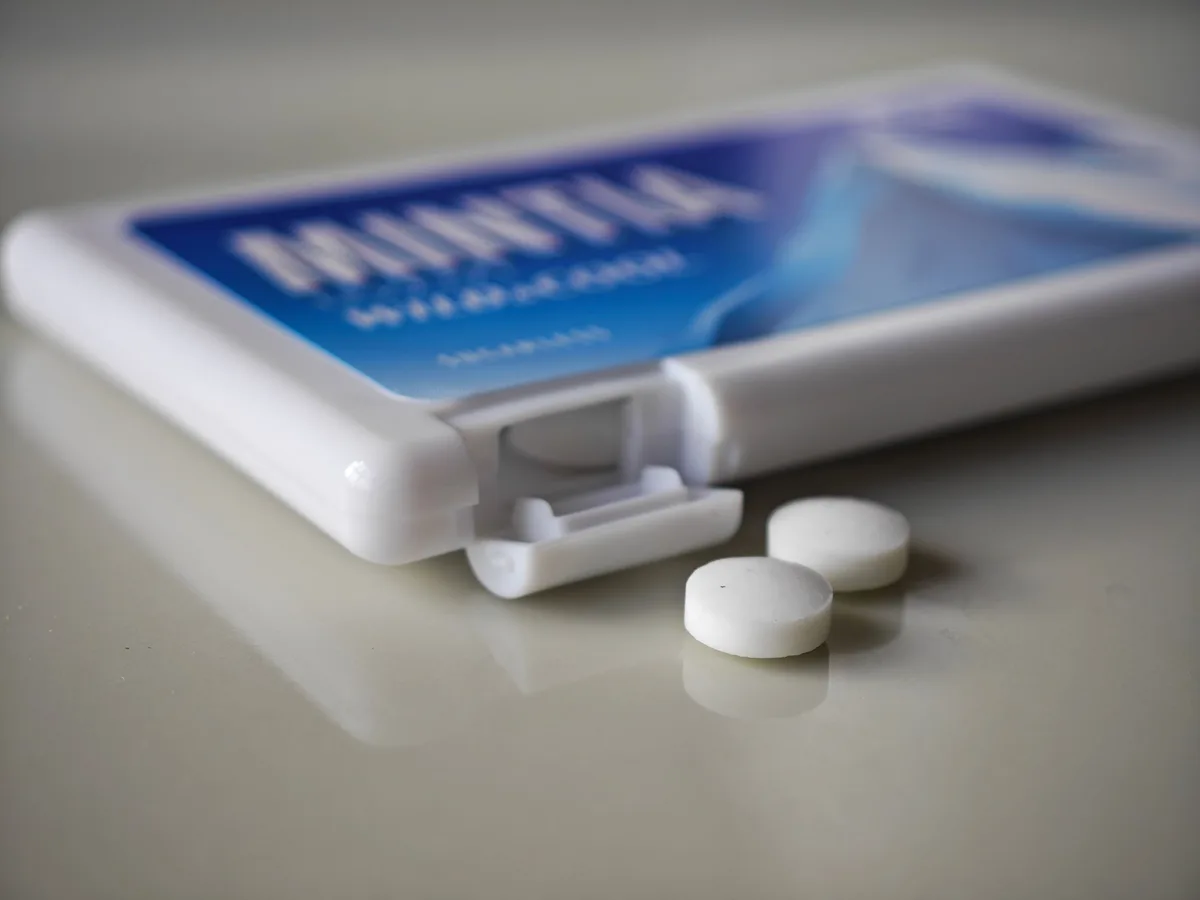
The mint feeling is the entire point, and that clean sū rush through the mouth is irresistible. What makes it the everyday pick is the harmony: sweetness and mint sit at the same volume instead of one shouting over the other. If Dry Hard is too pointed and Cold Smash is too cold, this is the one that just works.
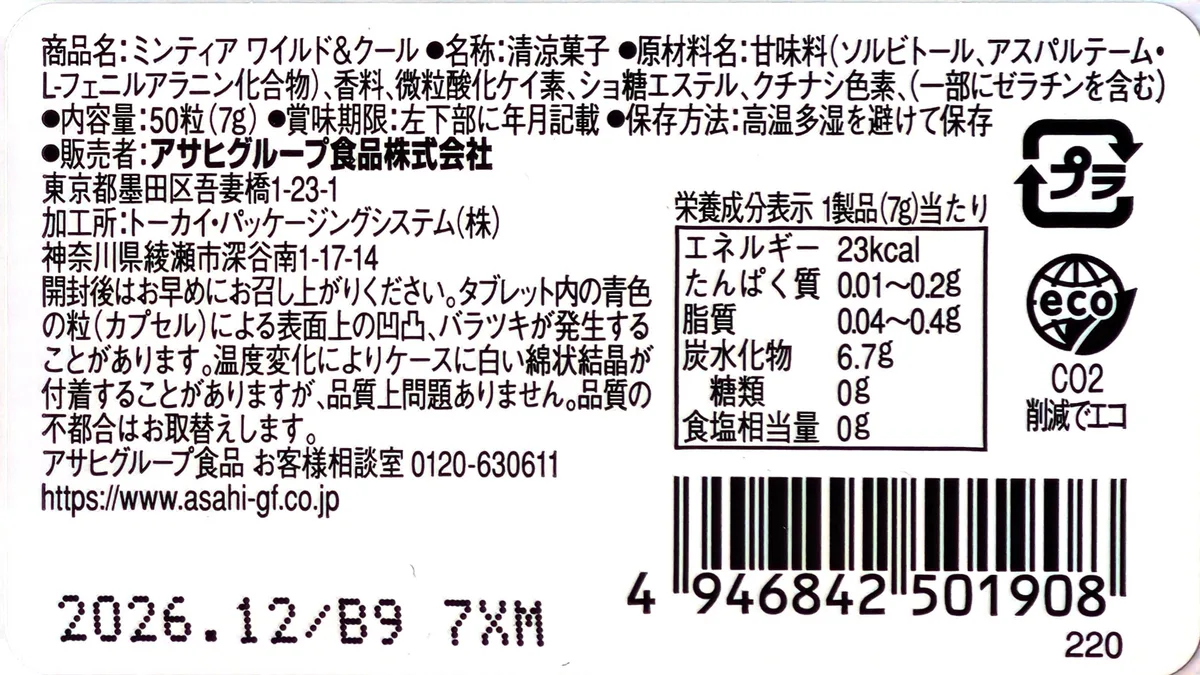
Around since 1997, which makes it the oldest survivor here after the original peppermint. Level 4, 23 kcal, blue capsules.
Catechin Mint — the tea one
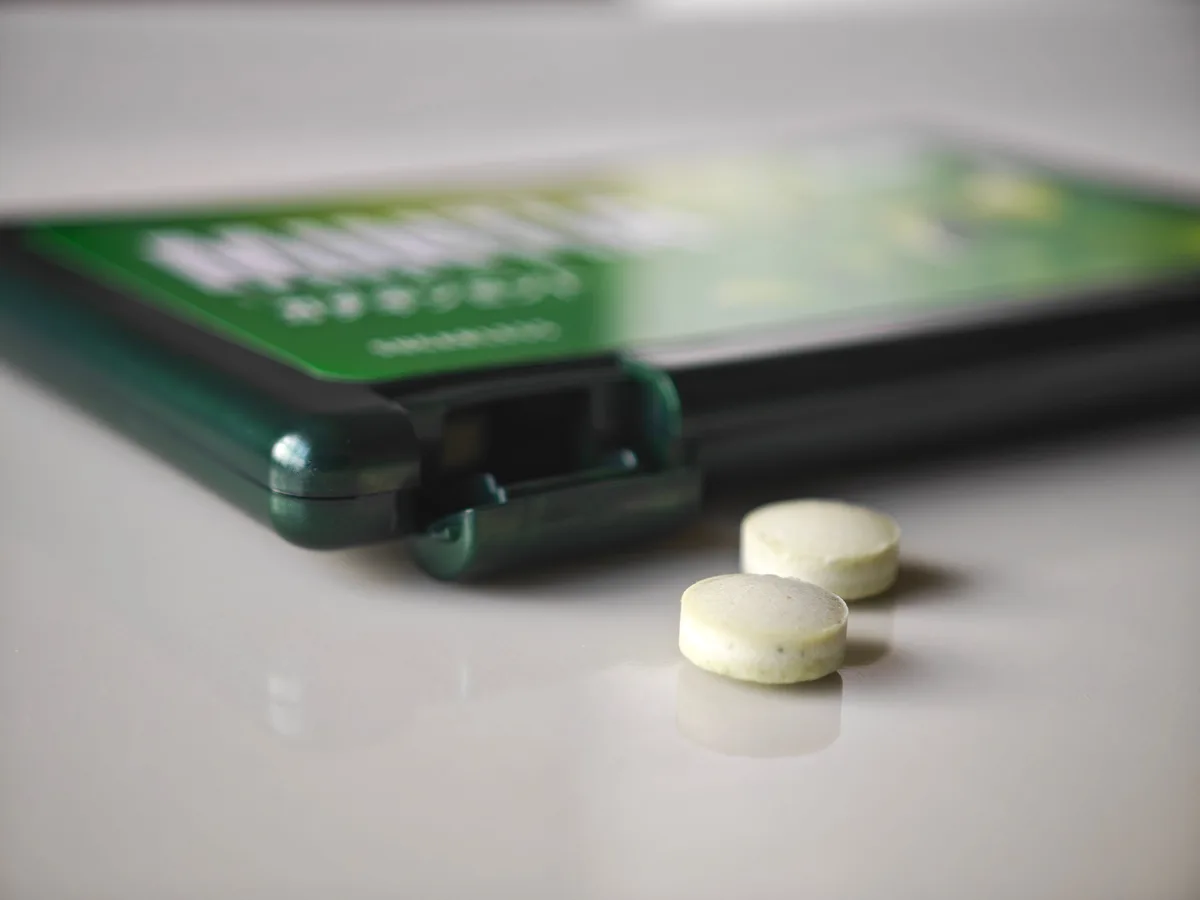
Catechin is the tea compound that Japanese consumers associate with deodorizing — you will see the same idea on breath sprays and even socks. Whatever the mechanism, the sensation genuinely differs from plain mint: a biri-biri buzz that lands lower, on the tongue itself, rather than a cold wave across the palate. A different kind of freshness.
Like Dry Hard, it leaves the mouth wide awake, so it earns a place in the anti-drowsiness rotation.
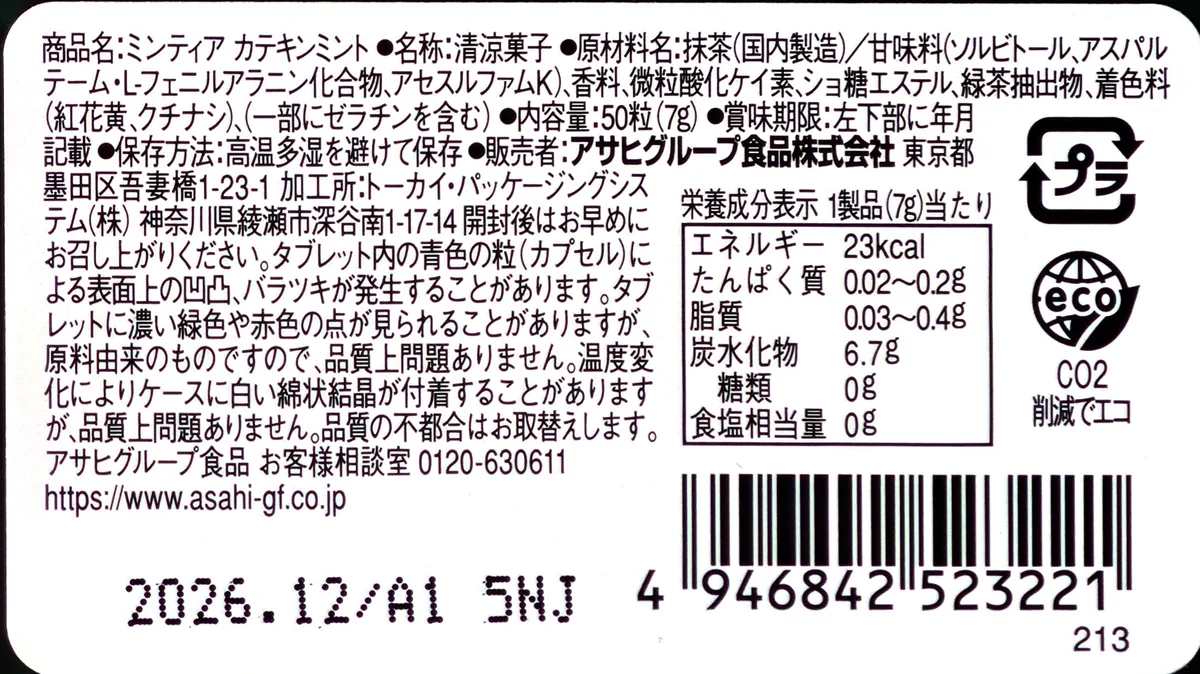
Look at the top of the ingredient list: matcha, domestically produced, listed first, plus green tea extract further down. That is why the green case has leaves printed on it. Level 4, 23 kcal.
Clear Plus Peppermint — breath care without the jolt
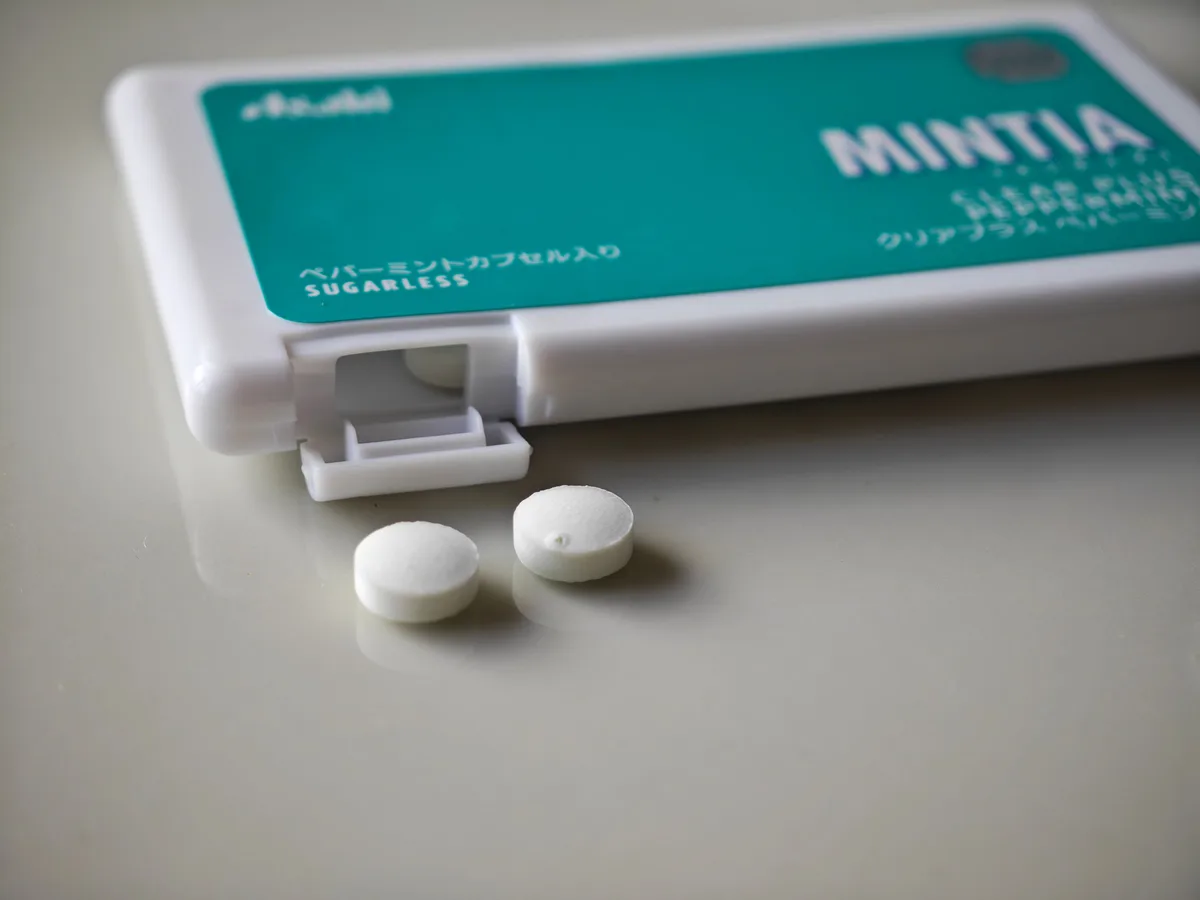
Peppermint plus sweetener, and it is genuinely delicious. This one is not about stimulation. It works by wrapping your mouth in peppermint scent rather than attacking it — a veil instead of a slap. Mild, pleasant, and clearly built for the moment before you speak to someone rather than the moment you need to wake up.
When you do not want to be jolted, this is the answer.
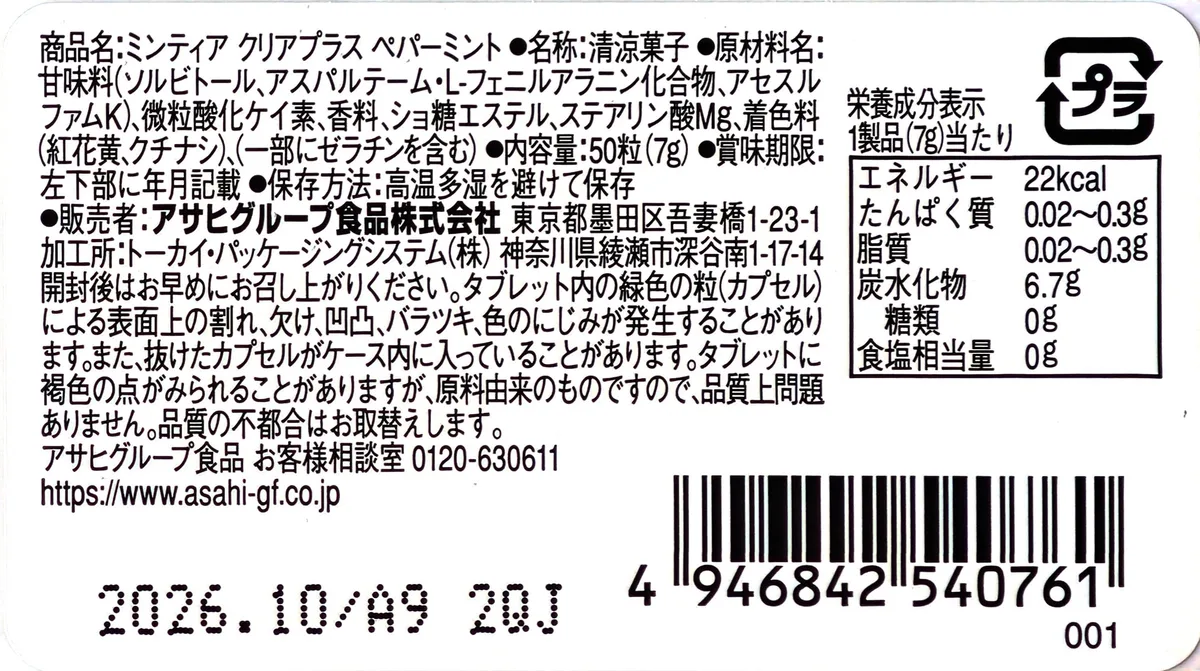
The one etiquette specialist in the group, and the only case whose Japanese copy promises 「ササっと3秒息みがき!」 — a three-second brush for your breath. Level 2.5, 22 kcal, green capsules.
Then MINTIA stopped being about mint
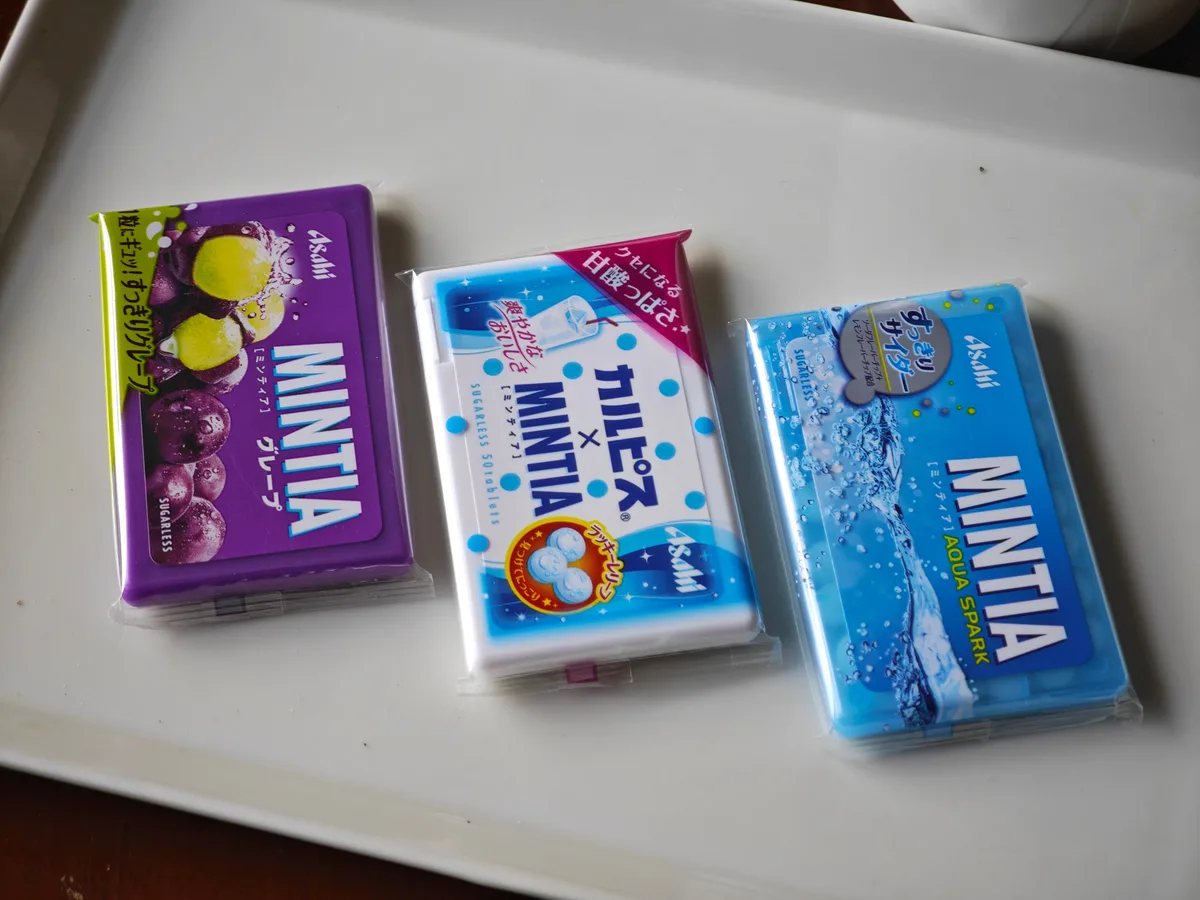
Here is where visitors get surprised. MINTIA’s reputation is breath care, but the tablets are shaped and pressed like ramune — Japan’s chalky, dissolve-on-the-tongue sweet — and once you have that format, there is no reason to limit yourself to mint.
Purple grape, white Calpis, light blue Aqua Spark. All three sit at the bottom of the coolness scale. None of them are trying to fix your breath. They are candy that happens to come in a case designed for a shirt pocket, and they are some of the best things in the whole lineup.
Aqua Spark — dry, sparkling, nostalgic
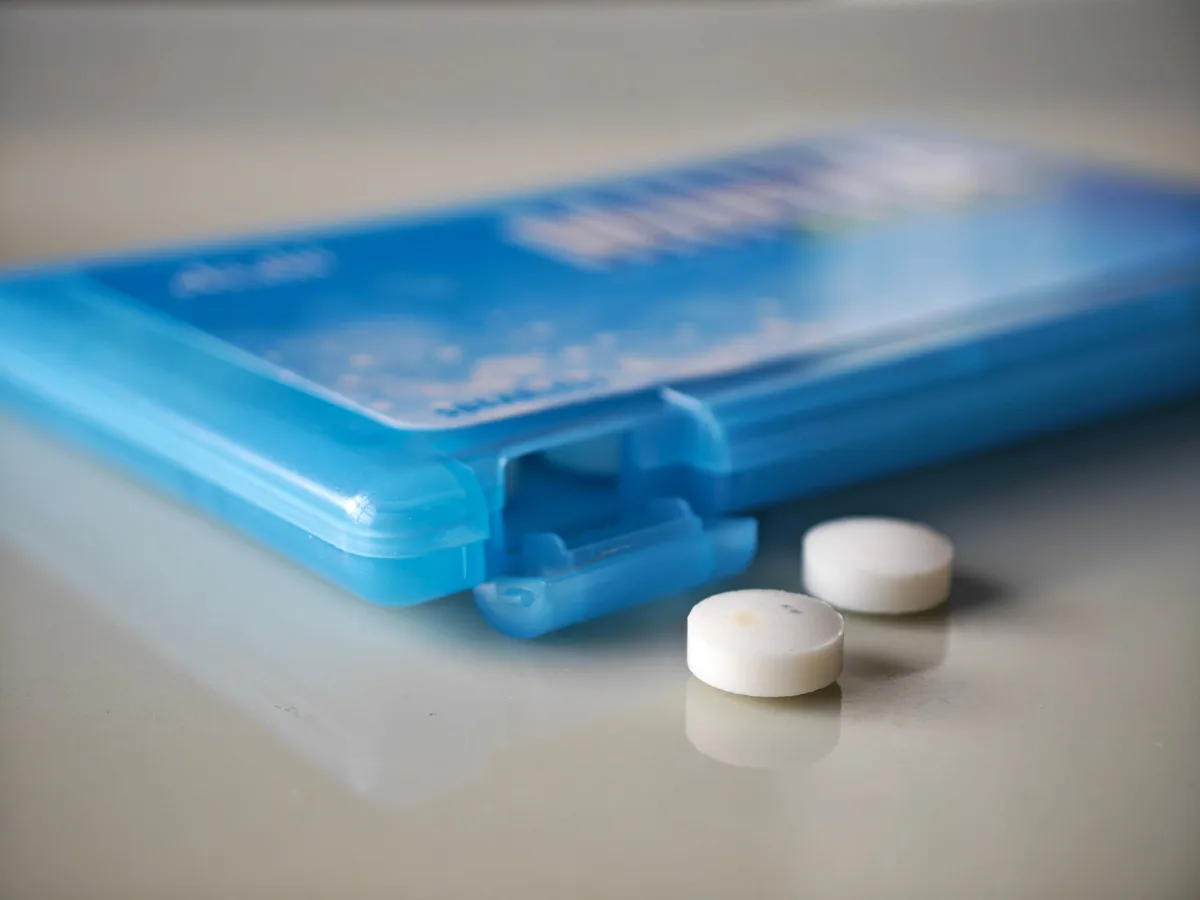
It has a ramune-like brightness, but specifically a dry brightness. My honest first association was non-fried instant noodles, which is an unflattering comparison for a candy and also the most accurate one I have: that same airy, crisp dryness. The plain soda scent rising through the nose is pure nostalgia, and the sourness is excellent.
This is not breath care. This is a snack you eat because you feel like it.
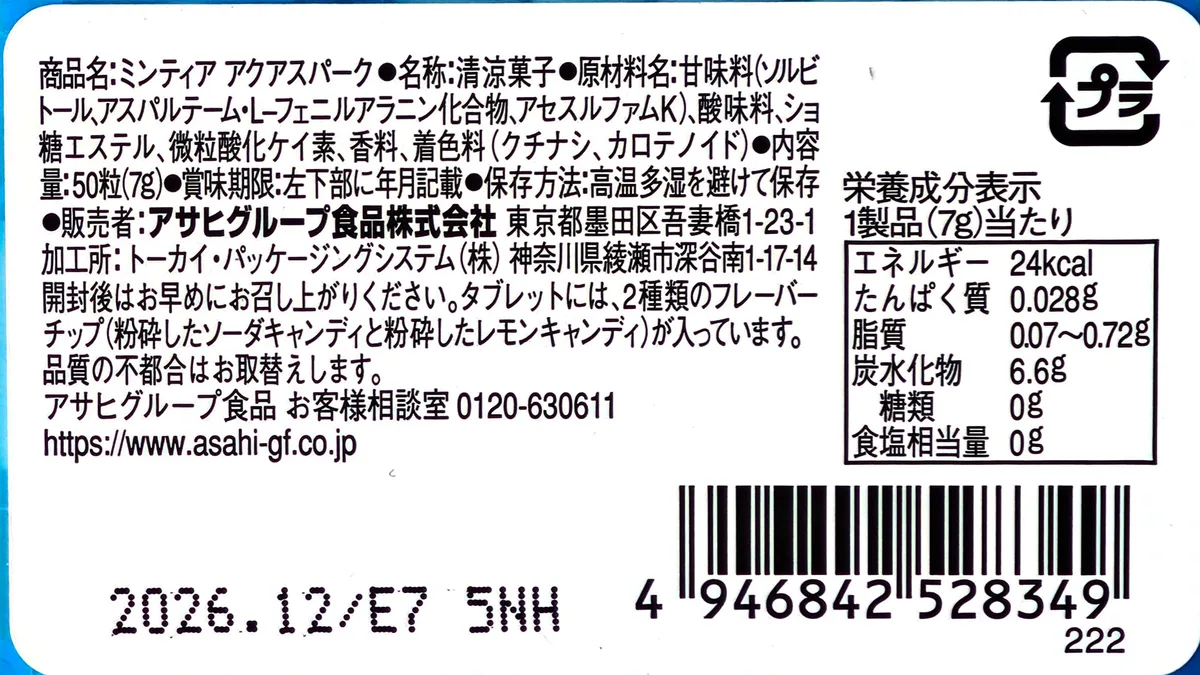
The label reveals the trick: two kinds of flavor chip, crushed soda candy and crushed lemon candy, plus an acidulant. 24 kcal, level 0.5.
The case is genuinely nice on its own
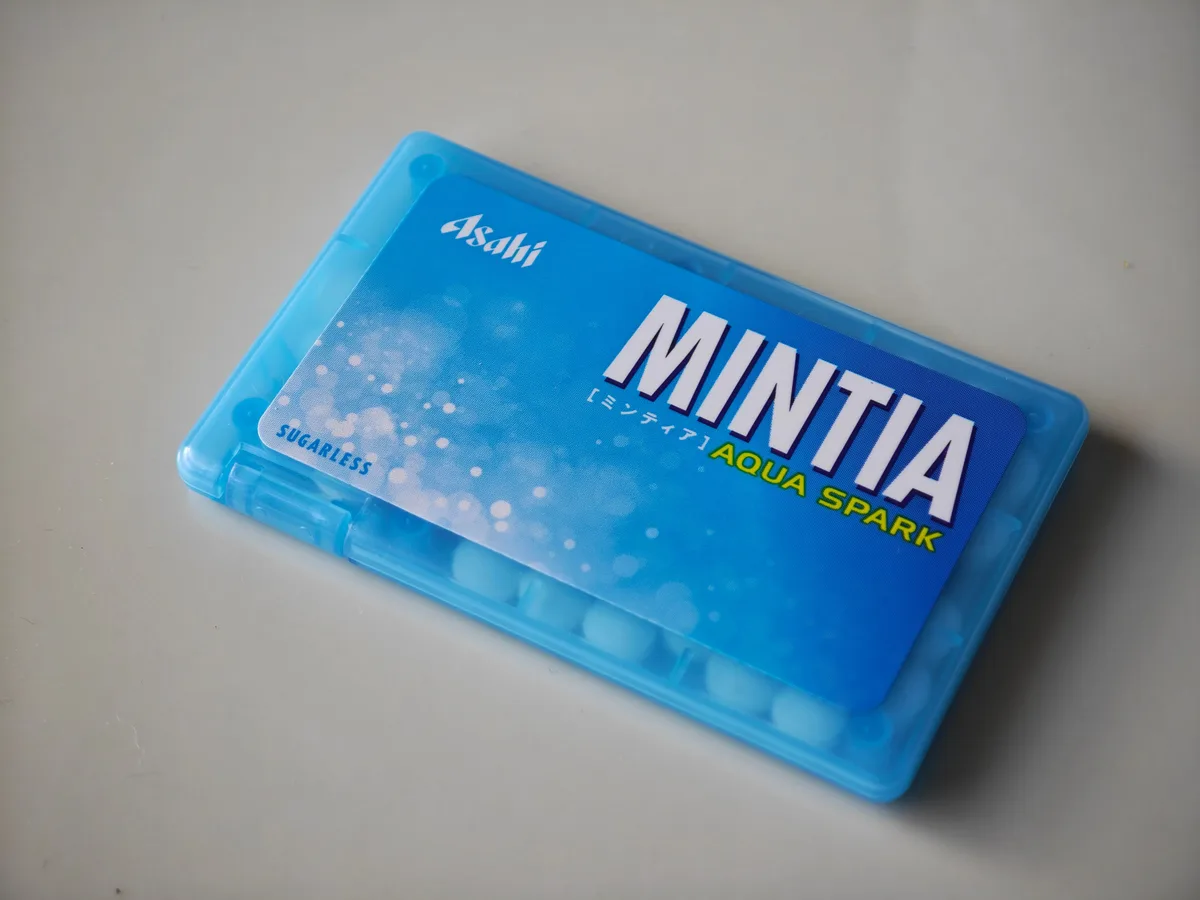
Look at the Aqua Spark case empty. Translucent light blue, rounded corners, a sliding lid with a real click. Some people peel the sticker off when the tablets are gone and reuse the shell as a tiny container — pills, earrings, spare SD cards, guitar picks.
Two details worth knowing. Asahi thinned the case in 2022 to cut plastic use by about 10%. And that little groove at the mouth of the case, the one that looks like a dispensing tray? It is not. Asahi says it is a moisture-proofing design. When a tablet lands neatly in it as you shake the case, that is a coincidence, and I refuse to accept this information.
Grape — the best-tasting one
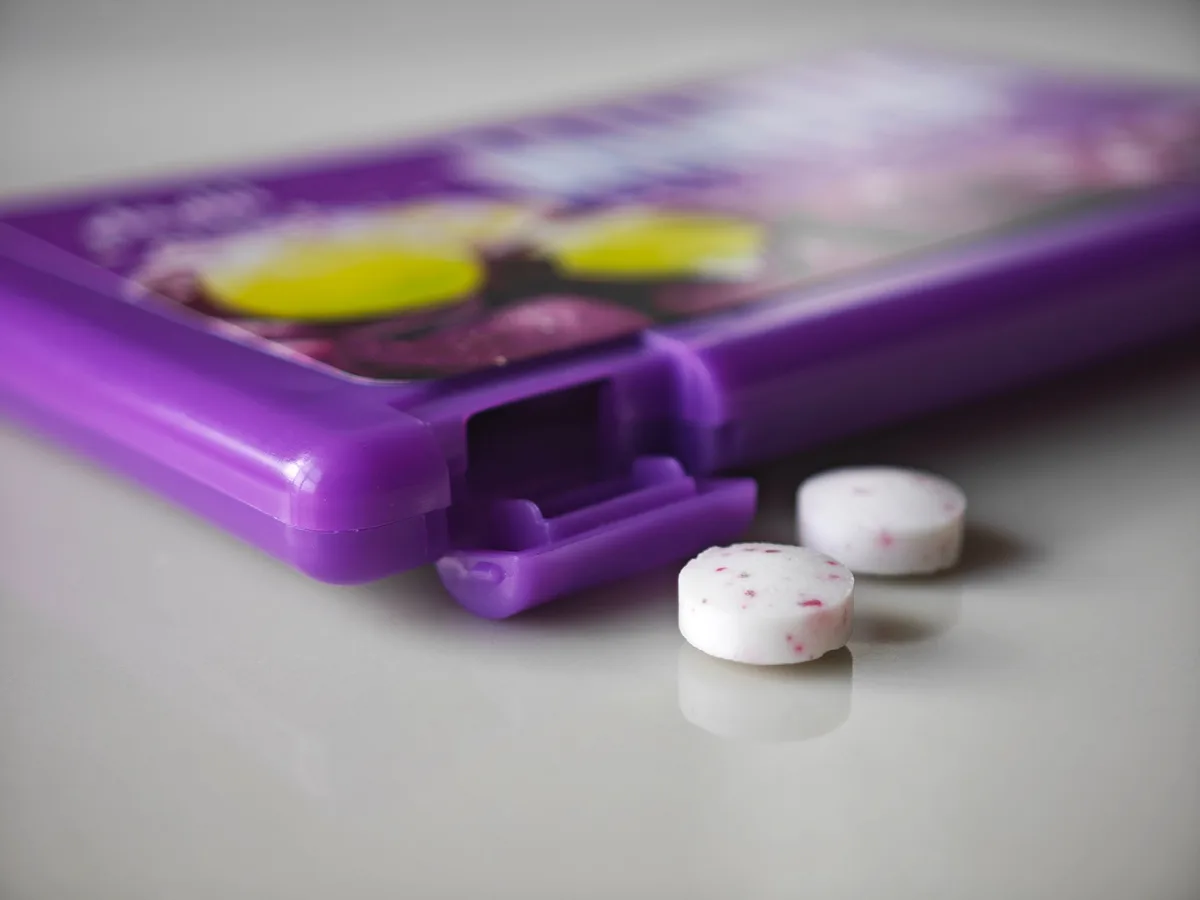
Very good. It tastes like grape ramune, and because of that juice powder the texture is noticeably different from the mints: it crumbles in the mouth rather than dissolving smoothly. That makes it fun in a way the mints are not — you can chew it, and chewing rewards you.
If you are buying MINTIA for someone who does not like mint, buy grape.
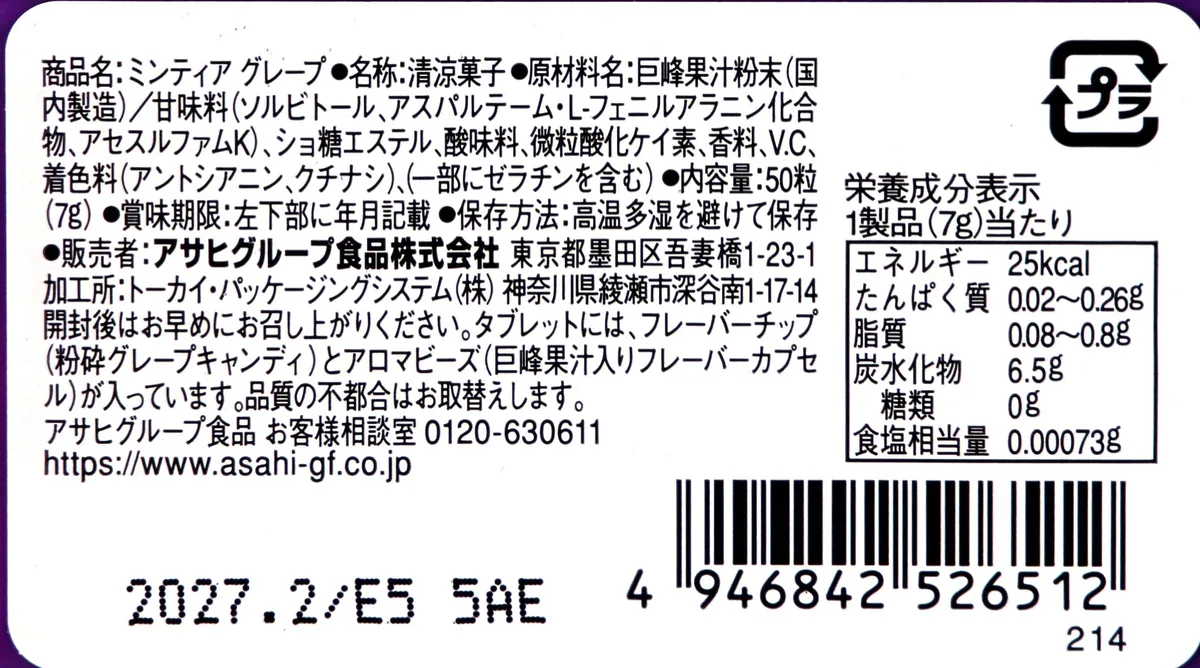
The first ingredient is Kyoho grape juice powder, domestically produced — Kyoho being Japan’s famous large, dark, intensely sweet grape. Inside the tablet there are flavor chips of crushed grape candy plus aroma beads holding actual Kyoho juice. 25 kcal, level 0.25.
Calpis × MINTIA — a drink you can pocket
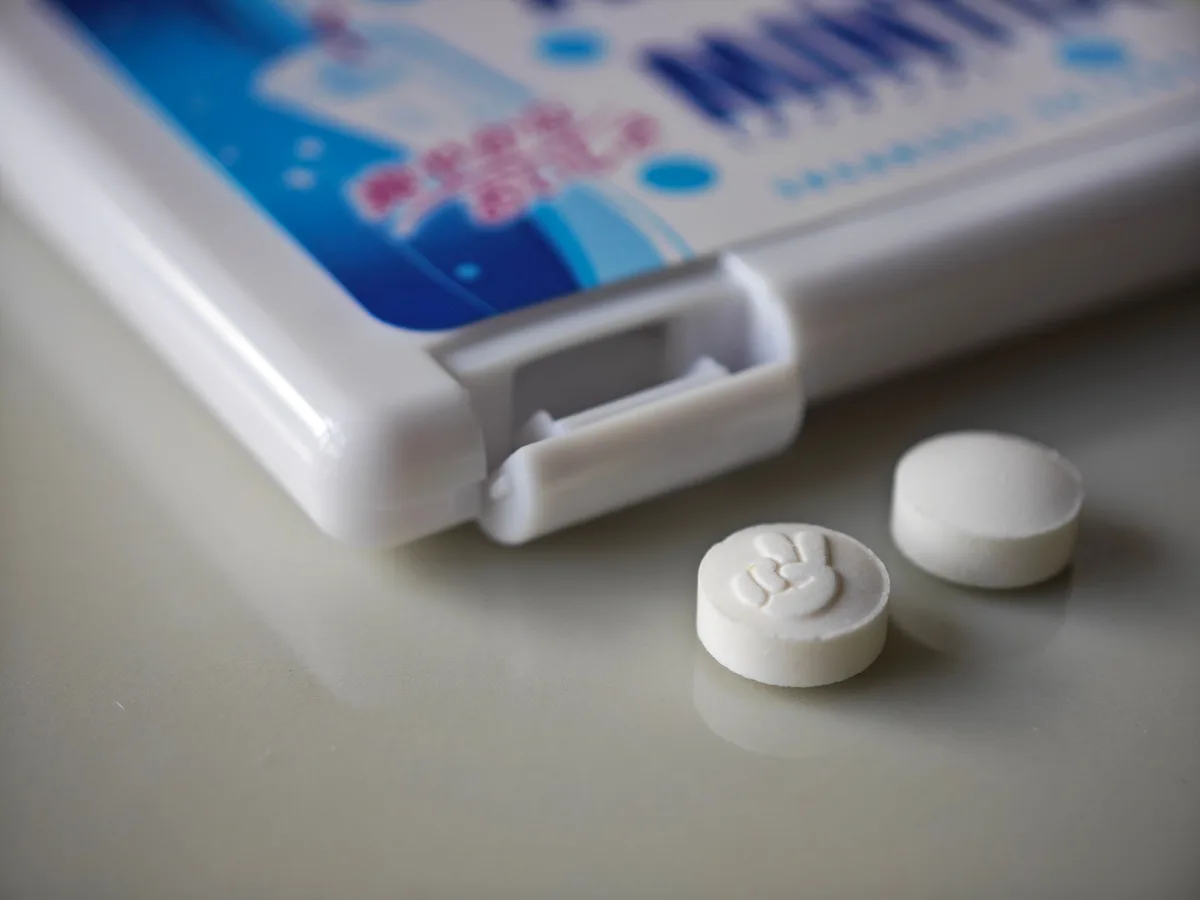
It is a straightforwardly nice sweet, and the thing to catch is the Calpis note going up the back of your nose — that soft, milky, slightly sour signature.
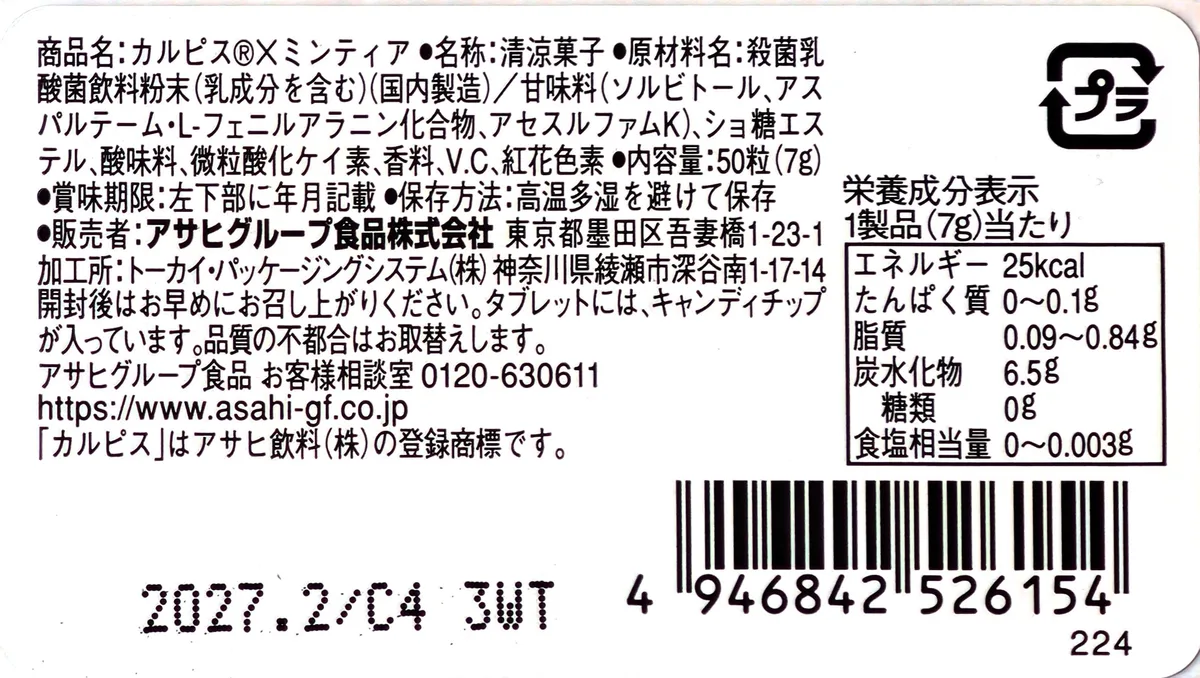
The ingredient list starts with sterilized lactic acid bacteria drink powder, containing milk components — so unlike the mints, this one carries a dairy allergen. 25 kcal, level 0.25. The label also notes that 「カルピス」 is a registered trademark of Asahi Soft Drinks, which is how you can tell this is an in-house collaboration between two arms of the same group.
What is Calpis? If you have not been to Japan, this needs explaining. Calpis is a lactic acid fermented milk drink launched on July 7, 1919 — Tanabata, the star festival, which Asahi still treats as its birthday. Its founder, Mishima Kaiun, was a temple priest’s son from Osaka who went to China as a young man and, in 1908, recovered his health drinking fermented sour milk among nomads in Inner Mongolia. He brought the idea home. More than a century later it is one of the most recognizable flavors in the country, sold as a concentrate you dilute yourself, and overseas it often appears under the name Calpico.
Calpis is also the single most collaborated-with flavor in Japanese confectionery. Ice cream, jelly, gummies, shaved ice syrup, chuhai, and this tablet — when something says Calpis flavor in Japan, everyone already knows the target. Drink the real thing at least once while you are here so the candy makes sense.
The lucky tablets
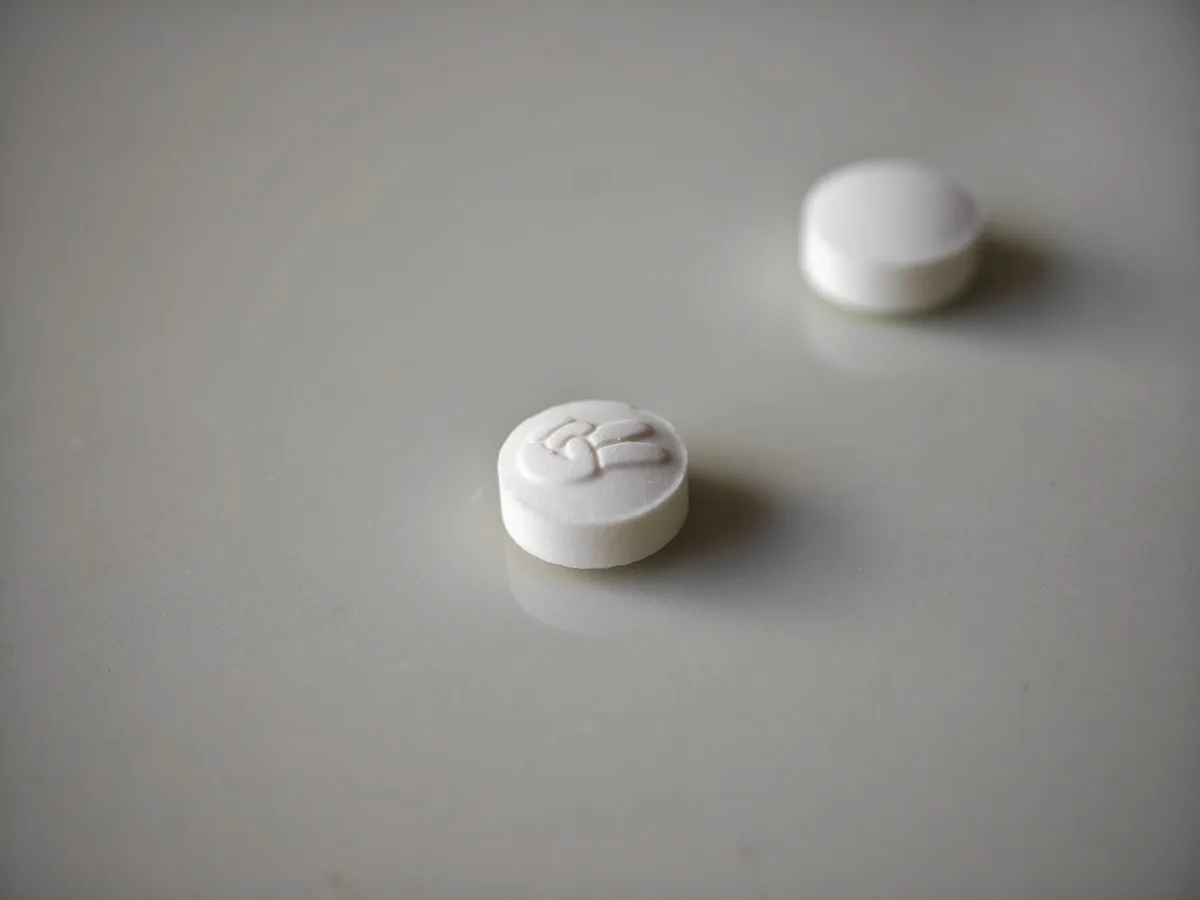
Some Calpis MINTIA tablets are not blank. They are embossed.
Asahi’s official copy says the case contains 「3種のラッキーレリーフ」 — three kinds of lucky relief — and publicly names only one of them, the smiling face. The rest are deliberately kept secret; even Asahi’s own product description teases that finding a non-smiley one is extra lucky.
So I emptied a case and counted all fifty tablets. Four were marked. One of them was a clear peace sign, pressed into the tablet like a tiny coin.
Four in fifty is not a published rate — it is one case, counted once on my table — but it is a good ratio. Frequent enough that it can happen to you, rare enough that it counts as something. And that is really the point. Hand the case to a friend, they tip out a tablet, and a face is looking back at them. Suddenly a ¥100 candy is a small event.
That is a very Japanese piece of design thinking: the product works perfectly well without it, and someone added it anyway, so that sharing has a chance of turning into a story.
The MINTIA tablet quiz
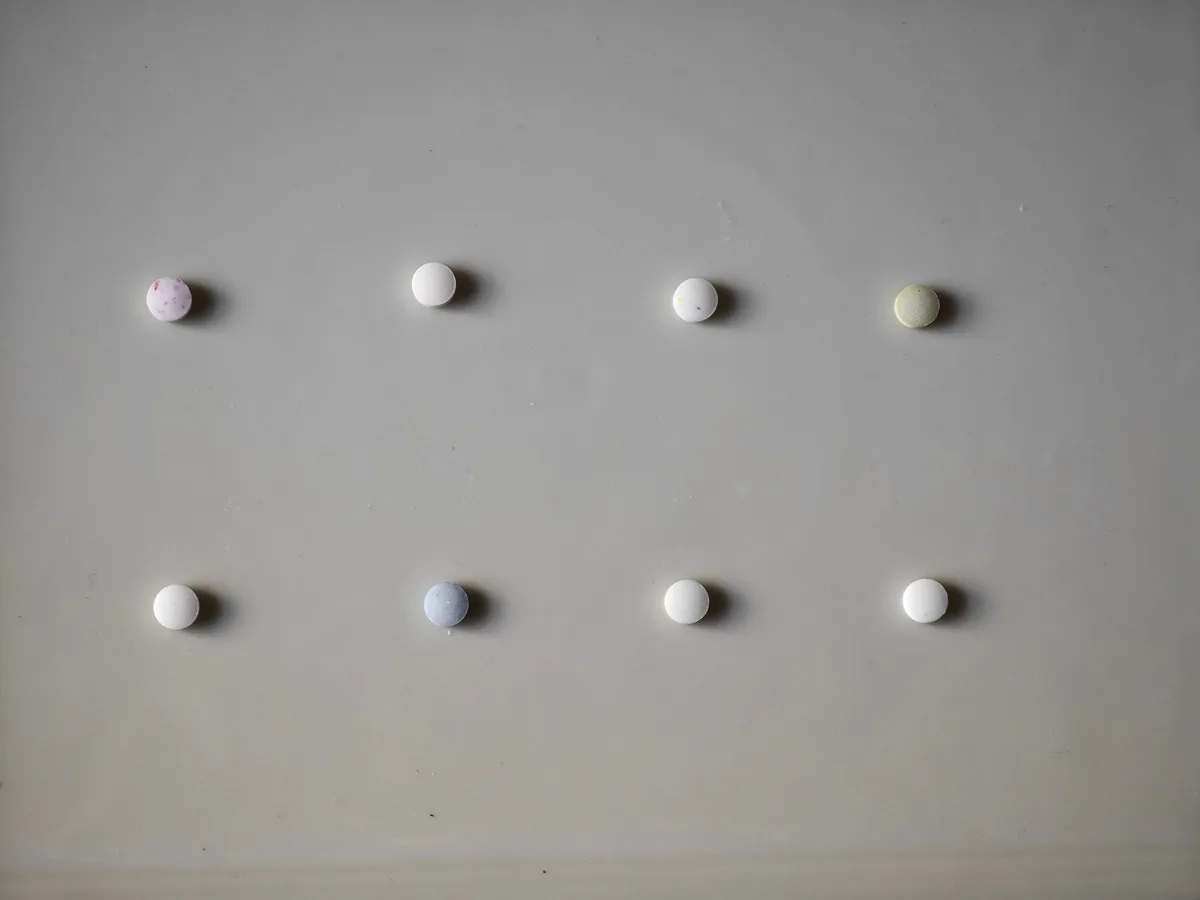
One tablet from each of the eight cases, laid out in two rows.
Can you tell which is which?
Some are obvious once you look properly — a faint speck of color, a shade of blue, a pale yellow cast. Others are eight identical white discs pretending to be strangers. I am not printing the answers. Buy the eight cases, line them up yourself, and check.
If you can call all eight cold, you are not a tourist anymore. You are a MINTIA doctor.
I ate all eight at once
Then I looked at the eight tablets sitting there and thought: what if all of them. At the same time. Into one mouth.
Reader, my mouth became outer space.
The first half second is fine. The second half second is not. Eight sugarless tablets do not politely take turns — they arrive simultaneously and start fighting, and the thing nobody tells you is that mint is not one thing. It is at least five things and they all want different parts of your face. The tongue goes biri-biri, the roof of the mouth goes piri-piri, the throat goes sū all the way down like somebody left a window open in there, and somewhere behind all of it grape and Calpis and lemon soda are still trying to be pleasant. Sweet. Sour. Bitter. Cold. Colder. Caffeine, apparently. Matcha?? Stimulus stimulus stimulus. I want to state clearly that during the entire experience I was sincerely asking myself whether this was legal. It is legal. Eight tablets is under four calories. FOUR CALORIES DID THIS.
It was a Big Bang. Everything in the universe compressed into one point and then released across my palate.
Ten seconds later it was over and my mouth was the cleanest it has ever been.
Would I recommend it? No. Would I do it again? Also no. Should you? Absolutely, at least once, ideally with witnesses.
The rest of the MINTIA universe
The eight card cases are only the entry level. If you see these on a shelf, they are not mistakes:
- MINTIA BREEZE — launched 2014, the tall upright case. Tablets are about five times the size of a regular MINTIA and the cooling is engineered to last around five minutes per tablet. Twelve varieties, including its own Calpis collaboration. Different product, same family.
- MINTIA MEGA (Hard / Cold) — a bottle instead of a case, tablets roughly seven times the standard size, sitting at coolness level 6. The top of the scale.
- MINTIA +VOiCE — a lemon-ginger throat tablet, developed with a voice-actor agency, which is an extremely Japanese way to validate a product.
- MINTIA +FOCUS — a 2026 addition, and the published exception to the sugarless rule; it is built around glucose.
- e-MINTIA — the energy variant, caffeine-free.
- Seasonal fruit — Asahi keeps pushing further from mint. Peach and pineapple arrived in spring 2026, with mango and La France announced for September 2026, engineered for a thick, pulpy mouthfeel.
More than 350 MINTIA products have been released in 30 years. Whatever is on the rack when you visit will not be exactly what is in my photographs, and that is part of the fun.
Where to buy MINTIA
In Japan: convenience stores first. Check the counter area near the register rather than the confectionery aisle — tablet candy is treated as an impulse buy. Supermarkets, drugstores, Don Quijote, airport shops, and station kiosks all carry it too. Don Quijote usually has the widest flavor selection under one roof.
For US readers, a check on August 15, 2026 found stronger purchase evidence on Amazon.com and a specialist importer than through Amazon Japan’s international-shipping filter. Multipacks are normal on marketplaces; single and seasonal cases are easier to sample through an importer.
- US multipack example: MINTIA Cold Smash 10-pack on Amazon.com — verify seller, pack count, and current stock
- Single and seasonal flavors: Japan Candy Store’s MINTIA collection — verify US shipping total and stock
- Official lineup and coolness levels: see the current MINTIA range
These research links are not currently US affiliate links. Check the seller, the count, the delivered cost, and the best-before date, and read the actual allergen line — the mint cases photographed here declare gelatin, and Calpis MINTIA contains milk.
Affiliate disclosure: links above may be affiliate links. If you buy through them, I may earn a commission at no extra cost to you.
As a souvenir, it is almost unfair
Think about what you actually want in a suitcase. Flat. Light. Sealed. Unbreakable. Cheap enough to buy eight of. Instantly recognizable as Japanese. Nothing melts, nothing crumbles, nothing leaks, and customs will not blink.
Buy one of each flavor, hand them out at home, and let people fight about which mint is best. Include the Calpis case and tell them to look for a face. You have just turned pocket change into a party trick.
Final verdict
MINTIA is one of the easiest things to overlook in Japan and one of the most quietly clever. A cosmetics company invented it, a beer company perfected it, and a category that used to cost ¥200 got cut in half and never recovered.
Start with Dry Hard if you smoke or drive, Cold Smash if you want to be shocked, Clear Plus Peppermint if you want to be polite, and Grape if you never wanted mint in the first place. Then buy a Calpis case and go looking for a smile.
And if you can identify all eight tablets by sight — congratulations, doctor.
Frequently Asked Questions
Is MINTIA the same as Frisk or Tic Tac?
No. All three are small tablet candies, but MINTIA is Asahi’s own brand, sold in a flat card-shaped case, sugarless across the regular line, and spread across a far wider flavor range than mint alone.
How many tablets should I eat at once?
One is the intended number. Two is normal. Eight is a scientific experiment that I have already conducted so you do not have to, though I understand if you do anyway.
Which MINTIA is best for smokers?
Dry Hard. It is the sharpest of the regular line, contains caffeine, and clears the mouth quickly after a cigarette. Cold Smash is the alternative if you prefer cold to sharp.
Can I reuse the MINTIA case?
Plenty of people do. Peel the label off the transparent cases like Aqua Spark and you have a small hinged box for pills, picks, or earrings. The groove at the mouth is a moisture-proofing feature rather than a dispensing tray, in case you were wondering.
Is Calpis MINTIA suitable for lactose-intolerant travelers?
It contains milk components, so treat it as a dairy product and check the label. The mint flavors photographed for this article declare gelatin instead.
What does the coolness level number mean?
It is Asahi’s own published freshness scale, running from 0.25 to 6. Grape and Calpis sit at 0.25, Dry Hard and Cold Smash at 5, and the MEGA bottles at 6. It is printed on the brand’s product listing and it is a reliable guide.
Why does MINTIA cost so little?
That was the founding decision. When it launched in 1996, tablet candy in Japan sold for around ¥200; MINTIA came in at ¥100 and expanded the market. Pricing is now open, so the shelf price varies by store, but it remains an inexpensive impulse buy.