Japan has a whole aisle of potato snacks. Thin chips, thick chips, shoestring fries, regional salted potatoes, even souvenirs that look like a field of Hokkaido imo.
Jagarico (じゃがりこ) still stands apart. It is a steamed potato shaped into a stick, fried, and sold in a cup you can hold with one hand. Calbee’s slogan is hajime kari-tto, ato kara saku-saku: first a crackle, then a lighter crunch. The format is as Japanese as the flavor—outdoor-friendly, tidy, and built around potato rather than around a mountain of salt.
Quick guide: Buy Salad for the original 1995 potato-and-oil profile, Cheese for random cheddar bits inside the stick, and Jaga Butter for a sweet-salty butter finish. The cup, the stick, and the mild salt are the point. Potato chips remain a separate pleasure.
Jagarico in 30 seconds
- What is it? Fried potato sticks in a paper cup.
- Who makes it? Calbee, Japan’s potato-chip giant.
- When? 23 October 1995 in Niigata; nationwide by January 1998.
- First flavors? Salad and Cheese. Jaga Butter joined in 2005.
- Why a cup? The 1991 brief was an outdoor snack that would not oil your fingers the way a bag of chips does.
- Best first tasting? One of each photographed classic: Salad, Cheese, Jaga Butter.
- Texture? A hard first bite, then a dry saku-saku through a porous fried center.
Why Japan needed a stick, not only a chip
Potato chips are already a Japanese everyday food. Calbee’s Potato Chips sit in convenience stores beside regional salts, consommé, and butter-soy limited runs. That abundance is the context, not the rival.
Jagarico was designed for a different job. Development started in 1991 as a five-person project: take fresh potato, steam it, fry it, and put the result in a cup you could carry outside. A 1994 convenience-store test still used the working name Jaga Stick, a box, and square rods. The team later switched to round sticks and a cup because they were easier to eat.
The stick is the line it draws. A chip shatters into planes. Jagarico is a small fried cylinder you can take one at a time, pause, and put down. Oil stays in the cup. Potato flavor stays in the bite. Salt, on the photographed cups, stays modest.
Company lore says the name fused jagaimo (potato) with a taster named Rikako. Whether or not every retelling is exact, the sound is the brand: short, repeatable, and made for a commercial that simply shouted “Jagarico” until you remembered it.
A short history of the cup
Calbee first sold Salad and Cheese on 23 October 1995. That date is now Jagarico Day. Demand was strong enough that national rollout took until 19 January 1998, with Okinawa last.
The next decade proved that chip flavors do not automatically become Jagarico flavors. Light salt, nori-salt, consommé, and a “Kitchen Series” of nikujaga and gratin all appeared, then receded. Salad and Cheese held the center.
Jaga Butter arrived in 2005 and stayed. From 2007 the brand leaned into seasonal limited cups instead of forcing every idea to become a fourth staple. One of those limited cups, Tarako Butter (2011), returned as a regular in June 2012. The official core four is now Salad, Cheese, Jaga Butter, and Tarako Butter, with a rotating cloud of pizza, lemon, regional souvenir, and extra-spicy cups around them.
That is a very Japanese potato-snack strategy: keep one physical idea stable, then let flavor fashion move around it.
Look at the barcode before you eat
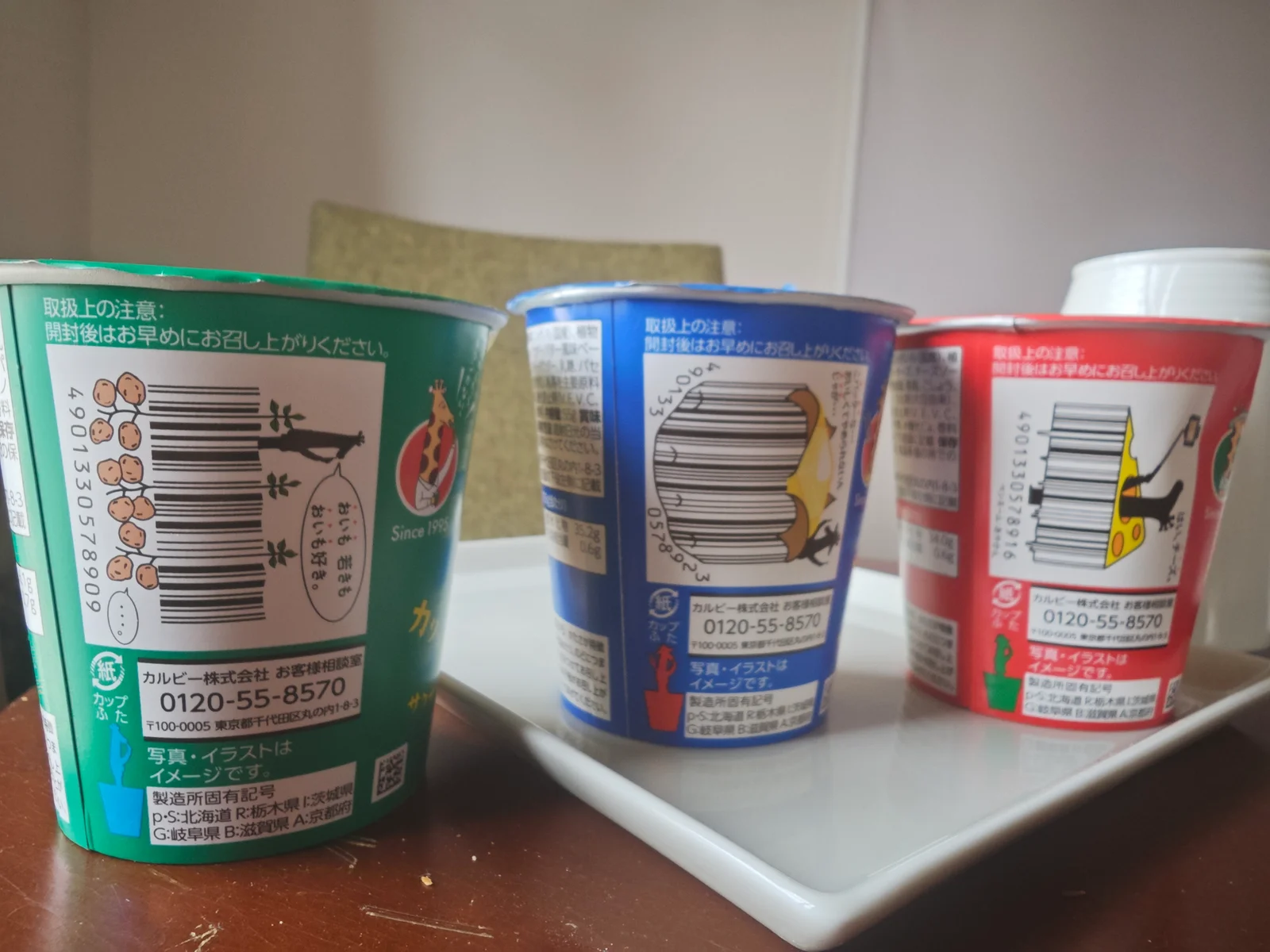
Most snacks hide the barcode. Jagarico turns it into a small cartoon: potato vines, a baked potato wearing a butter pat, a cheese wedge with a giraffe stretching a melted string. Official flavor pages archive years of these designs, including puns and fan-contest winners.
It is a useful cultural clue. The cup is not only a container. It is a tiny billboard for Calbee’s giraffe family and for the Japanese habit of making even logistics playful.
Tip: do not peel the whole lid
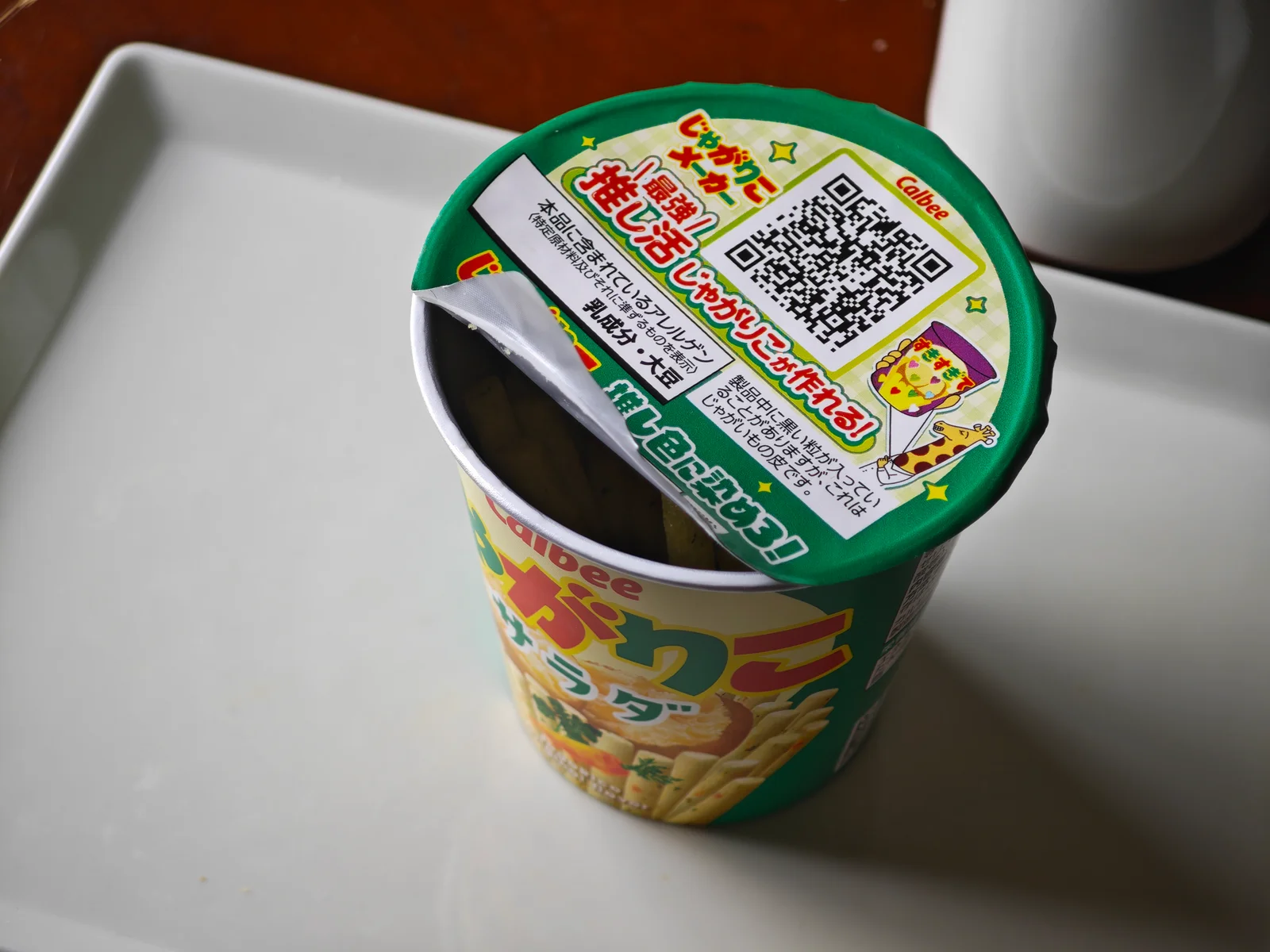
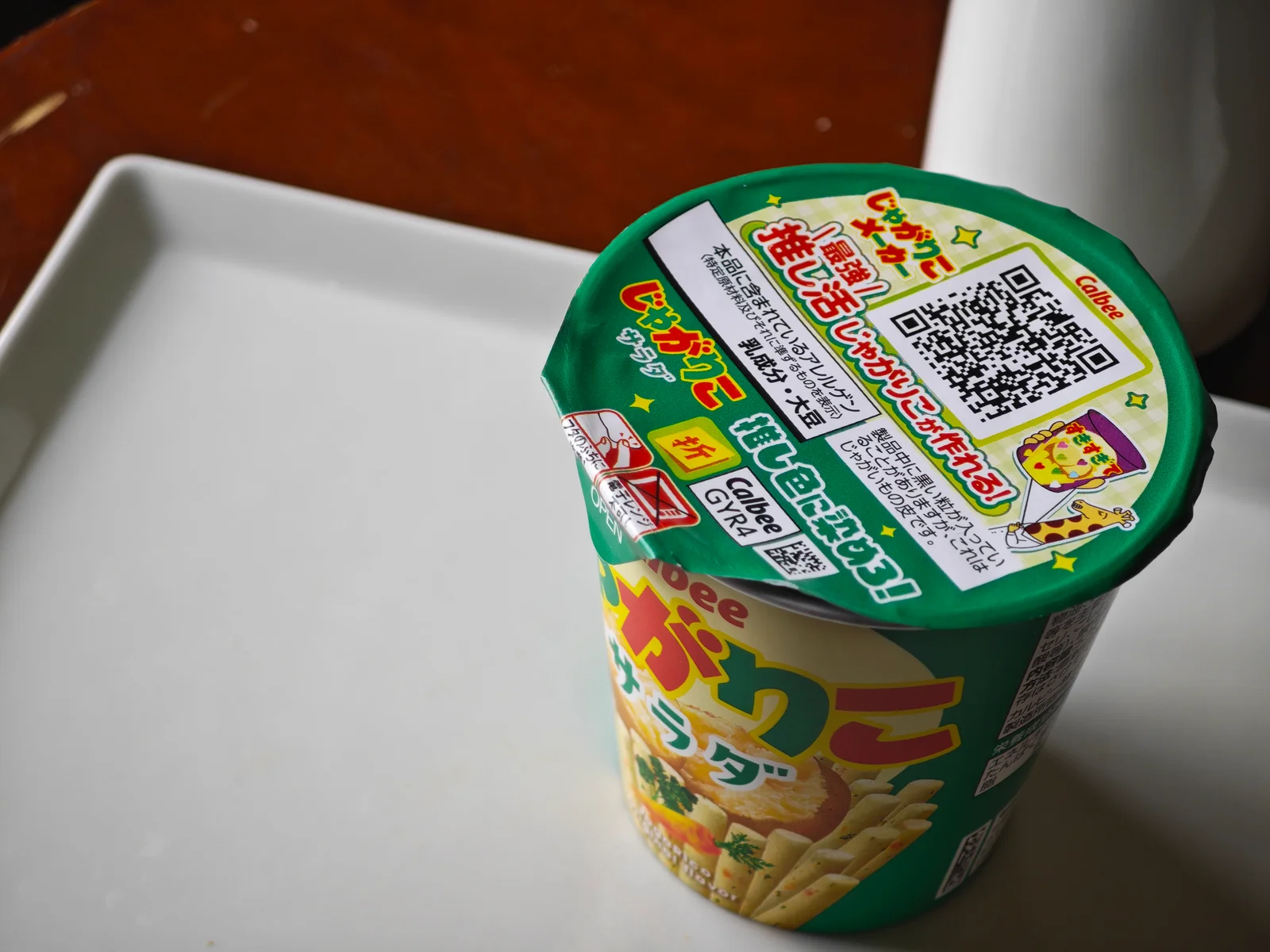
If you may stop halfway, open only a mouthful of lid. The aluminum foil still has enough body to fold back.
A small crease makes a light lock. It will not survive a backpack, but it keeps extra air from pouring in while the cup sits on a desk. Eat from the opening; the cup is doing the work a chip bag cannot.
Cheese: potato first, cheddar in flashes
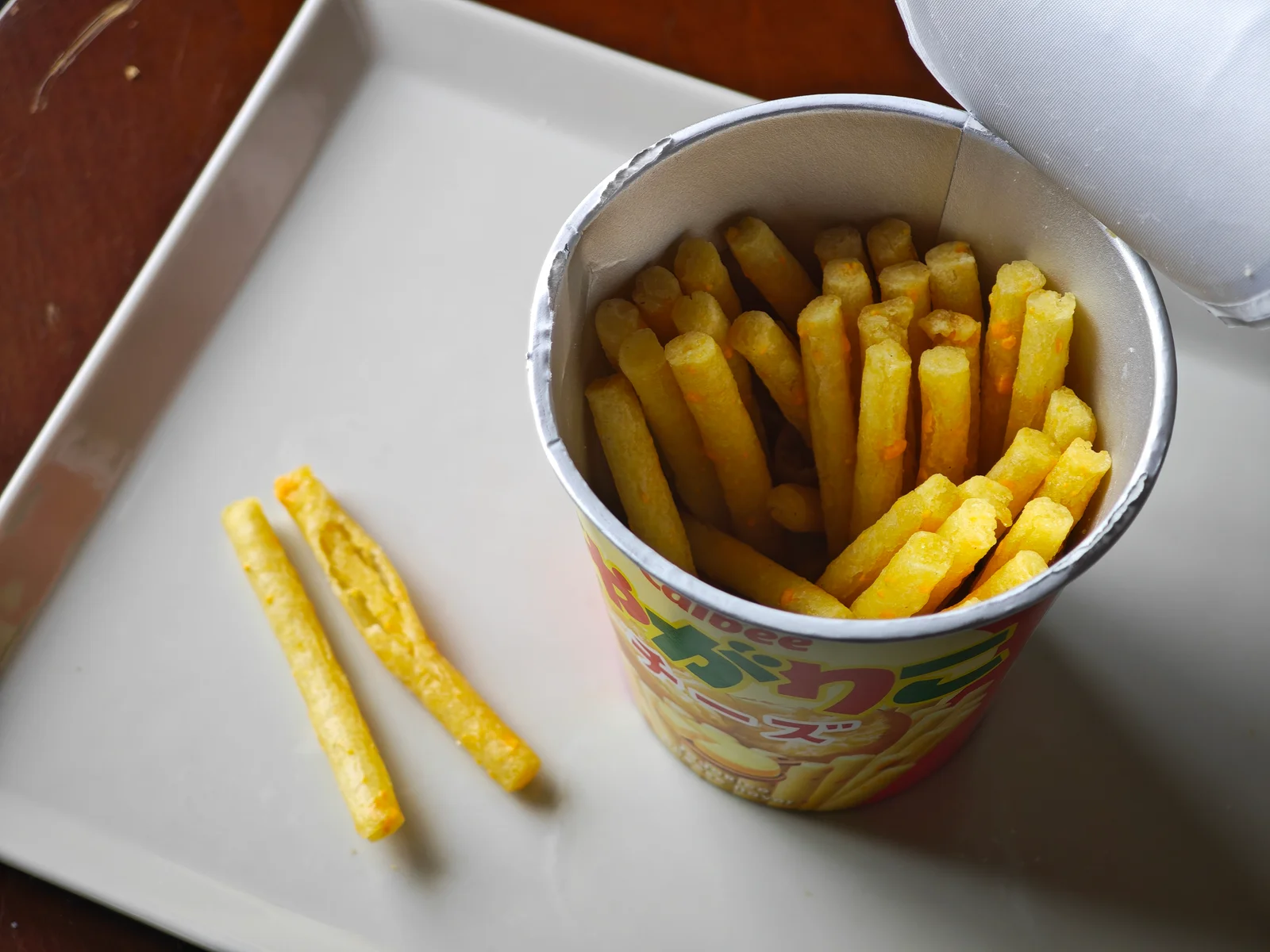
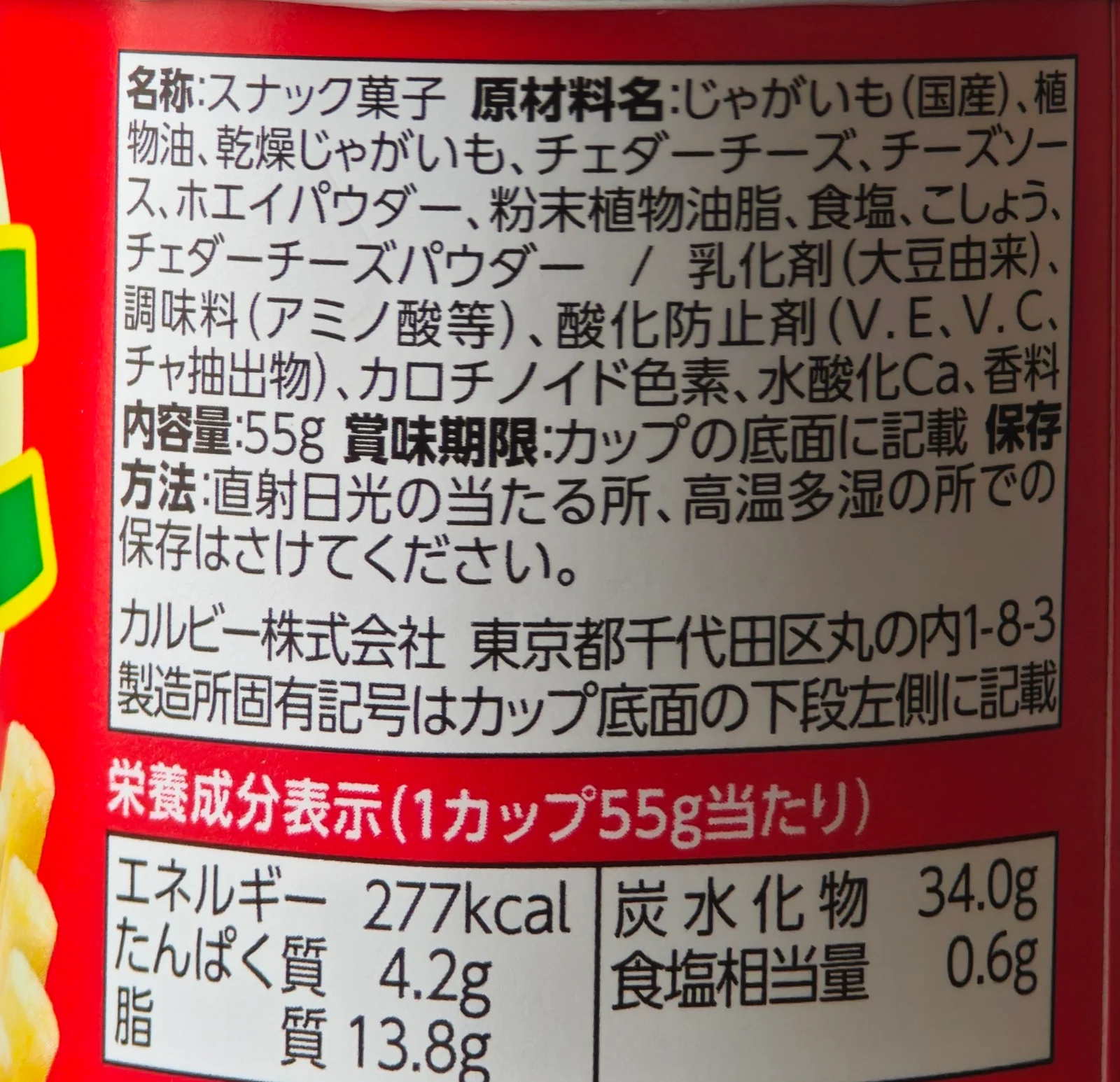
Cheese is one of the 1995 originals. Official copy now talks about steamed potato matched with cheddar; the photographed cup lists cheddar cheese, cheese sauce, and cheddar powder among its 55 g, 277 kcal ingredients.
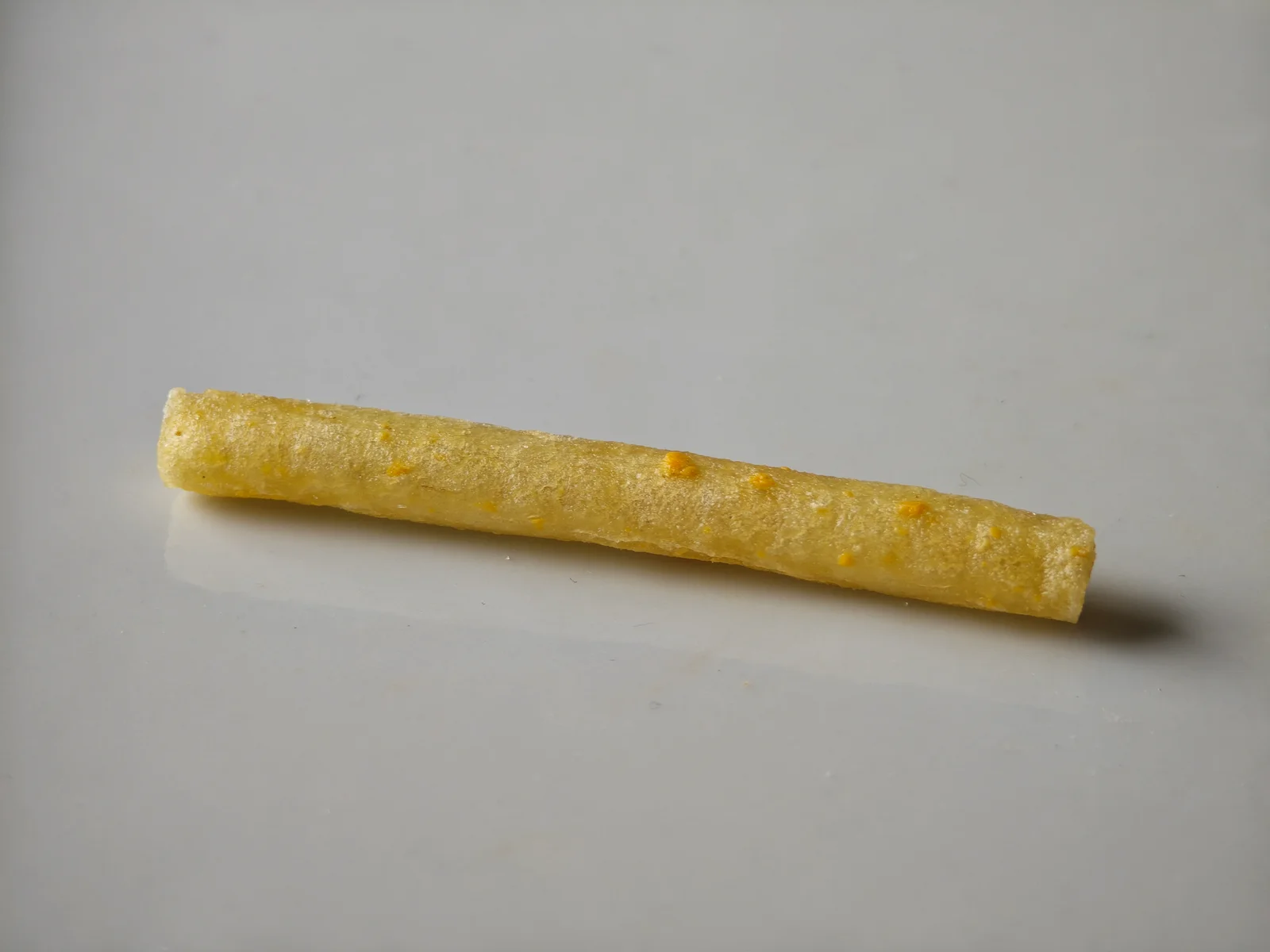
The pleasure is not a uniform cheese dust. Bits of cheese appear at random. One bite is almost plain fried potato; the next carries a small cheddar flash. Potato and a faint cheese note mix in the mouth rather than fighting. The pari-pari stick still lets you taste imo—that is the fun.
Salad: the orthodox fried potato
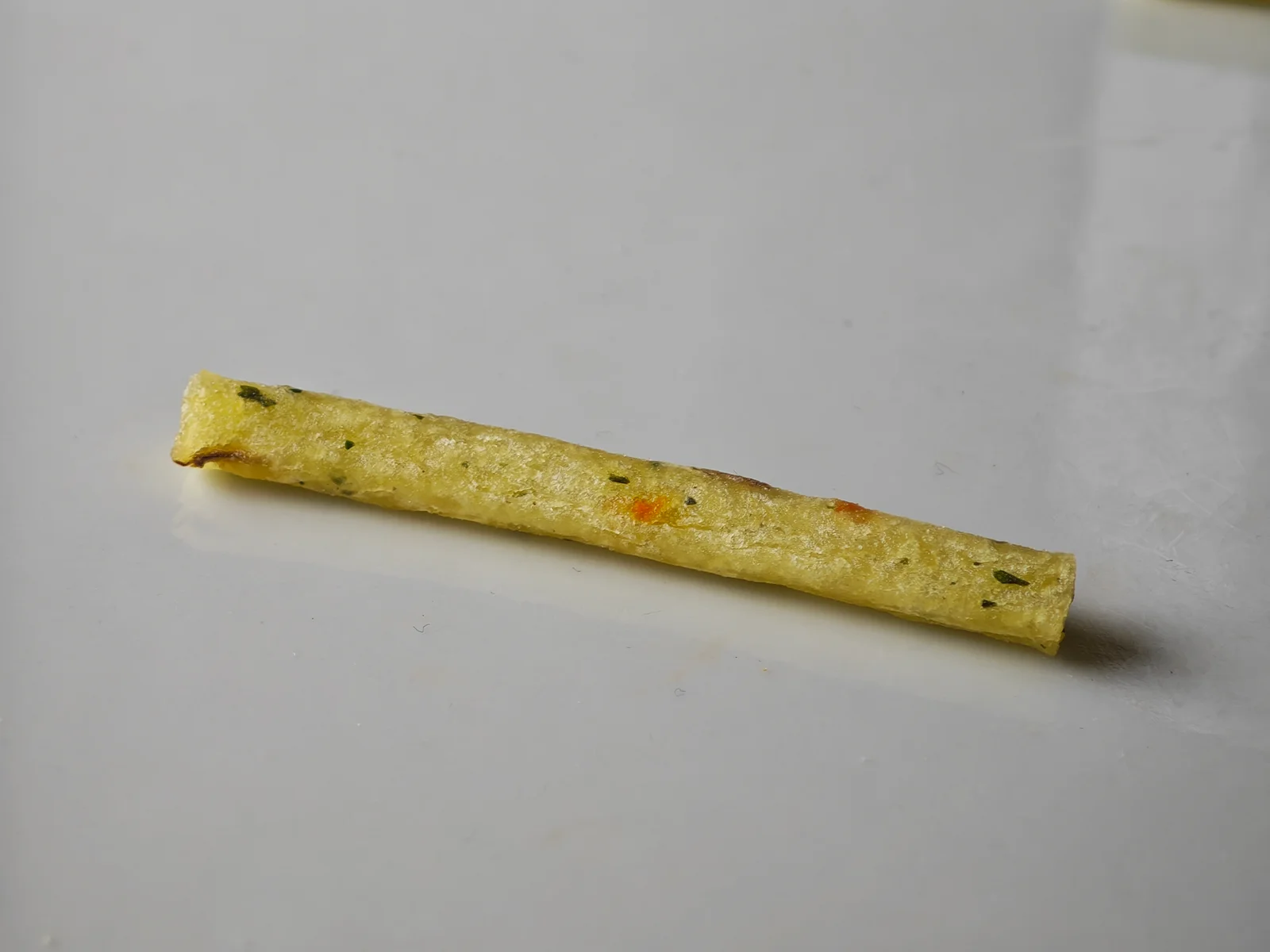
Salad is the baseline. Carrot and parsley are kneaded into the potato, the salt is mild, and the fried oil is honest. It is orthodox Jagarico: pari-pari plus the richness of something that has actually been fried. The potato taste is clearer here than in many Japanese chips, which often lead with seasoning.
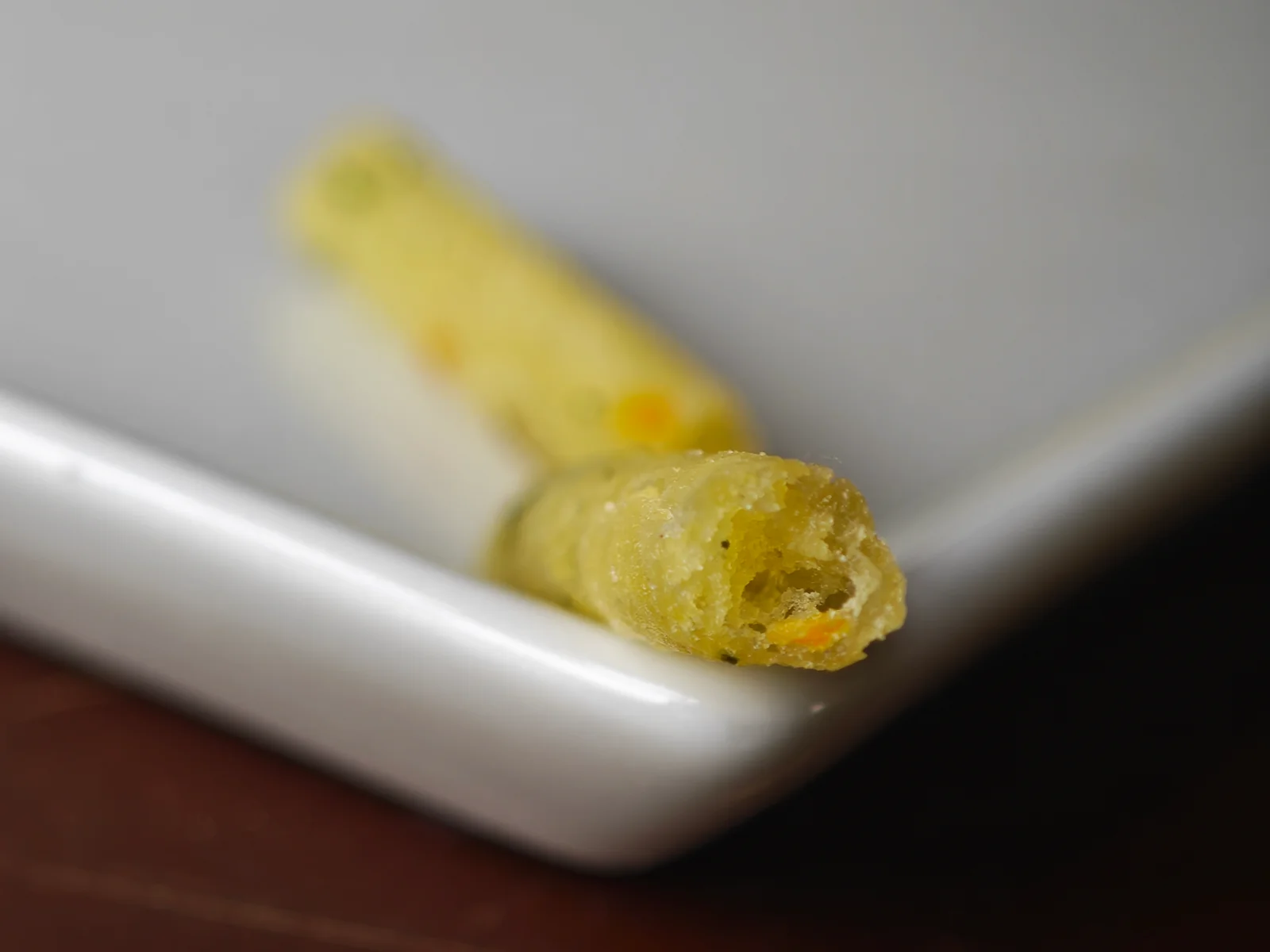
A snapped stick shows why the texture works. The center is dense but full of tiny fried pockets, not a hollow tube and not a paper-thin chip. Green and orange flecks run through the dough, so the “salad” is structural, not a powder on the outside.
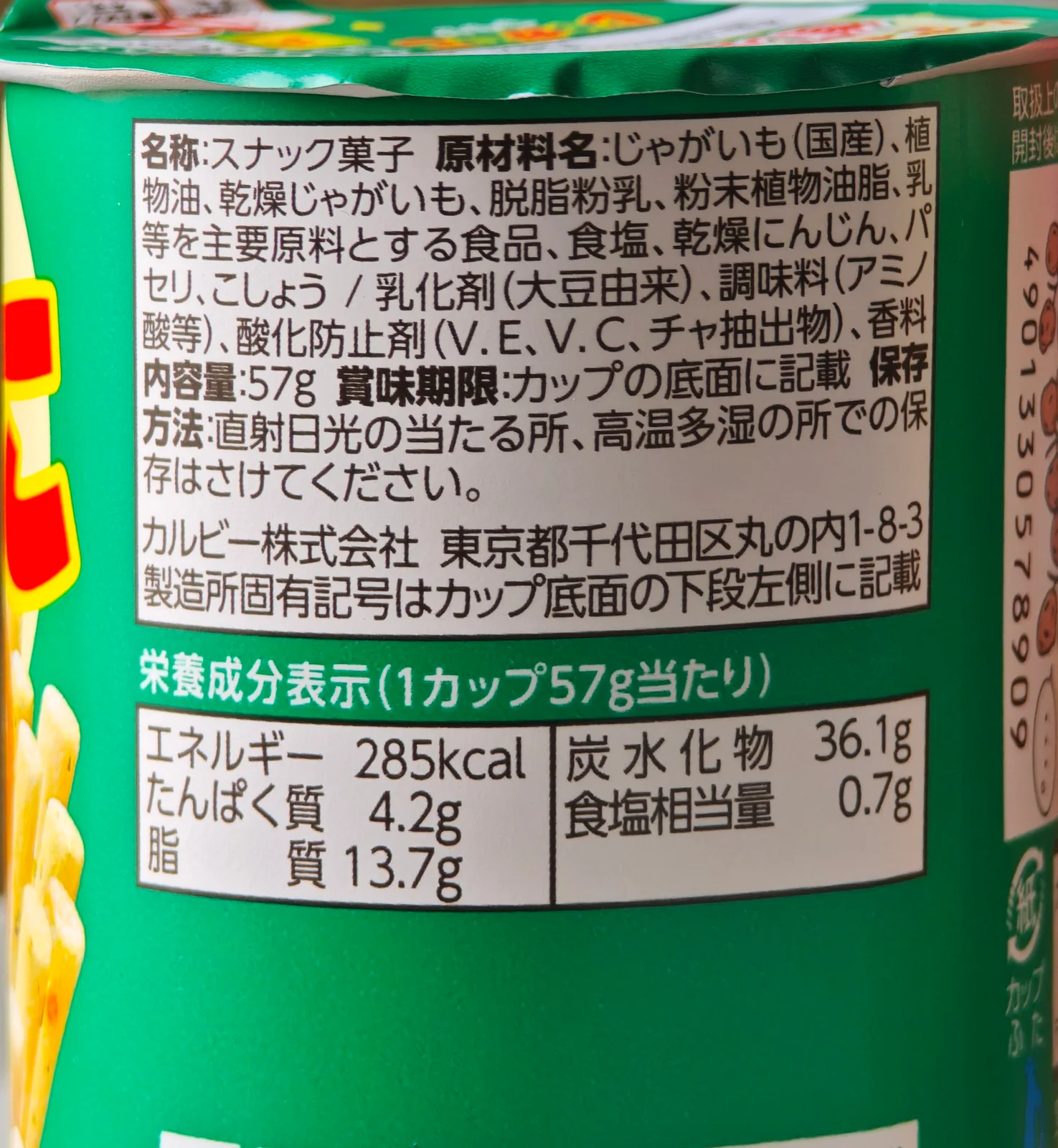
The photographed cup is 57 g and 285 kcal, with 0.7 g salt equivalent. That restrained salt is part of the Japanese potato-snack register: flavor from potato, oil, and a little vegetable, not from a salt crust.
Jaga Butter: sweet-salty aftertaste
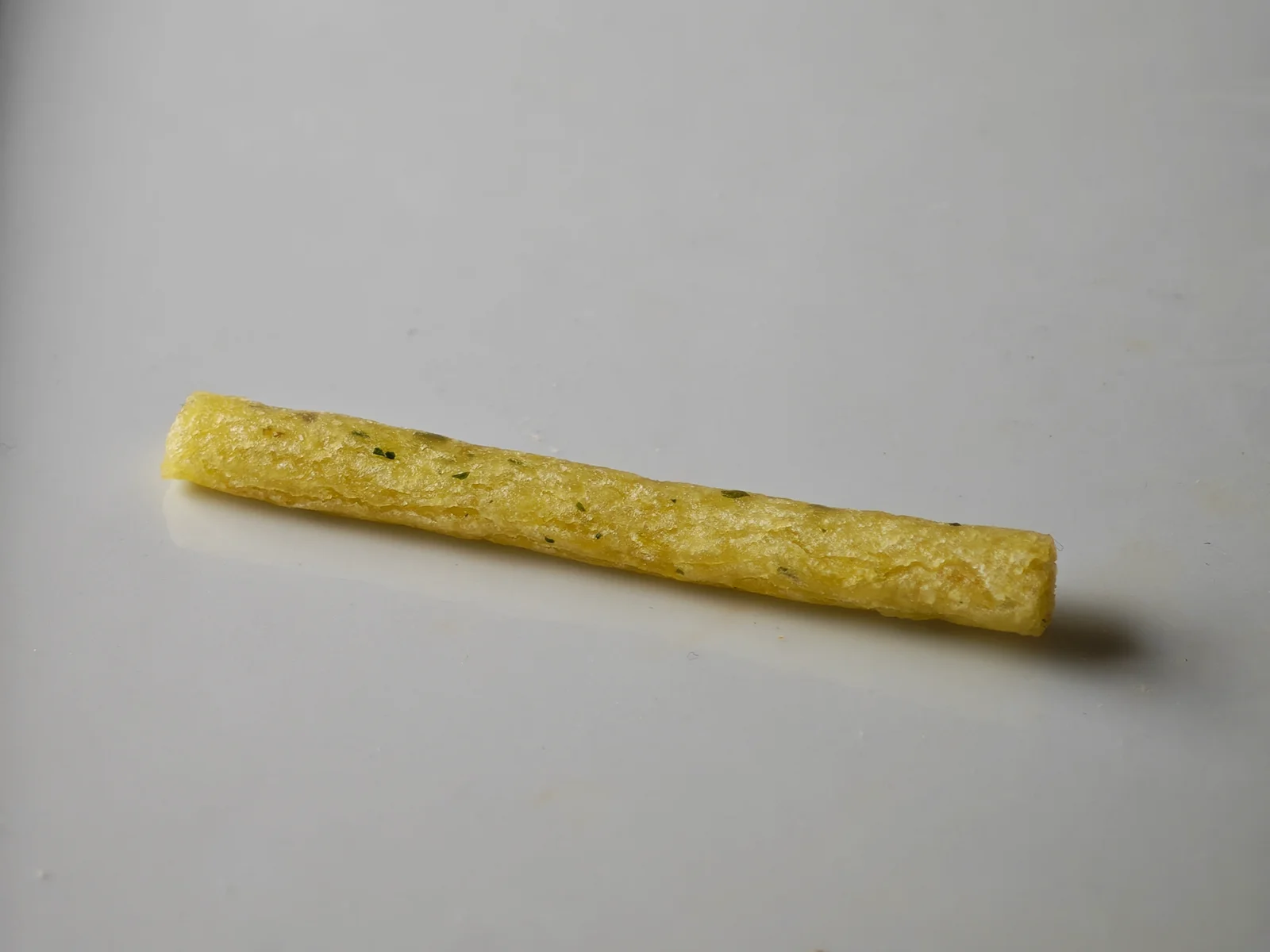
Jaga Butter is the 2005 hit that finally sat beside Salad and Cheese. Officially it recreates buttered steamed potato. In the cup, the first impression is still fried potato; the accent arrives after, as a gentle butter sweetness.
That sweet-salty finish is the whole point. Jagarico is already oily. Butter likes that oil. The combination feels amajoppai—sweet and salty together—without turning dessert-like.
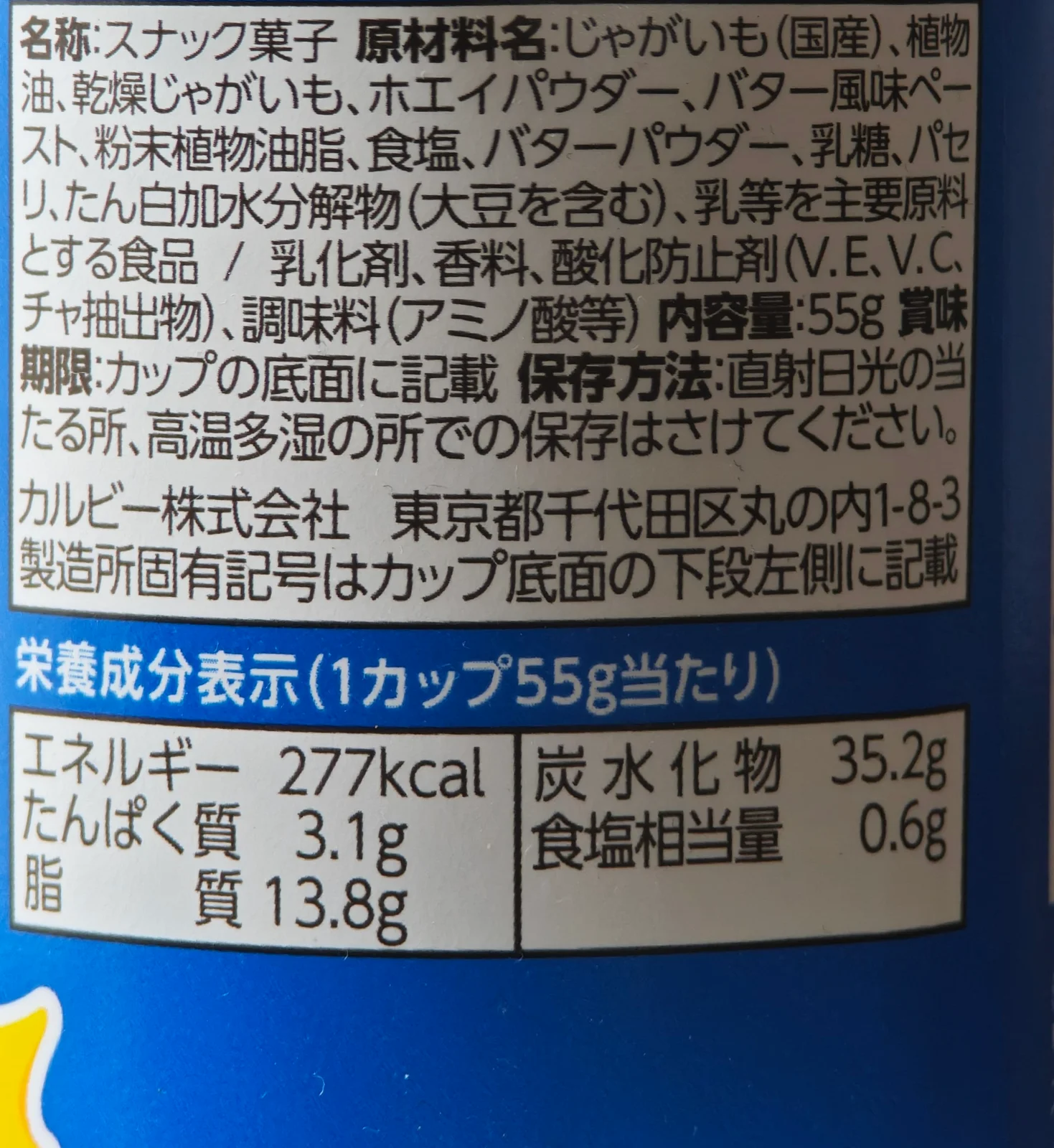
The photographed cup is 55 g and 277 kcal, with butter-flavor paste and butter powder on the label and the same 0.6 g salt equivalent as Cheese.
A lucky burst: the atari stick
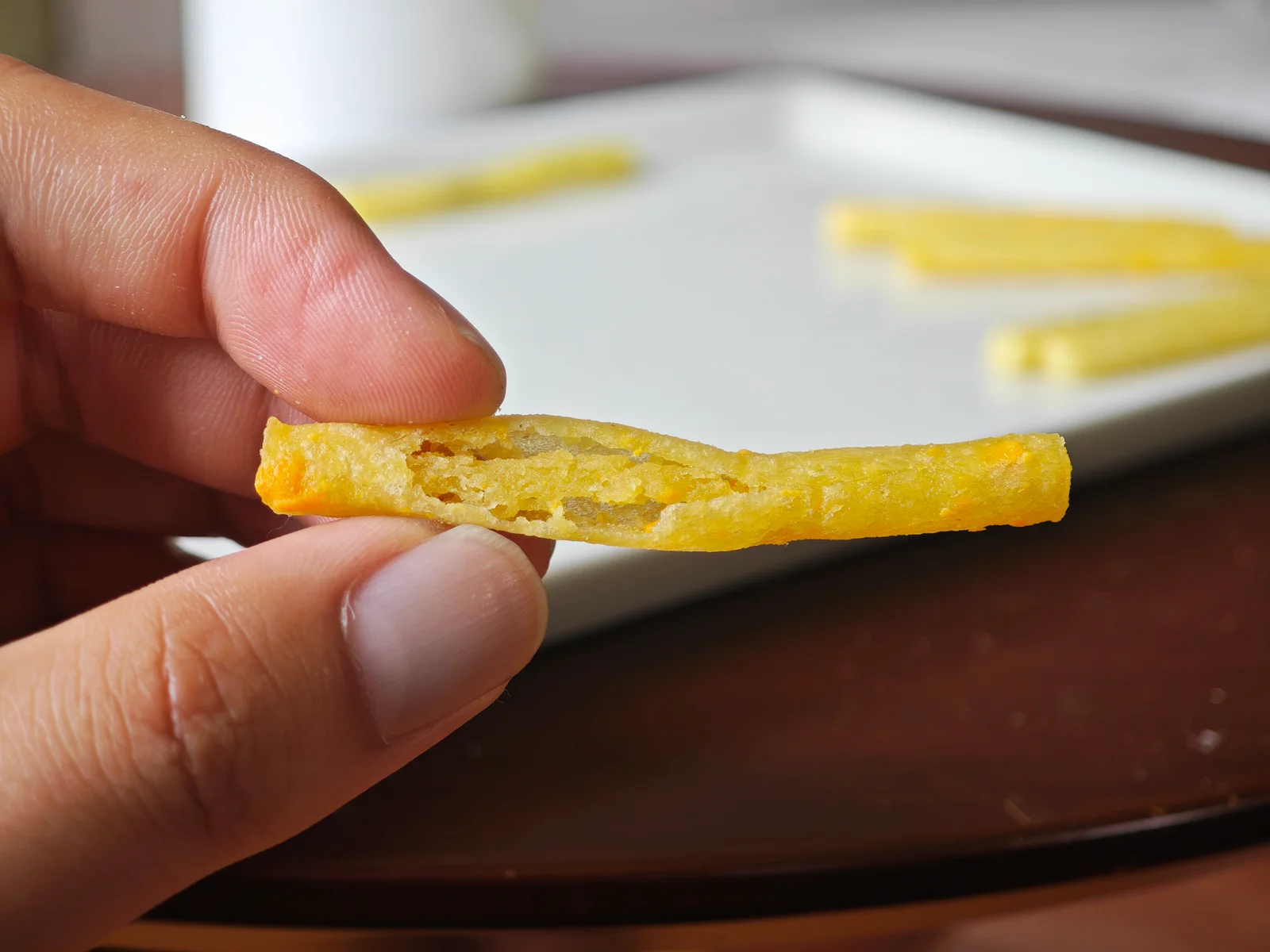
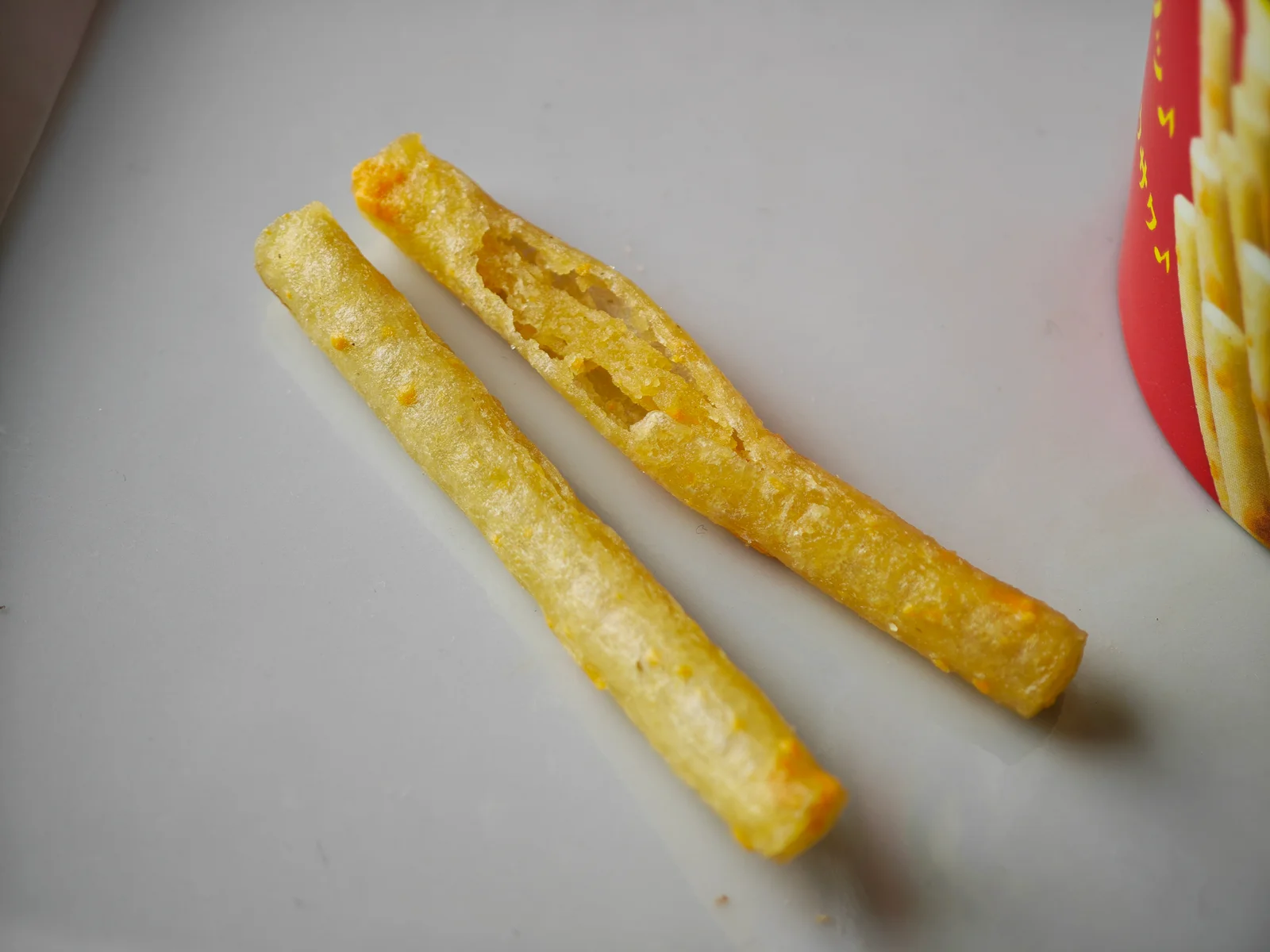
Any flavor can hide one. When these potato sticks are fried, some pieces burst and open like a branch. The extra surface goes pari-pari, and the odd silhouette feels a little like finding a strangely shaped bonsai. I call that piece an atari (当たり, a lucky hit). It is not a Cheese-only event—Salad and Jaga Butter can do the same.
Three sticks, one decision
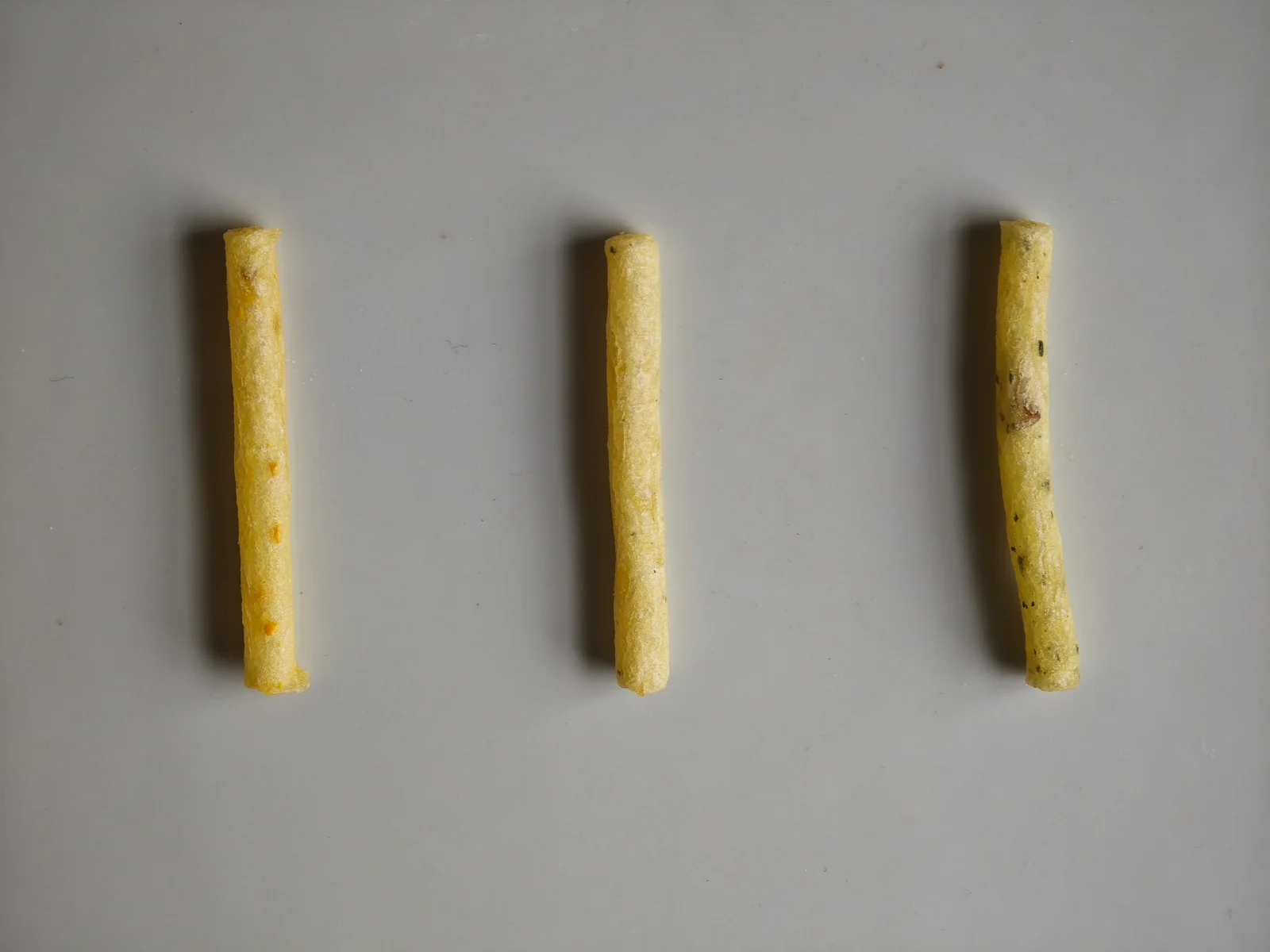
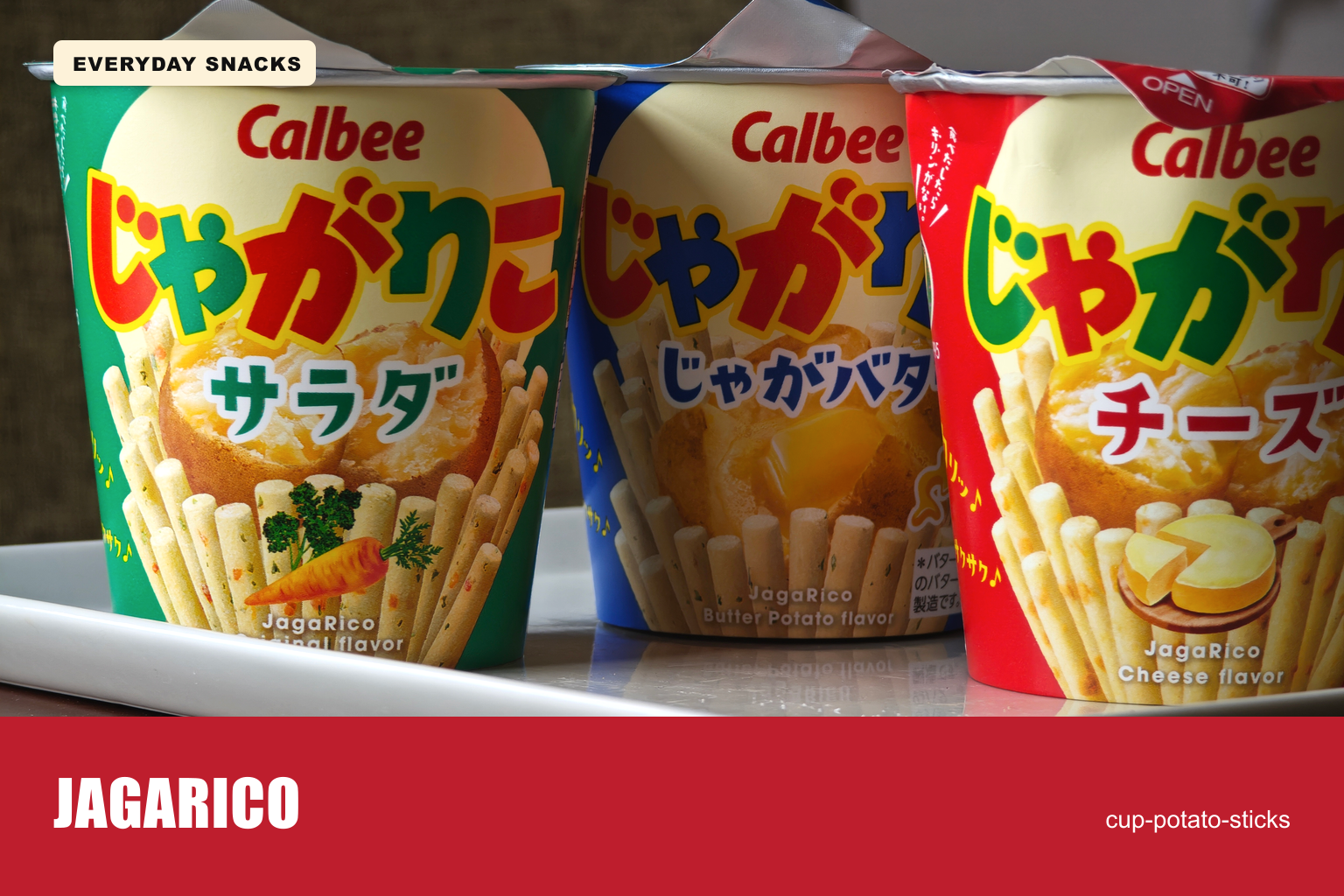
Left to right: Cheese, Jaga Butter, Salad.
| If you want | Choose | |—|—| | The 1995 original and the clearest potato | Salad | | Random cheddar bits and a small flavor surprise | Cheese | | A butter-sweet finish on fried oil | Jaga Butter | | The most efficient lesson | All three |
There is no need for a champion. Salad teaches the format. Cheese adds texture events. Butter changes the aftertaste. The stick, the cup, and the mild salt stay constant.
Other flavors around the core
Once you know the three photographed cups, the rest of the shelf makes more sense:
- Tarako Butter — the 2011 limited flavor that became a 2012 staple.
- L-size cups — longer sticks for when the standard cup disappears too fast.
- Bits — shorter pieces, including large packs.
- Limited and souvenir cups — lemon, pizza, regional beef tongue, takoyaki, extra-spicy, and collaboration designs rotate constantly.
Calbee’s official product page is the place to check what is actually on sale this month. Treat old flavor lists as history, not a shopping list.
Where to buy Jagarico
In Japan, look in convenience stores, supermarket snack aisles, Don Quijote, and drugstores. The color code is reliable: green Salad, red Cheese, blue Jaga Butter.
Travelers can buy single cups immediately. Online listings are usually 12-packs, which suit a shared tasting or a pantry.
Buy the three-flavor tasting
- Amazon Japan — Jagarico Salad, 12 cups: check price and availability
- Amazon Japan — Jagarico Cheese, 12 cups: check price and availability
- Amazon Japan — Jagarico Jaga Butter, 12 cups: check price and availability
- Official brand world — Jagarico Channel
Weights on Amazon and on the cup you photograph may differ. Confirm flavor, count, expiration, and allergens; milk and soy are common.
Affiliate disclosure: links above may be affiliate links. If you buy through them, I may earn a commission at no extra cost to you.
Final verdict: potato, in stick form
Jagarico is easy to underestimate if you only know chips. It looks like a small fry. It eats like a designed potato: steamed, fried, portioned, and mild enough that you still taste imo.
Salad is the textbook. Cheese is the textbook with lucky cheddar sparks. Jaga Butter is the textbook with a sweet afterglow. A burst atari stick can appear in any of them.
That is Japan’s potato-snack culture in a cup: not one flavor shouting, but a physical format that can carry many flavors without losing the potato.
Frequently Asked Questions
Is Jagarico a potato chip?
No. It is a fried potato stick sold in a cup. Chips are thin sheets; Jagarico is a thick rod with a first crackle and a later crunch.
Which flavor launched first?
Salad and Cheese launched together in 1995. Jaga Butter followed in 2005.
Why is the salt so mild?
The photographed cups sit around 0.6–0.7 g salt equivalent. The design leaves room for potato and oil. If you want a louder seasoning, look at limited cups or ordinary potato chips.
Can children eat it from the cup?
Yes, and that was part of the original outdoor-snack idea. Supervise small children; the sticks are firm and the lid foil has sharp edges.
What do the black specks in Salad mean?
The lid often notes that dark specks can be potato skin. Carrot and parsley flecks are separate, colored inclusions.
Is the burst stick a defect?
It is an irregular fry that can happen in any flavor. The author treats it as a lucky atari because the extra surface gets crisp. It is still the same potato.
How should I store an opened cup?
Fold the remaining foil into a light lock and finish it soon. Do not treat the cup as airtight travel packaging.