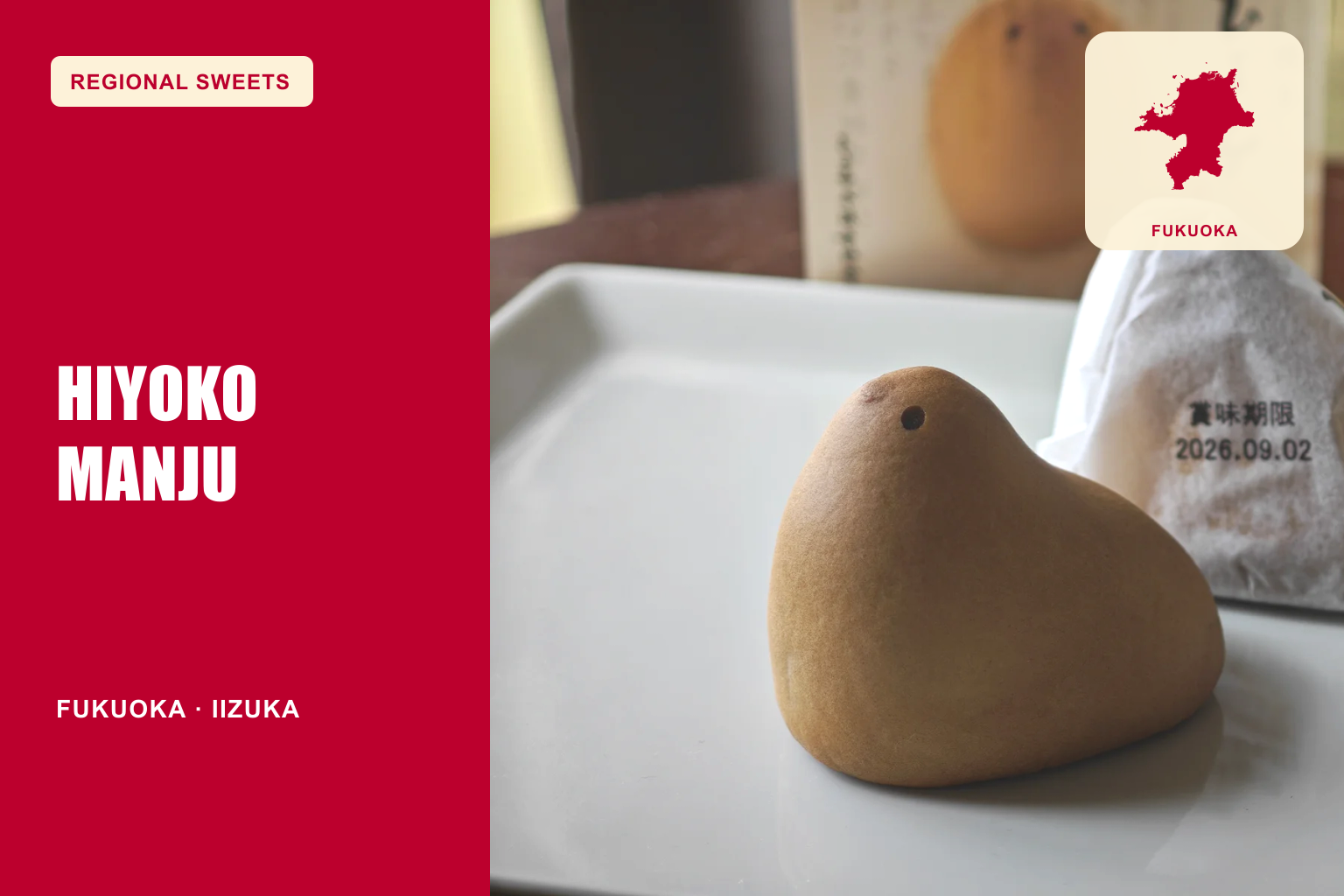
Hiyoko looks almost too smooth to be food. Its rounded back and tiny head have the calm surface of a small ceramic figure. Then you pick it up, choose a starting point, and discover that the shape is doing more than making the sweet cute.
In my tasting, the baked skin had a gentle tension before giving way to a firm, not-too-sweet filling. The little pointed edge at the rear was especially satisfying to bite. That detail convinced me that Hiyoko is not a normal manju wearing an animal silhouette. Its three-dimensional form changes the way you eat it.
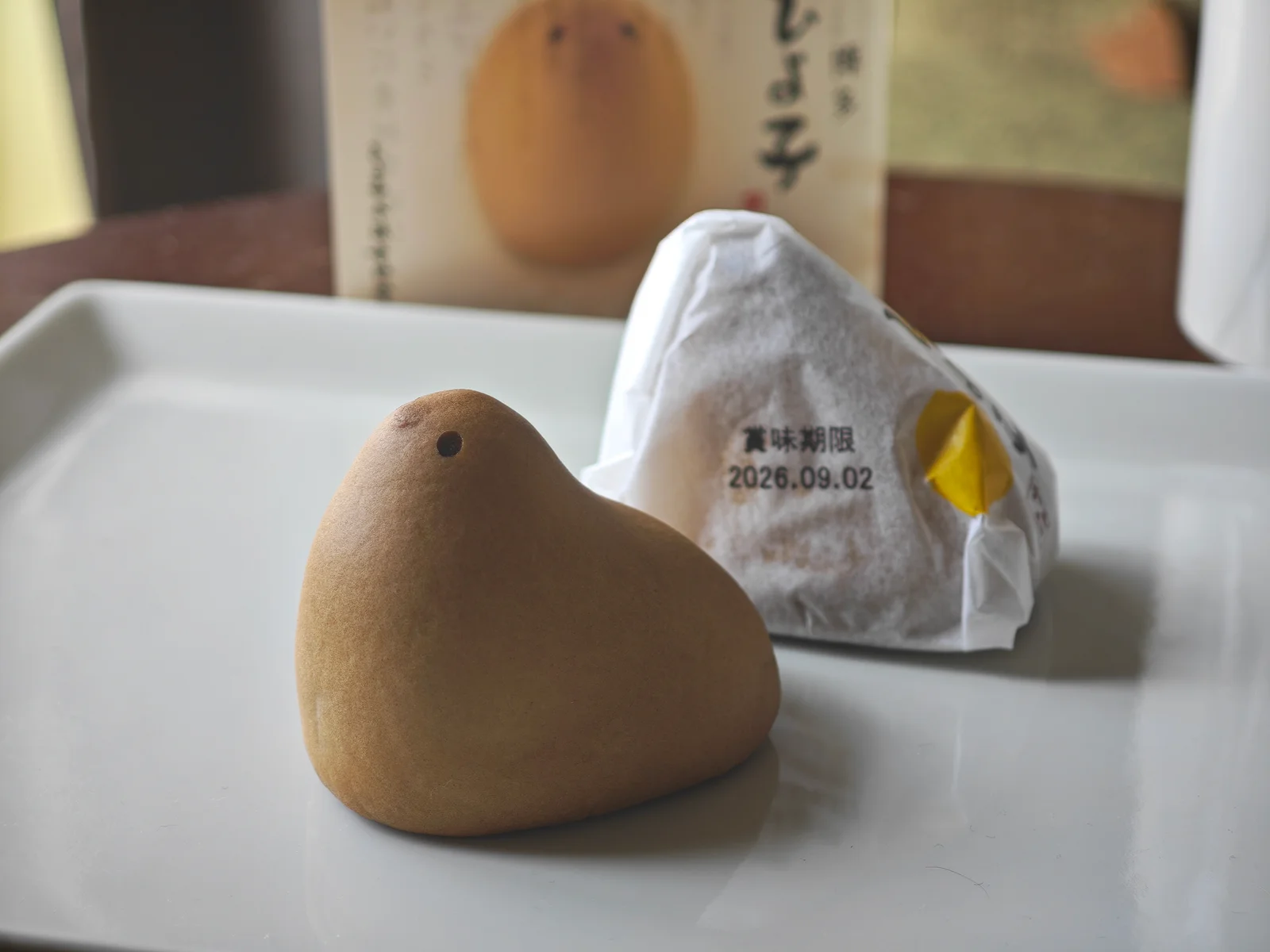
Quick take: Hiyoko (ひよ子) is a chick-shaped souvenir sweet created in Iizuka, Fukuoka, in 1912. Its smooth baked skin surrounds the maker’s kimi-an filling. Try one at room temperature first for a blended skin-and-filling bite; chill another if you want the contrast to feel sharper. At JR Hakata Station, look for it among the boxed souvenirs rather than expecting a convenience-store snack.
What is Hiyoko?
Hiyoko is the signature sweet of Hiyoko Honpo Yoshinodo (ひよ子本舗吉野堂). The name means “chick,” and the product is molded as a small bird rather than stamped with a flat picture.
English descriptions sometimes reduce it to “a chick-shaped cake,” but that misses the Japanese souvenir context. It belongs to the broad manju family: a baked outer layer surrounding bean-based paste. The maker calls Hiyoko’s center kimi-an (黄味餡), literally a yolk-style bean paste. It is better to use that name than to label it simply as white bean paste.
The design is friendly enough for a child to understand immediately, but it has lasted for more than a century because the eating experience supports the image.
The shape changes the first bite
A round manju gives you few decisions. Hiyoko gives you a small moral and tactical problem: head first, tail first, or straight through the middle?
I started paying attention to the rear edge. Where the body narrows, the baked skin forms a more distinct corner. Biting that area gives a brief, clean resistance before the filling arrives. The surface looks porcelain-smooth, but the mouthfeel is not blank or mushy.
That is the contrast I remember most:
- a taut but tender baked skin
- a firm center packed all the way inside
- restrained sweetness rather than a heavy sugar finish
- a changing ratio of skin to filling depending on where you bite
The silhouette therefore creates variation. Eating the head does not feel exactly like eating the broad body or pointed rear. It is a small difference, but it separates Hiyoko from an anonymous round bun.
Sorry, Hiyoko—this cut was for research
There is no elegant way to study the inside of a chick without making the scene look slightly cruel.
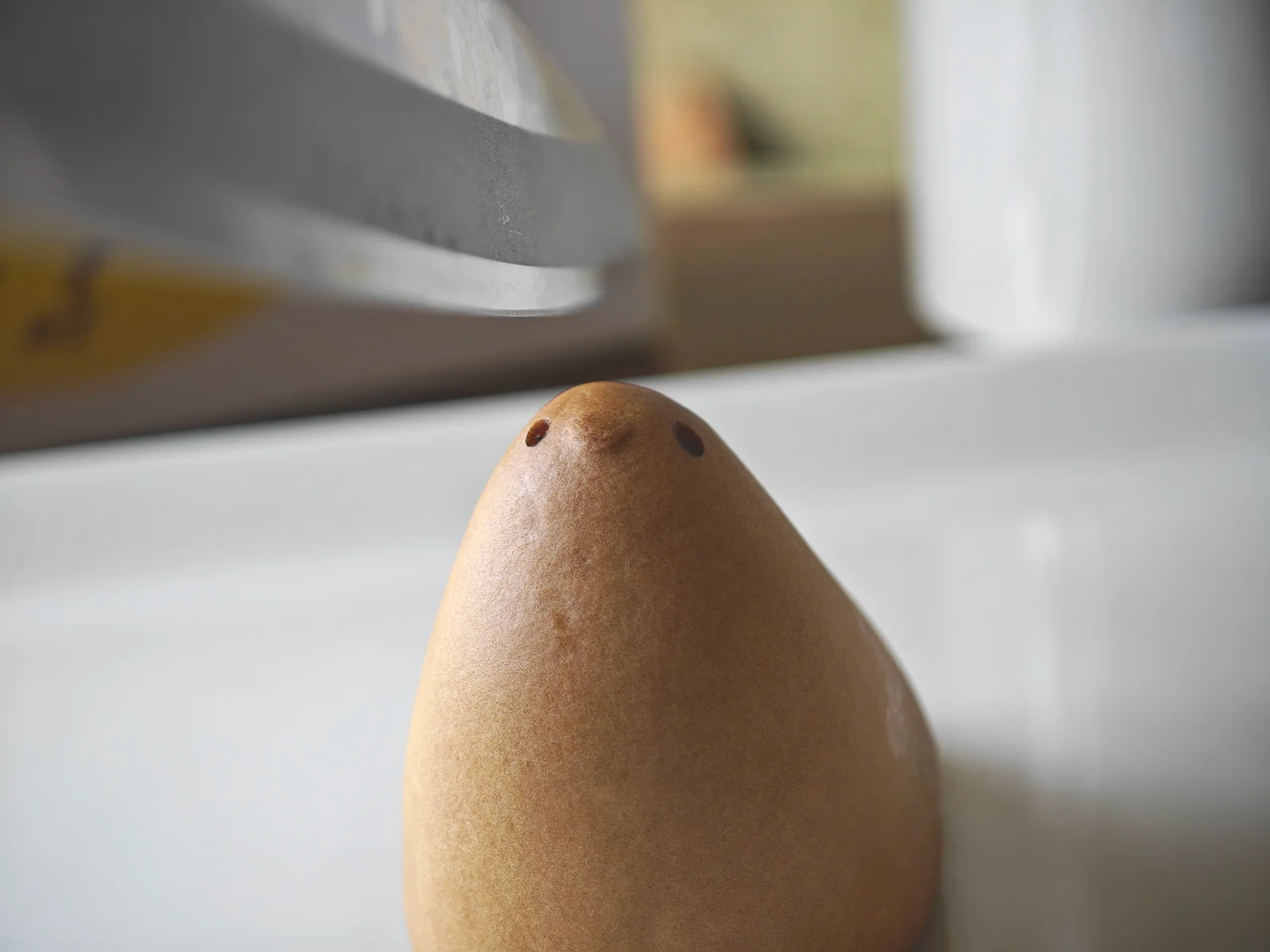
The knife above its head looks dramatic, so let me offer the necessary apology: sorry, Hiyoko—this was for research.
Once cut, the structure is simple and useful to see. A thin baked layer follows the body’s outline, while the dense paste fills most of the center.
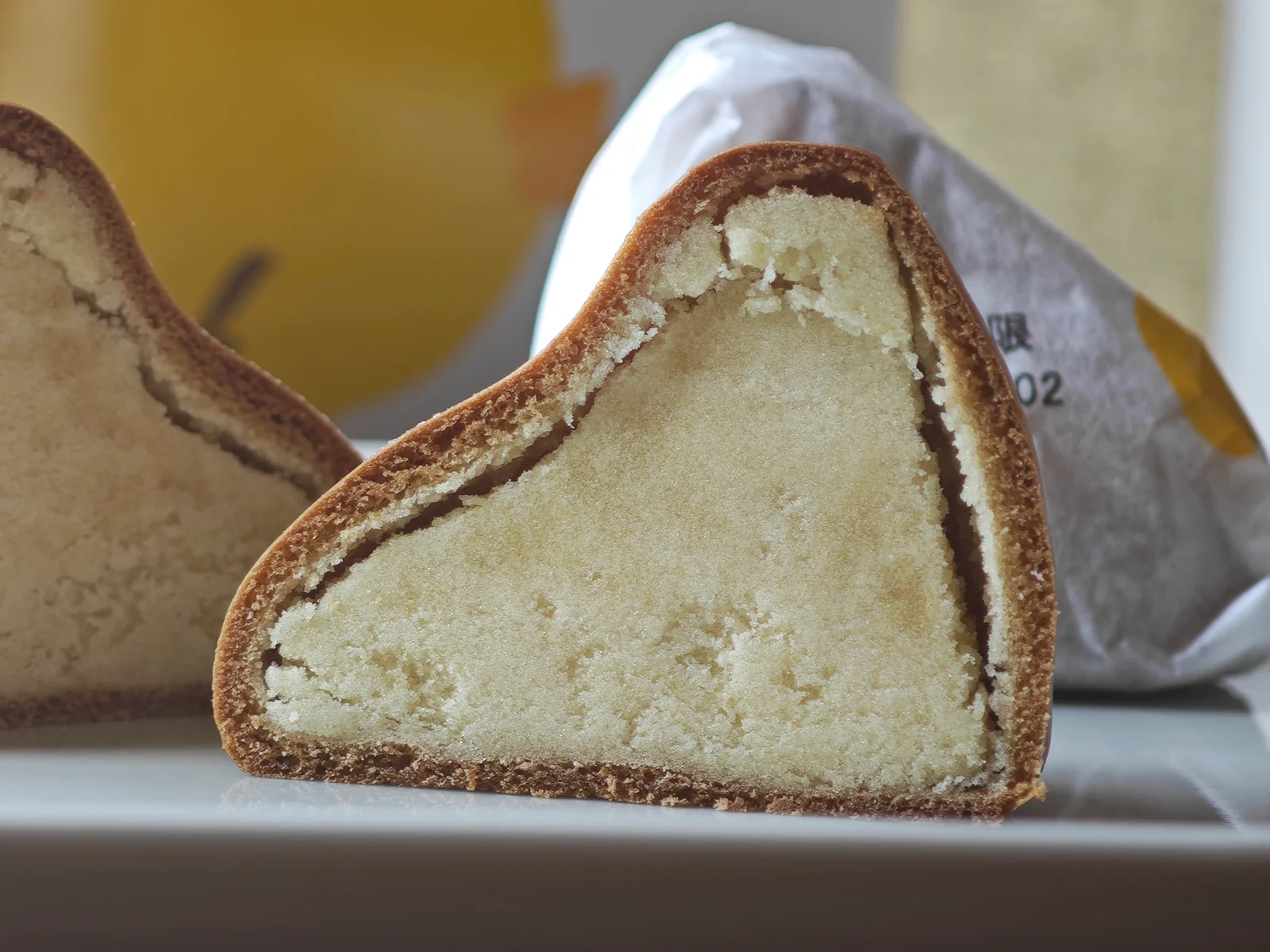
That cross-section explains why the sweet does not taste like shape alone. The filling has enough presence to carry the bite, while the skin contributes tension and a mild baked note. In my piece, the sweetness stayed calm enough that tea felt like the natural companion.
Room temperature or chilled?
At room temperature, the skin and filling seemed to meet more easily. Their boundary remained visible, but the bite felt integrated—as if both parts were designed to finish together.
After chilling, I felt the contrast more clearly. The paste and skin seemed to hold their own textures for longer. I would not call one condition universally better:
- Choose room temperature for a softer, more blended manju experience
- Try it chilled when you want the skin-and-filling contrast to stand out
This is a firsthand comparison, not official storage advice. Follow the package you buy, especially in warm weather.
Opening the box
The top-down view shows how Hiyoko works as an omiyage—a boxed gift meant to travel and be shared. The photographed box contains seven individually wrapped pieces.
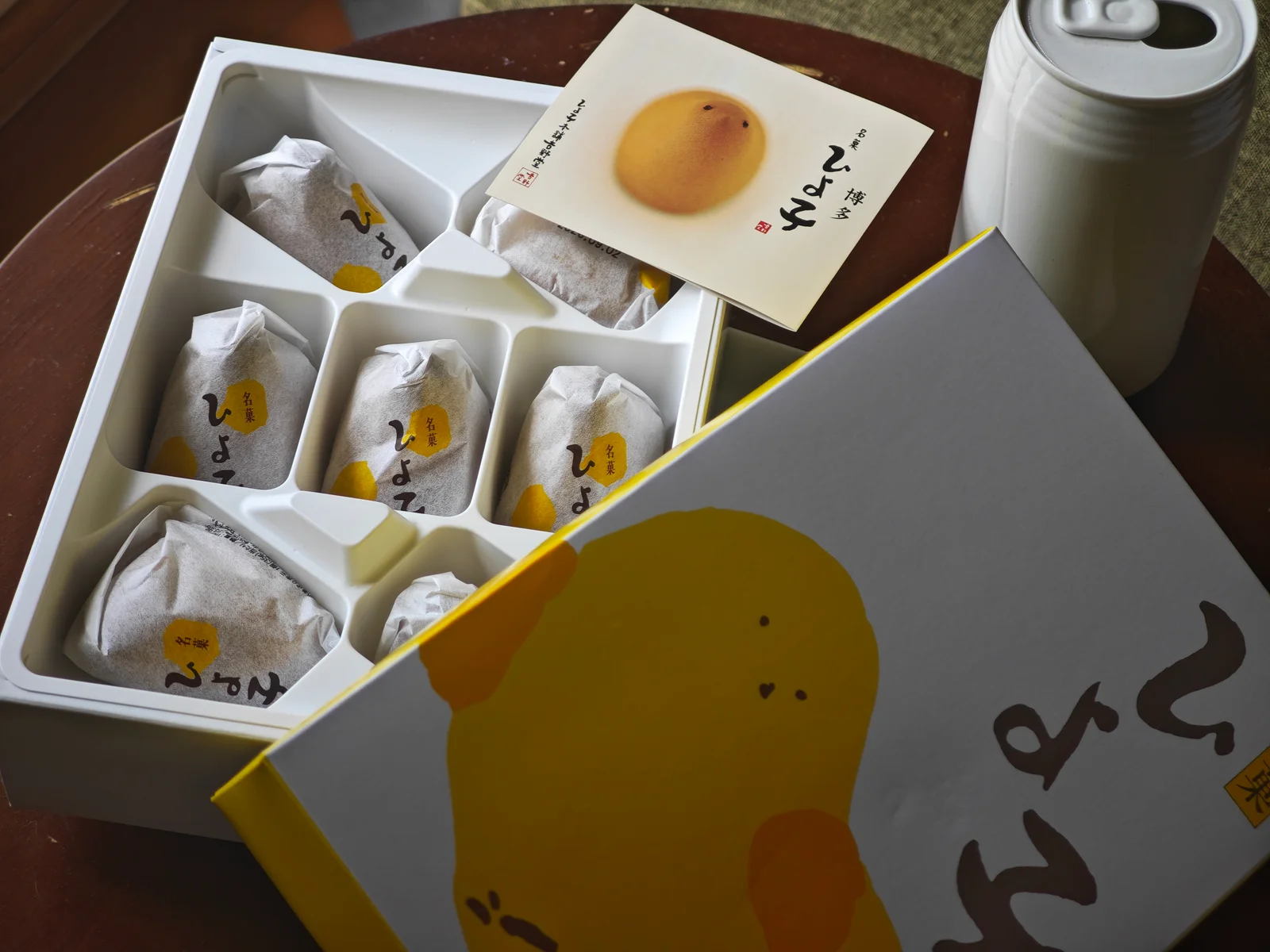
The box also included a printed pamphlet. In Japanese souvenir culture, that insert is part guide, part brand memory: it gives the recipient a story to open along with the sweets.
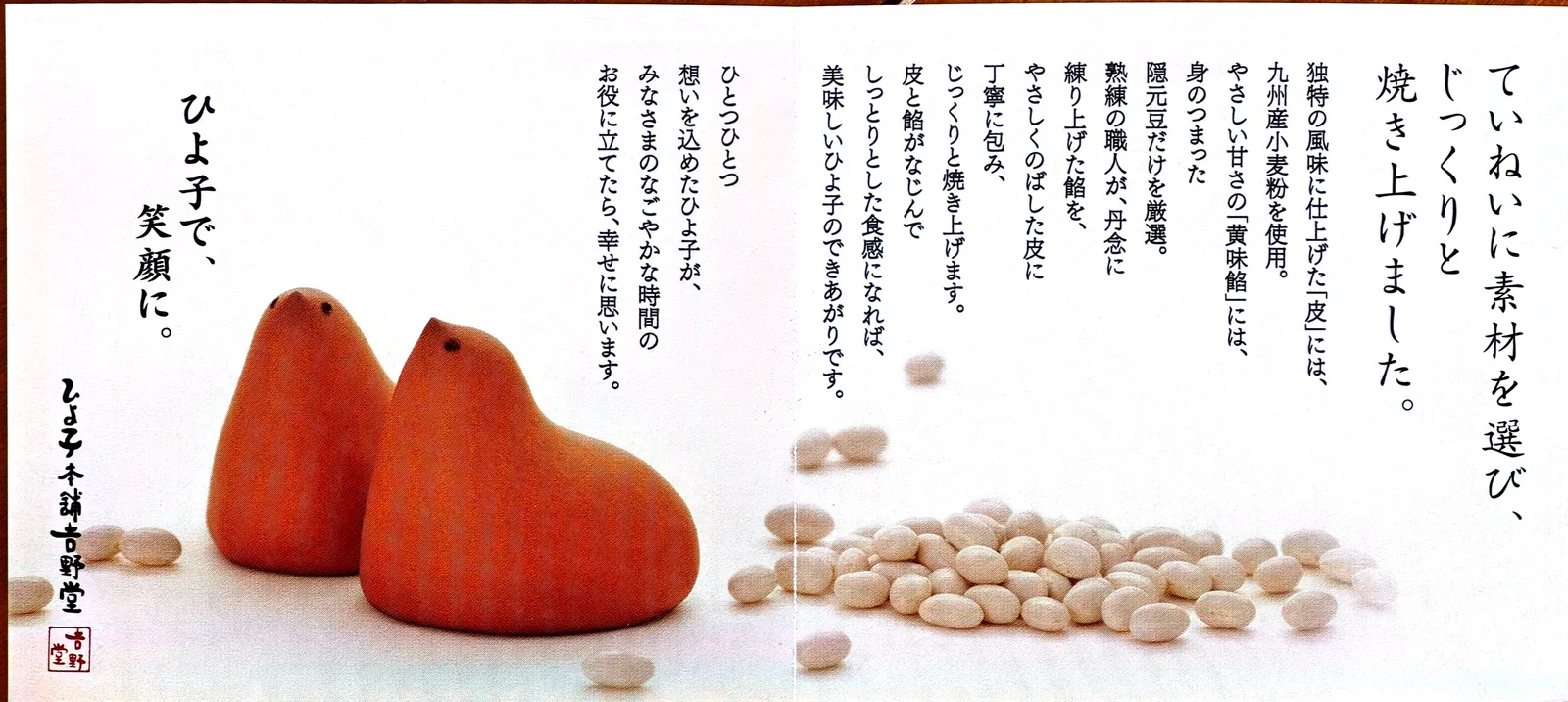
The photographed spread says the skin uses Kyushu-grown wheat, while the kimi-an uses carefully selected kidney beans (ingen-mame). It describes experienced artisans kneading the filling, wrapping it in the stretched skin, and baking it slowly until the sweet reaches its moist texture.
Package facts: ingredients, allergens, and nutrition
The package label is the final authority for ingredients, allergens, quantity, nutrition and storage. This seven-piece box provides the following details.
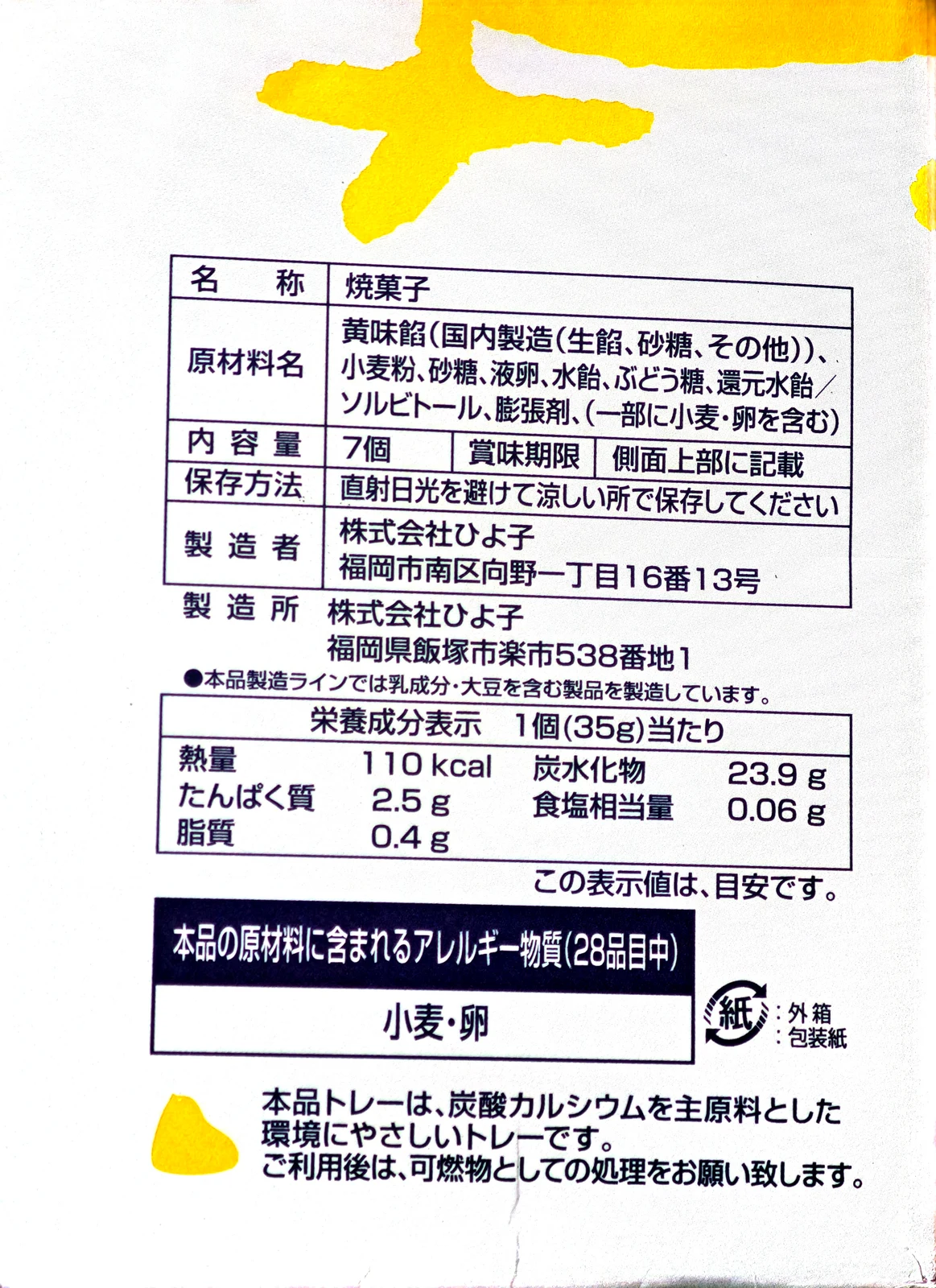
The label lists a yolk-style filling made in Japan (bean paste, sugar and other ingredients), wheat flour, sugar, liquid egg, starch syrup, glucose and reduced starch syrup, with sorbitol and a leavening agent. The declared allergens are wheat and egg.
Approximate nutrition per 35 g piece:
- Energy: 110 kcal
- Protein: 2.5 g
- Fat: 0.4 g
- Carbohydrate: 23.9 g
- Salt equivalent: 0.06 g
The label identifies Hiyoko Co., Ltd. as seller in Fukuoka City and manufacturer in Iizuka. It says to avoid direct sunlight and store in a cool place; the best-before date is printed separately on the side. Always read the box you actually buy, because formulations and labeling can change.
What Hiyoko looks like at Hakata Station
For an overseas traveler, the easiest lesson may be the shelf itself. Hiyoko is not hidden in a specialist tea room. At JR Hakata Station, boxed Hiyoko sits among the region’s many formal souvenirs.
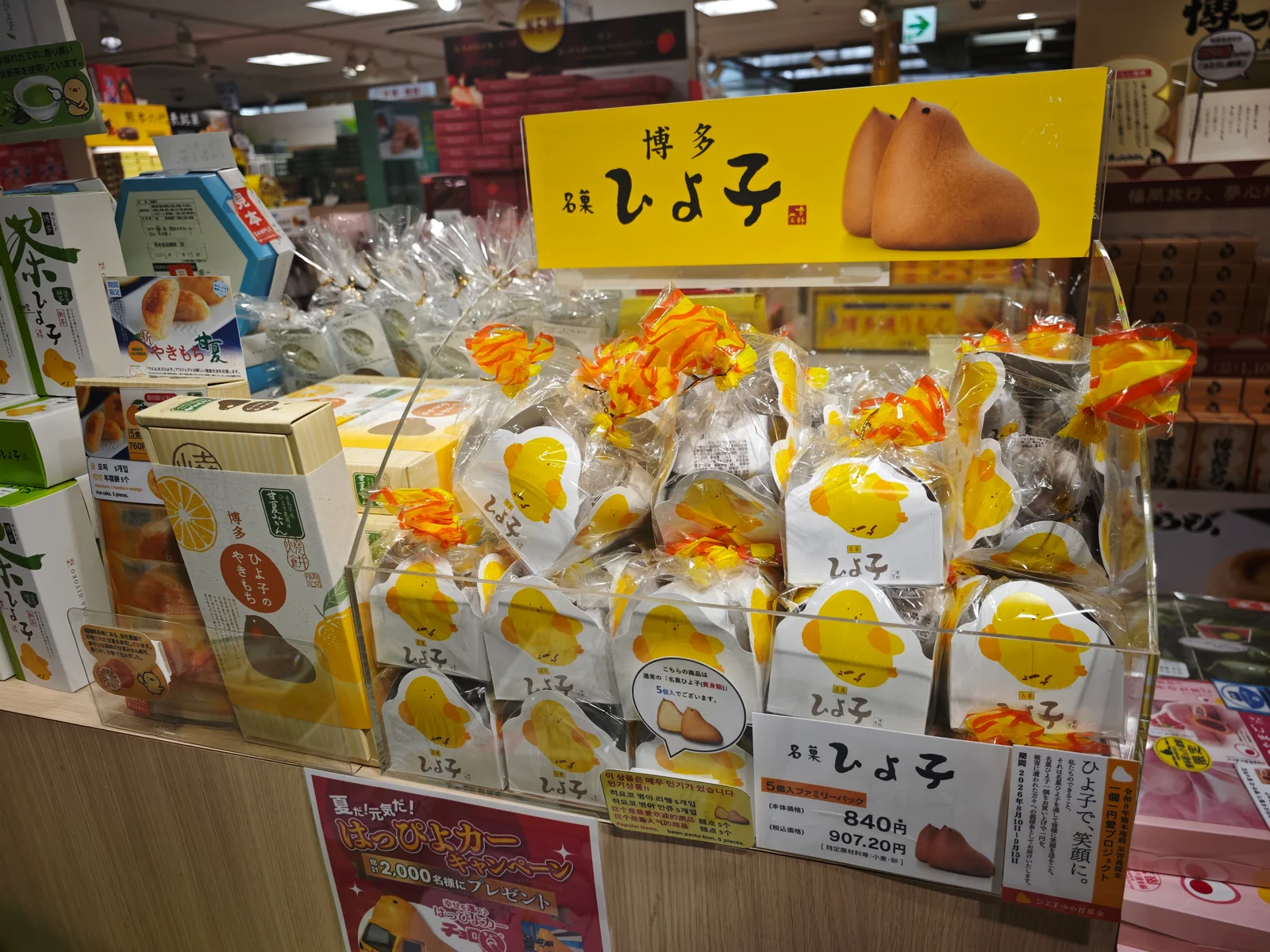
Japanese souvenir shops often display an opened sample so customers can understand what a sealed gift box contains. Here, a seven-piece box shows the individual wrappers clearly, making it easier to inspect the presentation before choosing a box.
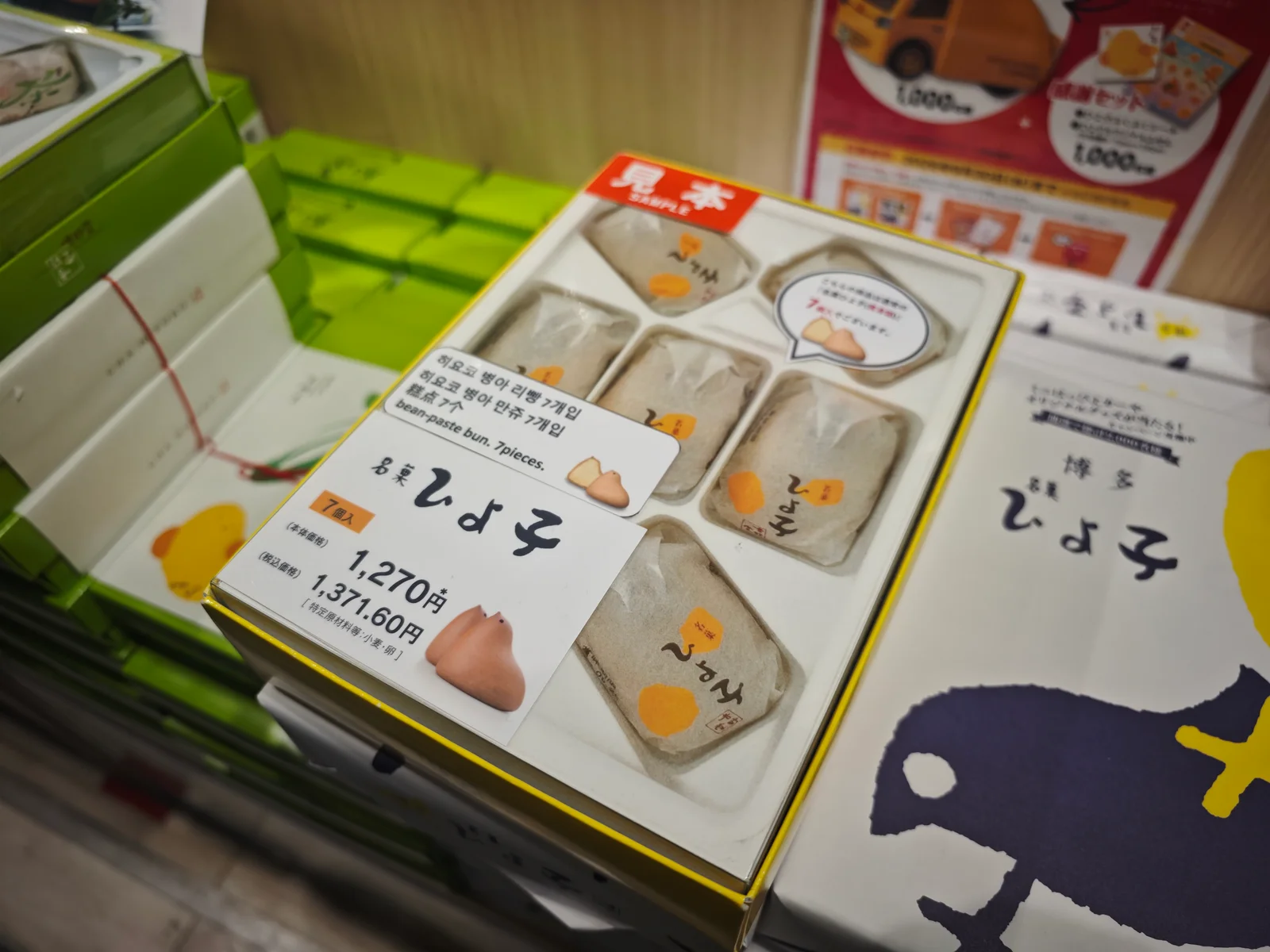
This is useful if you cannot read every line of Japanese. Look for the chick silhouette, compare the displayed contents with the box size, and check the current label before buying.
Born in Fukuoka, remembered in Tokyo
Hiyoko’s regional identity can confuse even Japanese shoppers, but the chronology is clear.
Yoshinodo began as a confectionery shop in Iizuka, Fukuoka Prefecture, in 1897. Second-generation confectioner Shigeru Ishizaka created the chick-shaped Hiyoko in 1912. The maker’s story says the form appeared to him in a dream, while poultry farming was familiar in the area.
Hiyoko moved from Iizuka to Fukuoka City in 1957, where it grew into a well-known Kyushu gift. The company then looked east during the rapid-growth era around the 1964 Tokyo Olympics, building a factory in Soka, Saitama. Tokyo Hiyoko was established in 1966, and the sweet became deeply associated with Tokyo Station and Kanto souvenir culture too.
So, is Hiyoko a Fukuoka souvenir or a Tokyo souvenir?
Its birthplace is Fukuoka. Its Tokyo identity is also real. Decades of eastern-Japan manufacturing, shops and advertising gave another region its own memories of the same chick.
Sources: Hiyoko’s official story, company history, and the official Tokyo expansion story.
The television jingle that stayed in my head
I lived in the Kanto region and heard Hiyoko commercials again and again. This was the era when a television might be running in a barbershop or supermarket, filling an ordinary room even when nobody had chosen a specific video. The repetition lodged the brand in my head almost like accidental brainwashing.
Relatives would occasionally bring a box, too. Hiyoko therefore existed first as a familiar name, sound and gift ritual—not as something I had carefully reviewed.
This archived 2000 Hiyoko Honpo Yoshinodo commercial is a third-party upload rather than an official company upload:
Watch the archived 2000 Hiyoko commercial on YouTube
Eating it again as an adult changed the emphasis. The chick was still nostalgic, but I noticed the construction: the tension of the skin, the packed filling, and the pointed edge at the rear. A childhood mascot became a designed food.
Other character-shaped Japanese sweets to compare
Hiyoko is not Japan’s only regional sweet built around a recognizable figure. Other examples include Inaba no Shiro Usagi from Tottori and Dojo Sukui Manju from the Sanin region.
They should not be grouped as copies. Similar-looking regional sweets can differ in:
- what the shape represents locally
- whether the shell is cake-like, cookie-like or manju-like
- the type and sweetness of the filling
- where the thick and thin parts change the bite
- whether travelers recognize the product from packaging, television or place
Hiyoko raises a useful comparison question: when does a shape stop being decoration and start changing how a sweet is eaten?
Where to buy Hiyoko in Fukuoka
For travelers, JR Hakata Station is the easiest starting point. Hiyoko Honpo Yoshinodo has station-area sales channels, including the large MING souvenir zone. MING currently lists general hours of 9:00–21:00, but individual store hours and stock can change.
At the photographed counter, the display showed a five-piece format at ¥907.20 including tax and a seven-piece box at ¥1,371.60 including tax. These were the prices visible when photographed and may change.
Hiyoko is also sold through Fukuoka Airport and other Kyushu souvenir outlets. Use the official store page before making a special trip:
- Hiyoko Honpo Yoshinodo — official store information
- Hakata Station MING souvenir mall
- Official Hiyoko product page
If you are taking a box overseas, check the date, allergens, heat exposure and your destination’s food-import rules.
Affiliate disclosure: Some links above may be affiliate links. If you buy through them, I may earn a commission at no extra cost to you.
Frequently asked questions
Is Hiyoko from Fukuoka or Tokyo?
Hiyoko was created in Iizuka, Fukuoka, in 1912. It expanded into the Tokyo market in the 1960s and became familiar as a Tokyo souvenir too. Fukuoka is the documented birthplace; both regions have long-standing consumer memories.
Is the filling white bean paste?
The maker calls it kimi-an (黄味餡), a smooth yolk-style bean paste—a more specific description than generic white bean paste. Always check the current package for exact ingredients and allergens.
What does Hiyoko taste like?
In my tasting, it was gently sweet rather than sugary, with a firm filling and a taut, smooth baked skin. The pleasure came from contrast—and from the skin-to-filling ratio changing depending on where I bit the chick.
Should I eat the head or tail first?
There is no rule. The choice is part of Hiyoko’s appeal. The pointed rear gave me the most satisfying initial texture; cutting through the middle gives the clearest view of the filling.
Where can I buy Hiyoko at Hakata Station?
Look in the station’s souvenir shopping areas, including Hiyoko Honpo Yoshinodo’s MING-area presence. Check the official store list and current station information because hours, counters and stock can change.