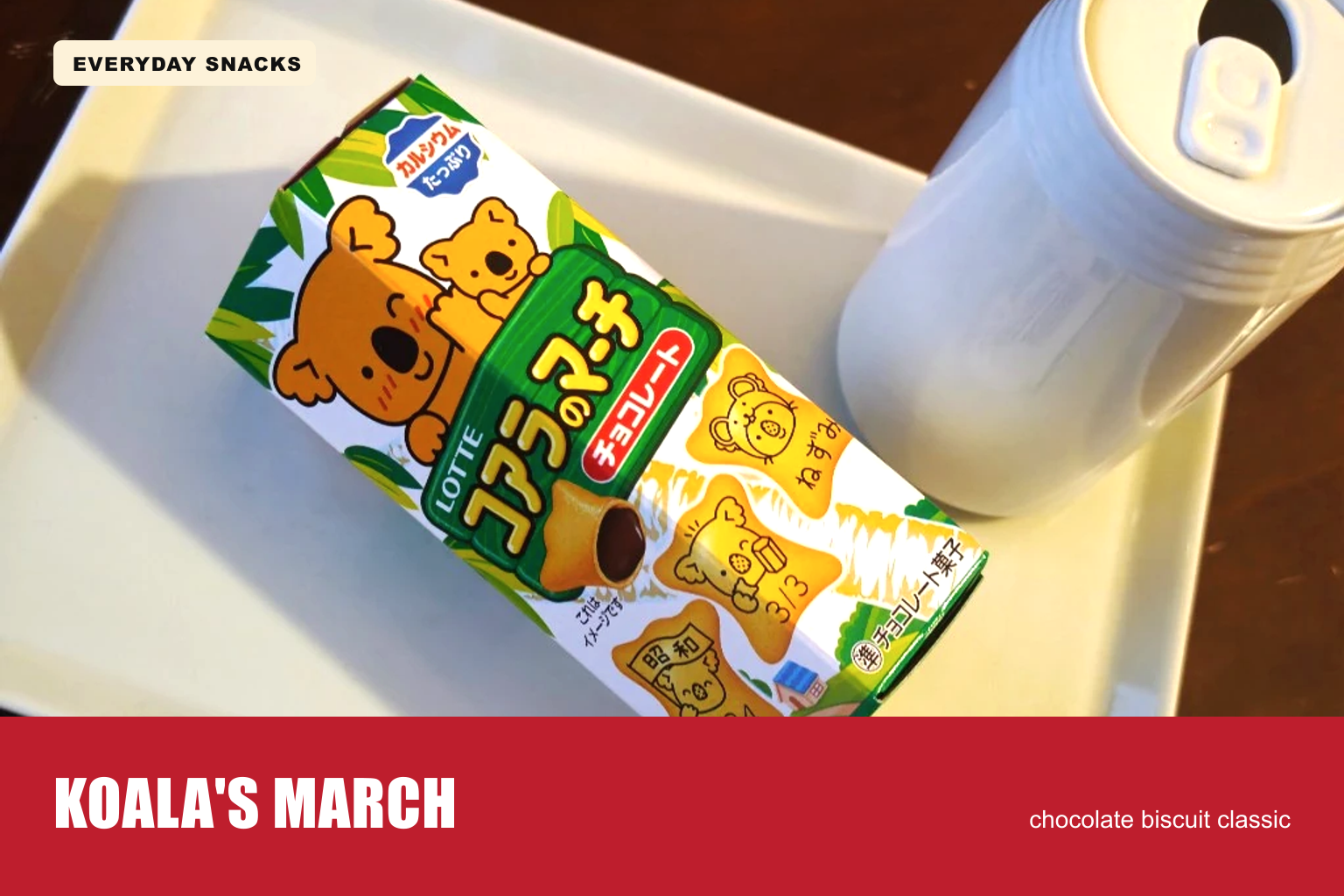
At first glance, Koala’s March looks like an uncomplicated children’s snack: a bright hexagonal box filled with tiny koalas. Open it slowly, however, and the product starts explaining why it has survived since 1984.
The lid asks you to play. The biscuits carry dates, years, and characters. The chocolate is hidden inside a hollow shell, leaving your fingers relatively clean. Even the empty space inside each koala contributes to the snap.
Koala’s March is not just chocolate in a cute shape. It is a compact example of how Japanese packaged snacks combine food engineering, characters, packaging, and communication.
Quick guide: Look at the print before eating. Notice the dry, airy biscuit first and the chocolate second. Use the carton tab if you want to stop halfway. The photographed 2026 box contains 500 profile-themed prints, while Lotte’s regular character catalog currently lists 365 designs—two different counting systems.
What is Koala’s March?
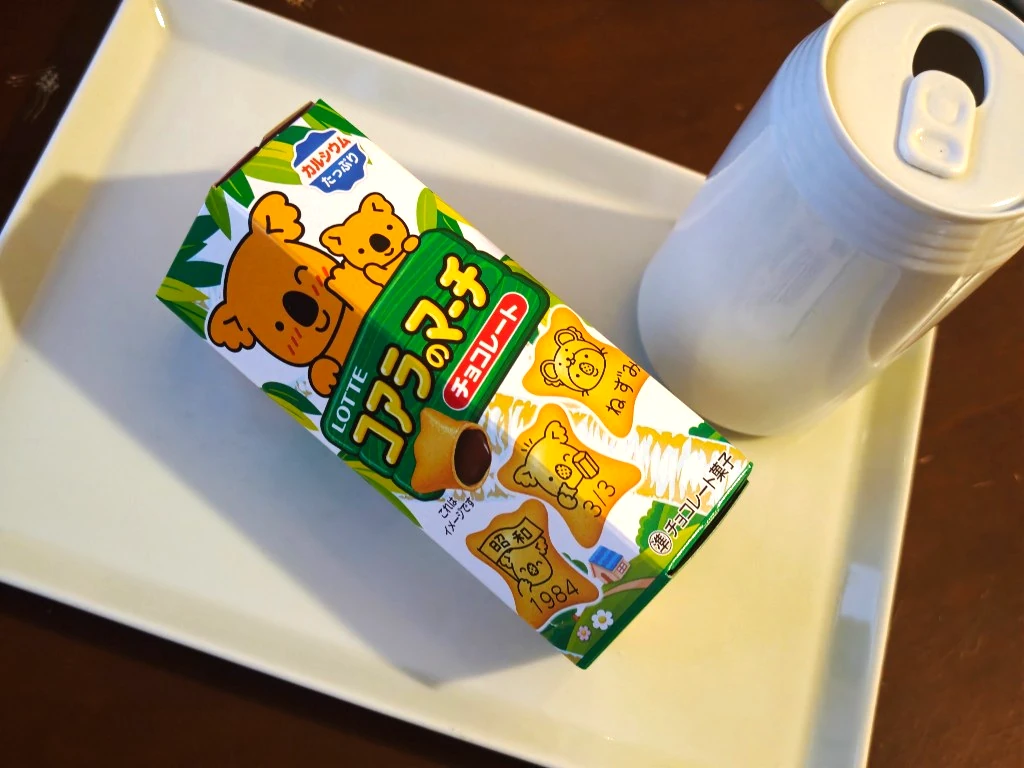
Koala’s March (Koala no Māchi / コアラのマーチ) is Lotte’s koala-shaped chocolate biscuit. The company launched it in March 1984, several months before koalas first arrived at Japanese zoos that October.
Lotte had already established technology for injecting chocolate into hollow biscuits in the early 1980s. News of the coming koalas supplied the missing concept. Because real koalas spend so much time sleeping, the developers imagined them arriving from Australia as a cheerful marching band. That gave the snack its active, memorable name.
The first series had 12 prints, many holding instruments. The six-sided box also belongs to the story: Lotte says it was designed to evoke a eucalyptus tree, the koala’s food.
Lotte official development interview — Lotte describes establishing technology to “inject chocolate into hollow biscuits” (空洞型のビスケットにチョコレートを注入する) and says the first set began with 12 designs.
That relationship between object, animal, and package is unusually complete. You do not merely open a box containing koalas. You open their little eucalyptus world.
How to open—and reclose—the hexagonal box
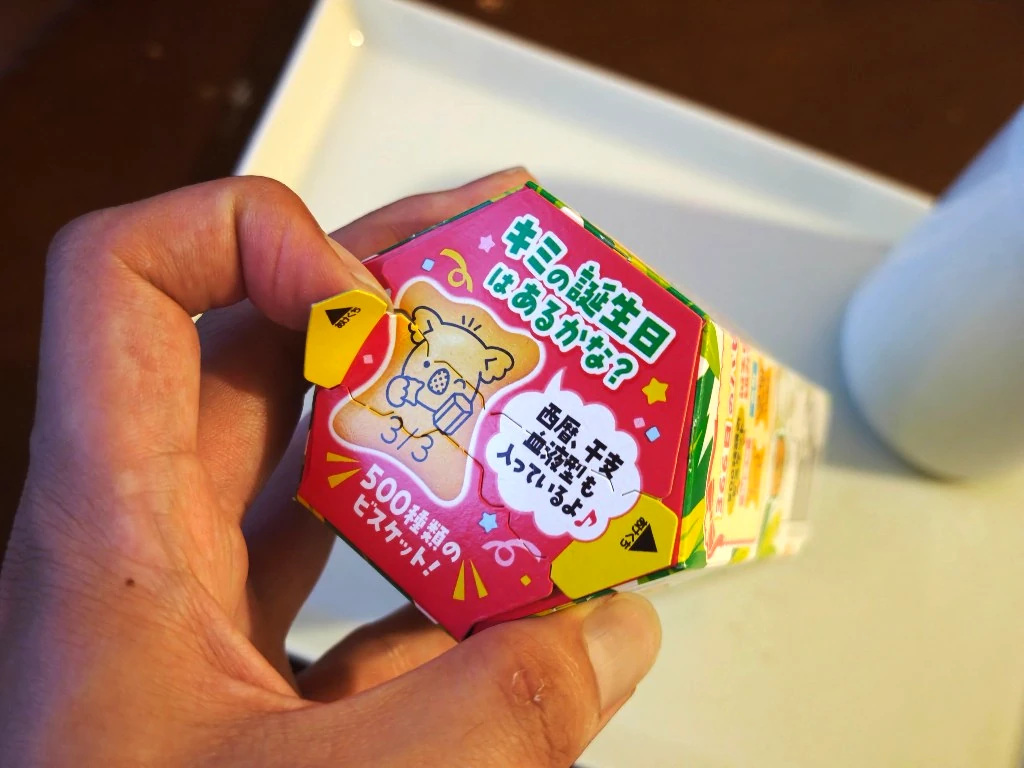
The top panel tells you where to begin. Lift the marked flap and follow the carton’s cut and fold lines rather than tearing randomly across the top.
Inside the photographed lid is another layer of play: a QR activity for making an original March-kun character. Campaigns change, but this is a useful lesson for overseas shoppers—Japanese snack packaging often contains content on surfaces you might normally throw away without reading.
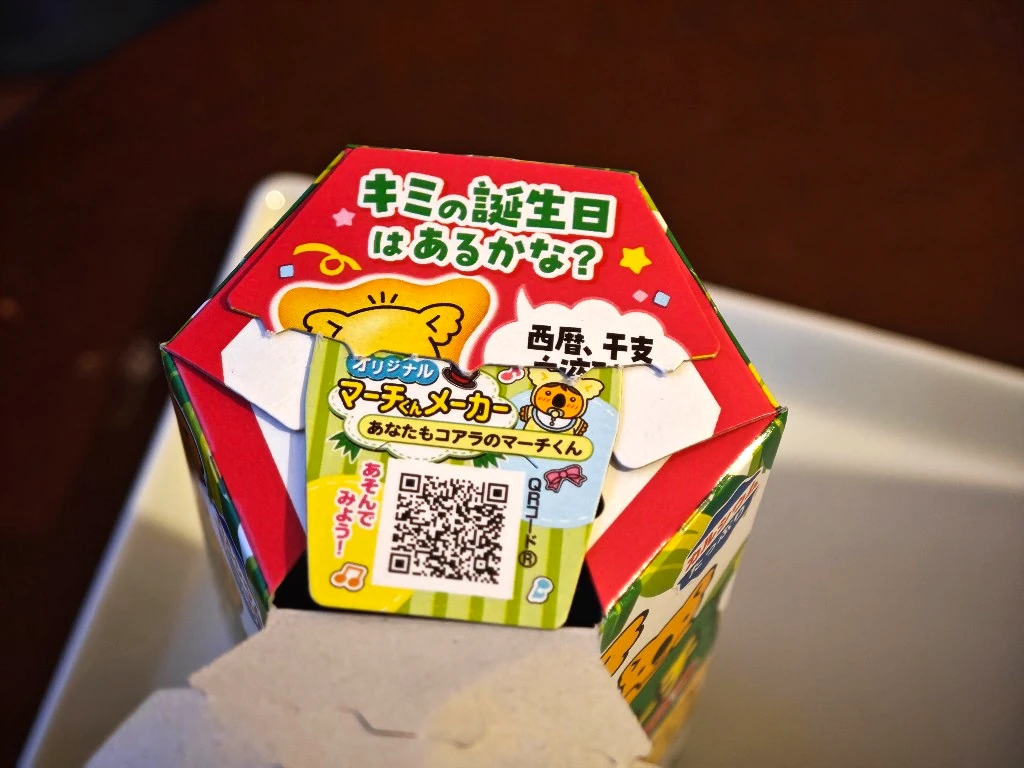
The box can also pause with you. On this carton, a small tab hooks into a slot so the lid stays closed between servings. It is not an airtight seal, but it is enough to make sharing one box between two people—or returning later—more convenient.
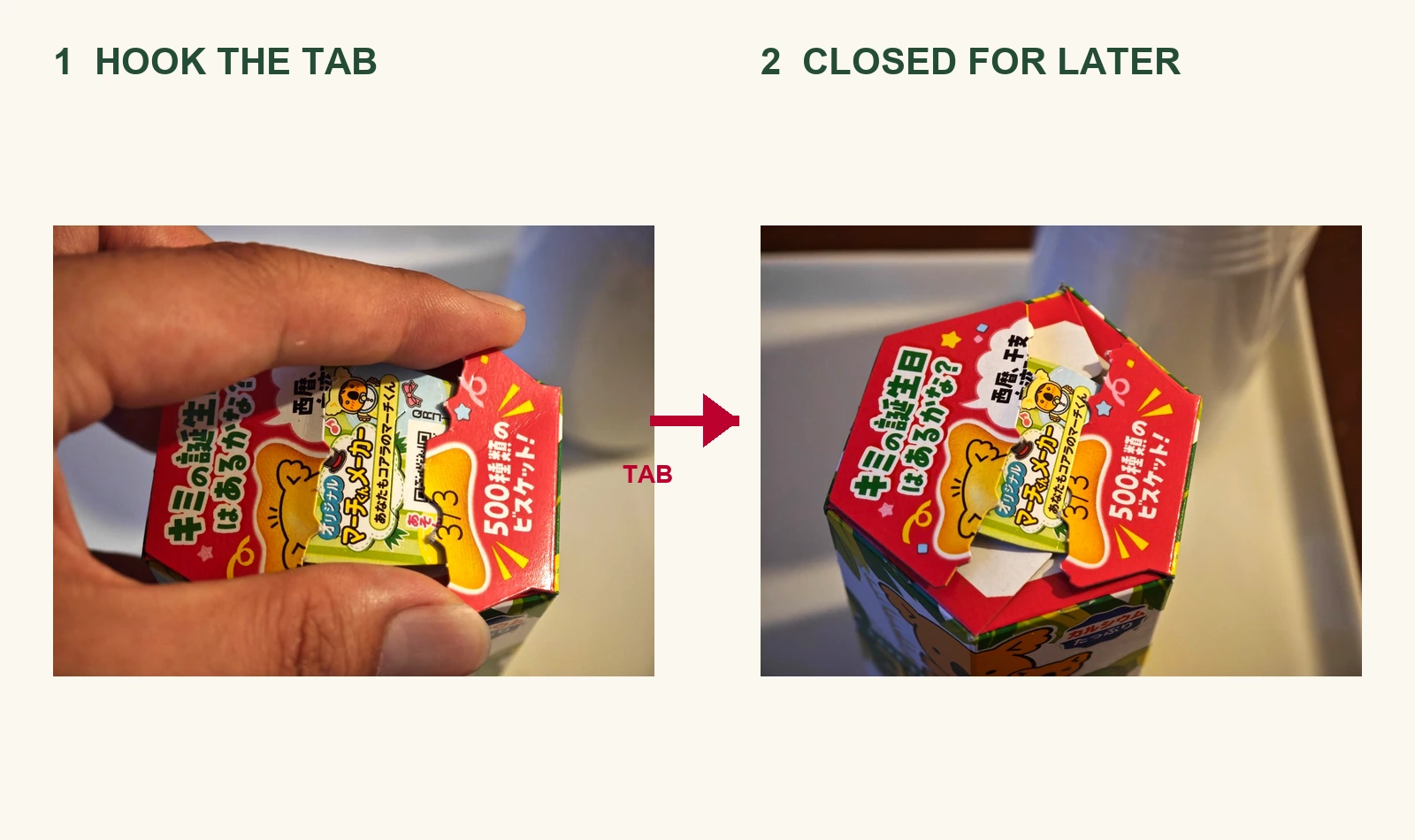
Openings, tabs, games, messages, and hidden answers deserve a guide of their own. A future Nippon Snacks article will explore why Japanese snack packages are designed to be played with, not merely discarded.
The 48g box: 252 calories and 240mg of calcium
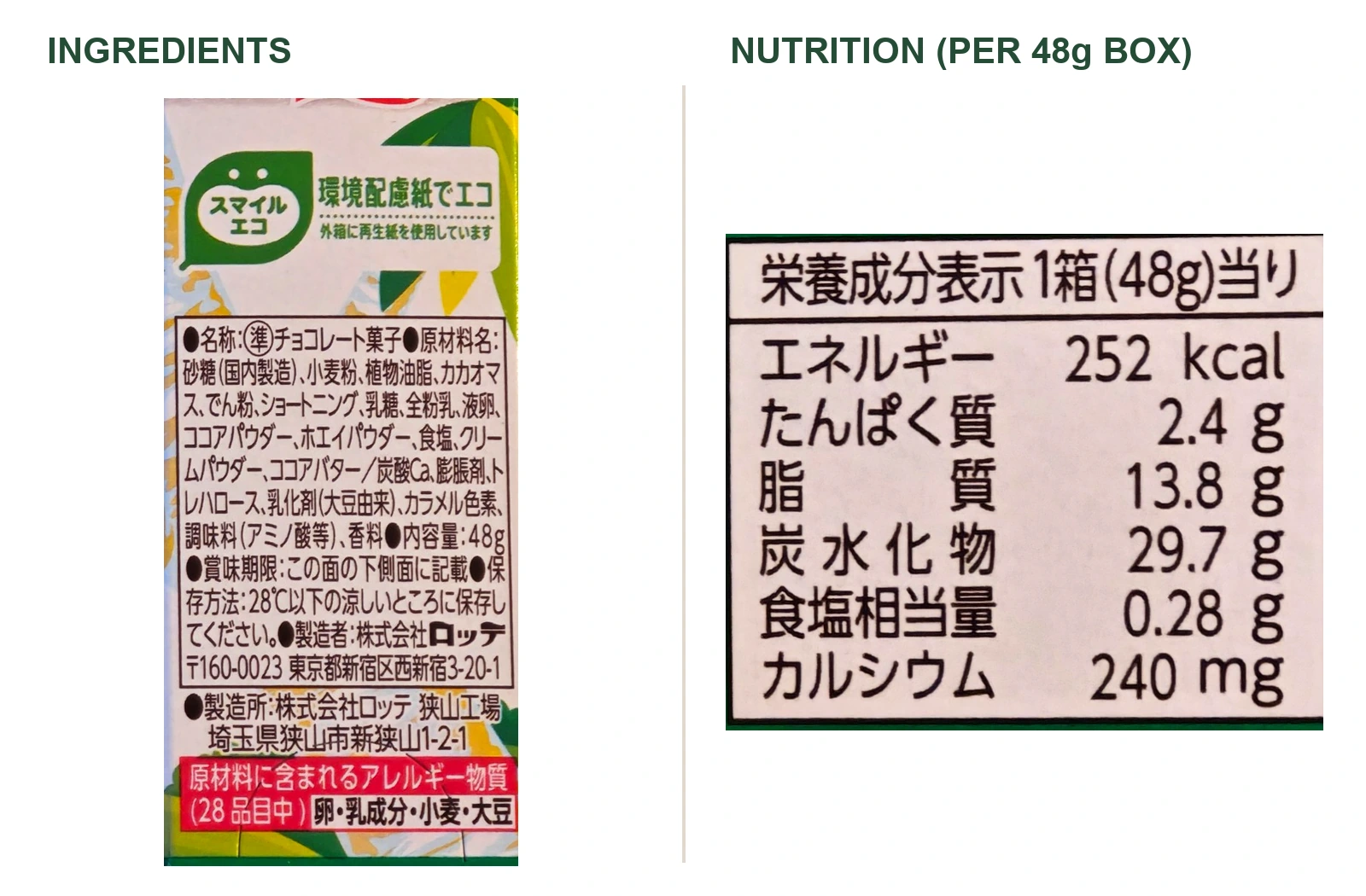
The photographed chocolate box lists:
- 252 kcal
- 2.4g protein
- 13.8g fat
- 29.7g carbohydrate
- 0.28g salt equivalent
- 240mg calcium
Its ingredients include calcium carbonate, alongside wheat flour, cocoa mass, milk ingredients, egg, cocoa powder, and cocoa butter. The marked allergens are egg, milk, wheat, and soy.
Why does it contain so much calcium?
The immediate answer is that calcium is intentionally added as calcium carbonate; the 240mg does not come only from the milk and chocolate ingredients. Lotte makes “calcium-rich” one of the product’s headline features.
Koala’s March was originally developed as a child-oriented product, so the calcium positioning fits its family-snack identity. However, I found no official statement saying, “We add calcium because children eat it.” The precise reason for choosing calcium has not been publicly explained in the sources checked. The defensible conclusion is therefore simple: it is deliberate nutritional fortification within a child-focused brand.
Lotte official product page — “カルシウムたっぷり” (“calcium-rich”); the same page lists calcium carbonate and 240mg per 48g box. J-Net21’s Lotte case study reports that Lotte was planning a child-oriented product when Koala’s March was developed.
The 2026 box turns your profile into a biscuit hunt
The two pieces in this photo carry different calendar information. In March 2026, Lotte launched “366 Days Happy Birthday March”, a campaign built around birthdays, years, zodiac signs, and blood types.
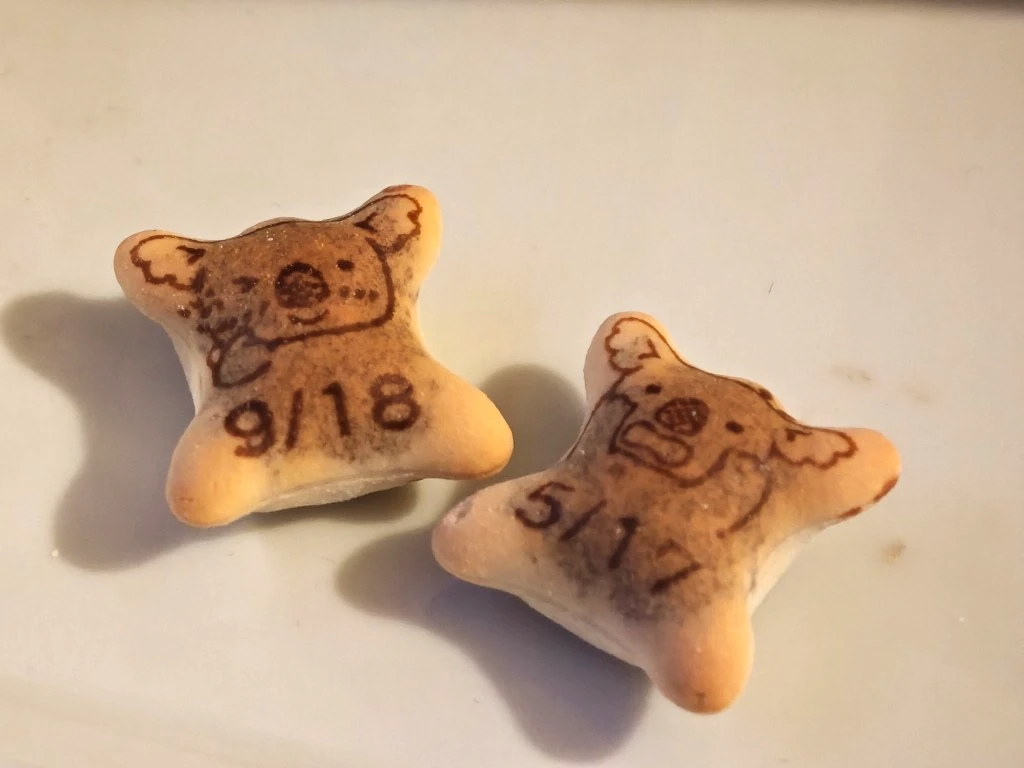
The campaign contains 500 profile prints. Lotte says combining year, birthday, and blood type creates about 170,000 possible profiles, turning a box into a search for yourself, your family, a friend, or a favorite celebrity.
Lotte official 2026 announcement — “絵柄は全500種類” (“500 prints in total”) and “組み合わせは…約17万通り” (“about 170,000 combinations”).
This follows the 2024 campaign that printed 500 names on biscuits. The product can create a new social game by changing the print and carton while keeping the fundamental biscuit format recognizable.
One number needs clarification:
- 500 — prints in the photographed 2026 profile campaign
- 365 — designs in Lotte’s current online character catalog
- 700+ — character designs created across the brand’s longer history, according to earlier official brand material
These numbers are not necessarily contradictions. They count different campaigns, catalogs, and historical totals.
Inside the koala: chocolate, shell, and deliberate air
I asked one koala to sacrifice itself for the cross-section.
The result shows that chocolate does not soak through the entire biscuit. A layer of air remains between parts of the filling and shell. That does not automatically mean the chocolate was “skimped.” Koala’s March is made as a hollow biscuit with injected chocolate, and the cavity is part of the structure you feel.
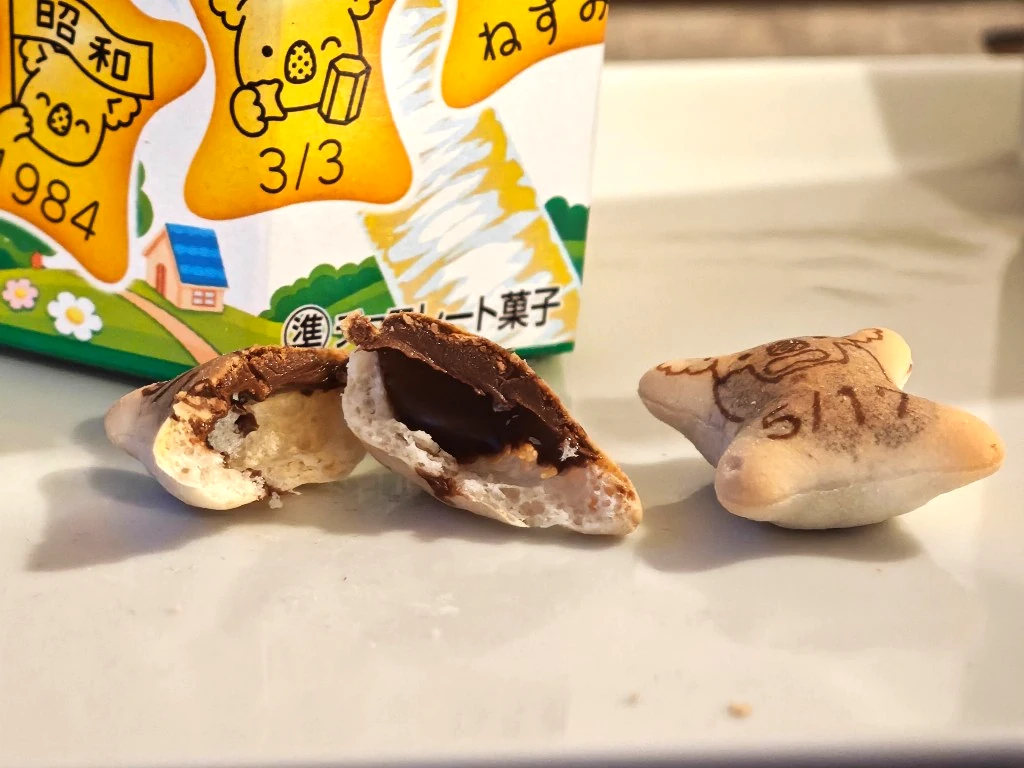
The shell breaks first with a dry, light snap. Then the chocolate arrives from inside. Filling every microscopic space would change that contrast and could make the piece feel heavier and more uniform.
A bite makes the separation easier to see:
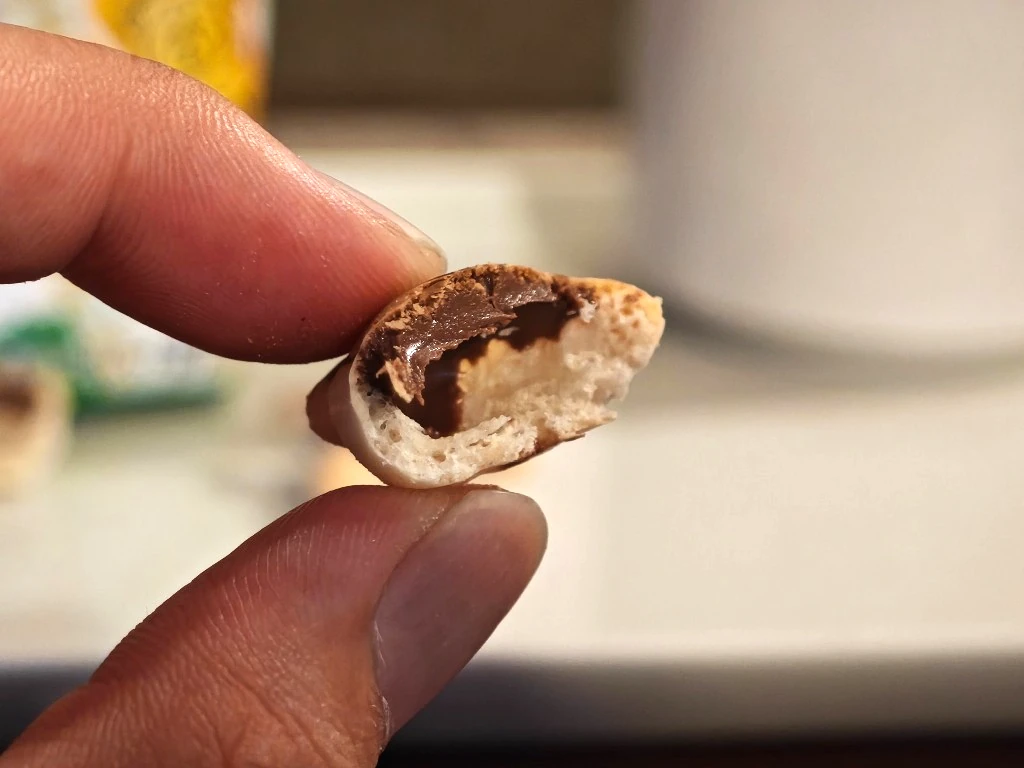
I also tried to produce a perfect knife-cut cross-section. The koala did not cooperate. The brittle shell fractured, the chocolate dragged, and the result looked less like food science and more like an apology.
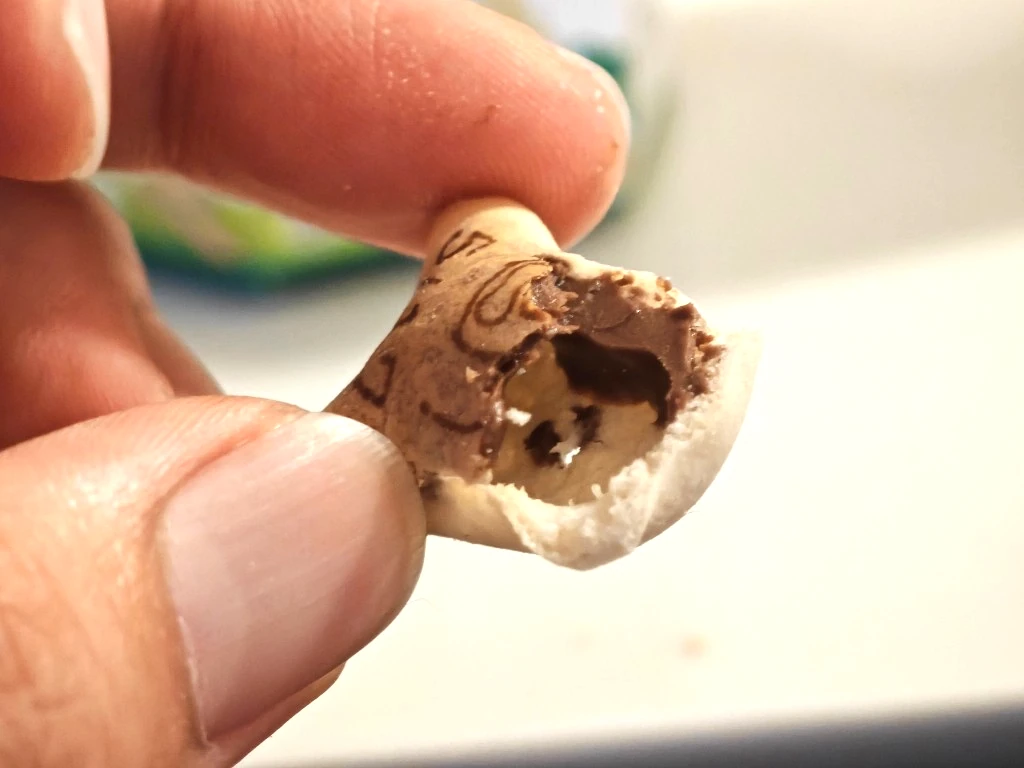
That failure is useful evidence of the texture: this is a fragile hollow biscuit, not a dense cookie waiting to be sliced neatly.
The small hole on the back is where the chocolate enters
Turn a piece over and you may find a small hole. Lotte’s official factory tour explains the process: a machine resembling a thick injection needle makes a hole in the biscuit’s back while filling it with chocolate.
Lotte official factory tour — “ビスケットのうらがわにあなをあけながらチョコを入れます” (“chocolate is inserted while a hole is made in the back of the biscuit”).
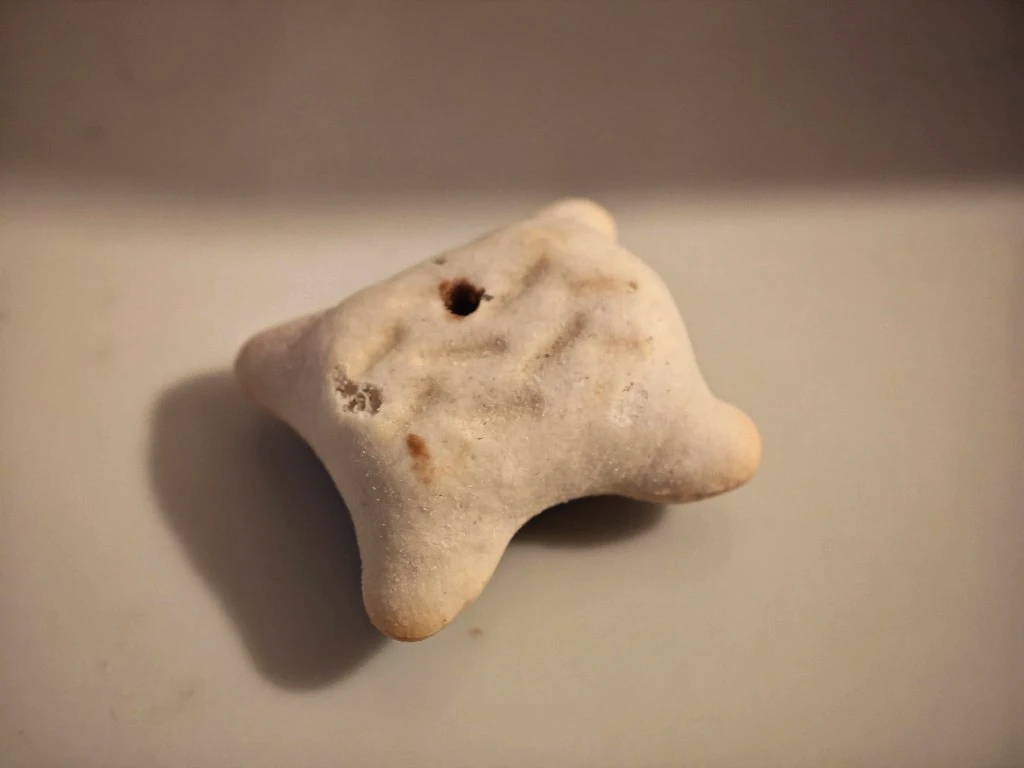
It is a tiny manufacturing signature hiding behind every printed face.
A chocolate biscuit that behaves better in summer
Enclosing the chocolate has a practical advantage: the outside stays biscuit-dry, so the snack is less likely to coat your fingers than exposed chocolate. Historical accounts of the product also connect the hollow injection technology with developing a chocolate snack that could keep selling through summer.
But “summer-friendly” does not mean heat-proof. The photographed package says to store it in a cool place below 28°C. A closed shell helps with handling; it does not repeal the melting point of chocolate.
Walkerplus interview with Lotte’s product team — the representative describes the benefit as chocolate staying inside the biscuit and not getting on children’s hands in summer. The below-28°C limit comes from the photographed package.
Within that limit, Koala’s March is an excellent warm-weather chocolate biscuit: crisp outside, chocolate inside, and comparatively tidy to share.
My tasting notes: a dry, almost ceramic snap
The first texture is very crisp, but “cookie-like” does not describe it completely. To me, the pale shell has a dry, airy break that almost resembles a tiny piece of edible ceramic—light, brittle, and hollow rather than buttery or crumbly.
Then the chocolate softens the experience. The unused air inside is not wasted space to my tongue; it is a texture chamber. The shell can fracture inward before chocolate fills the bite.
The pieces I tried were consistent in shape and texture. Koala’s March therefore offers less unit-to-unit mouthfeel variation than Choco Anpan. The playful “hit” is more likely to come from the print: a date you recognize, a character you love, or perhaps an unusual printing shift. I did not find an actual print defect in this box, so that last possibility remains a collector’s fantasy rather than a promised rarity.
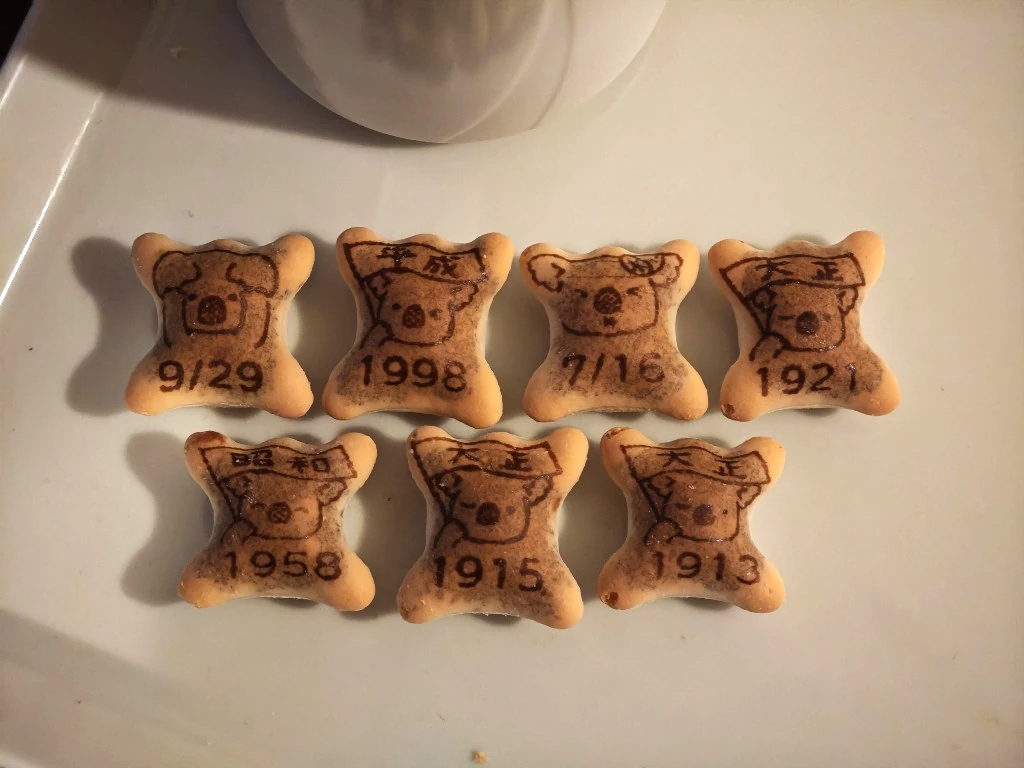
Why Koala’s March is fascinating with Vacuum Bite
Koala’s March also works with my Vacuum Bite method. Bite or position a safely controlled piece, use only gentle suction, and never inhale it.
The interesting moment is the collapse: the dry hollow shell loses its architecture, the cavity closes, and biscuit and chocolate merge in a sequence that ordinary chewing passes through too quickly.
Because this is a small hard-edged biscuit, follow the safety guidance in the full Vacuum Bite article. Children should not try the method, and anyone who cannot control the piece safely should simply enjoy the normal crunch.
The share pack turns the snack into a message
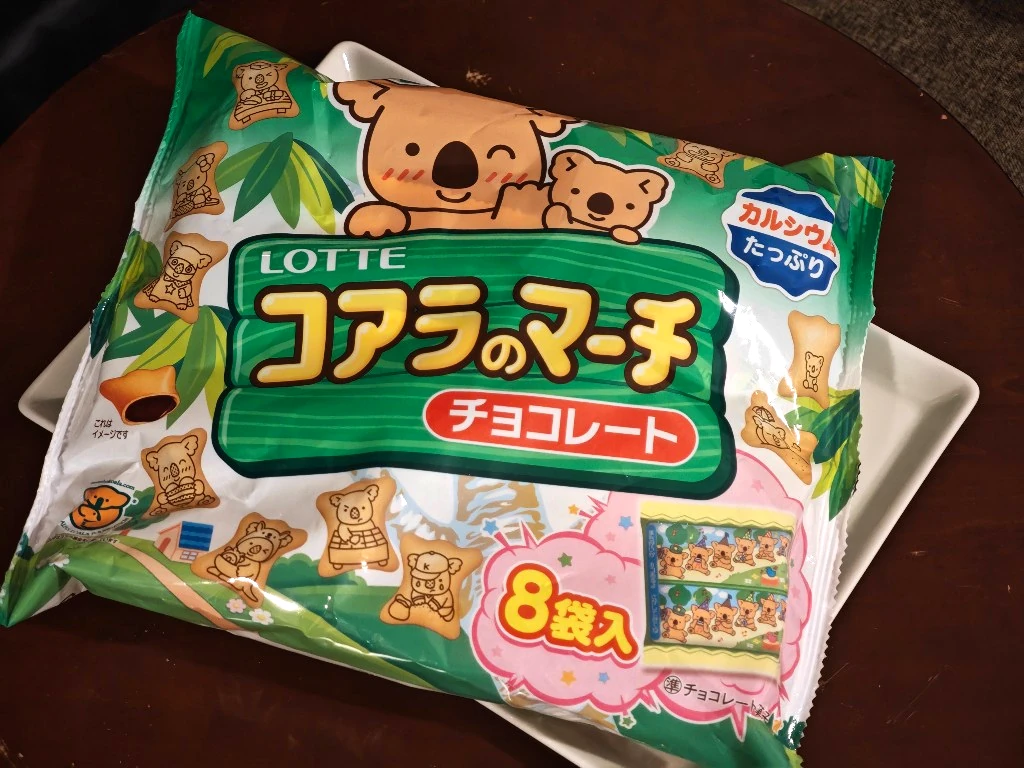
The larger Koala’s March Share Pack contains eight individual 12g bags.
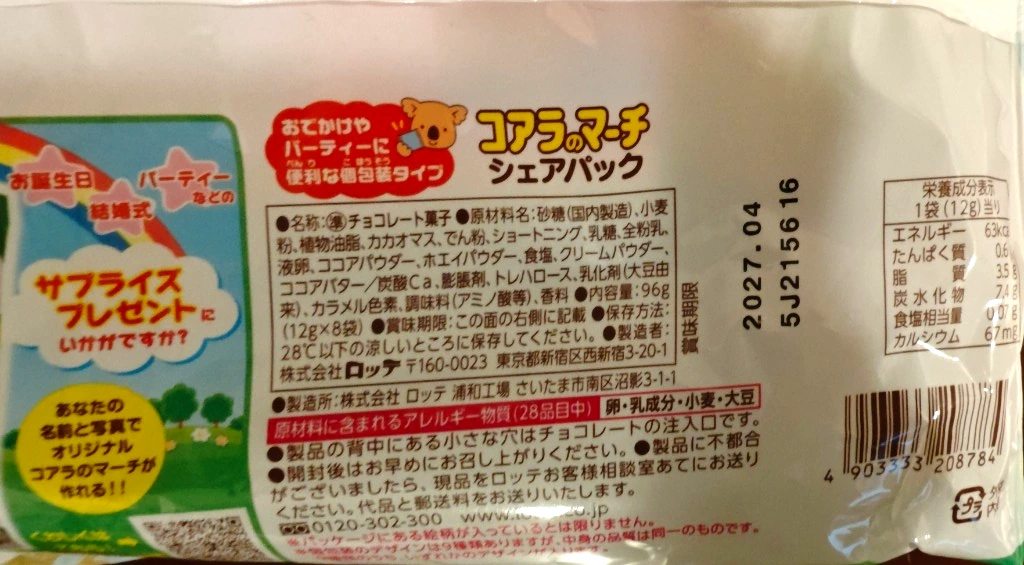
The photographed label lists 63 kcal and 67mg calcium per 12g bag. It also carries the same egg, milk, wheat, and soy allergen warning.
Lotte official Share Pack page — content is listed as 12g × 8 bags, with 63 kcal and 67mg calcium per bag.
Eight small bags make portioning and distribution easy:
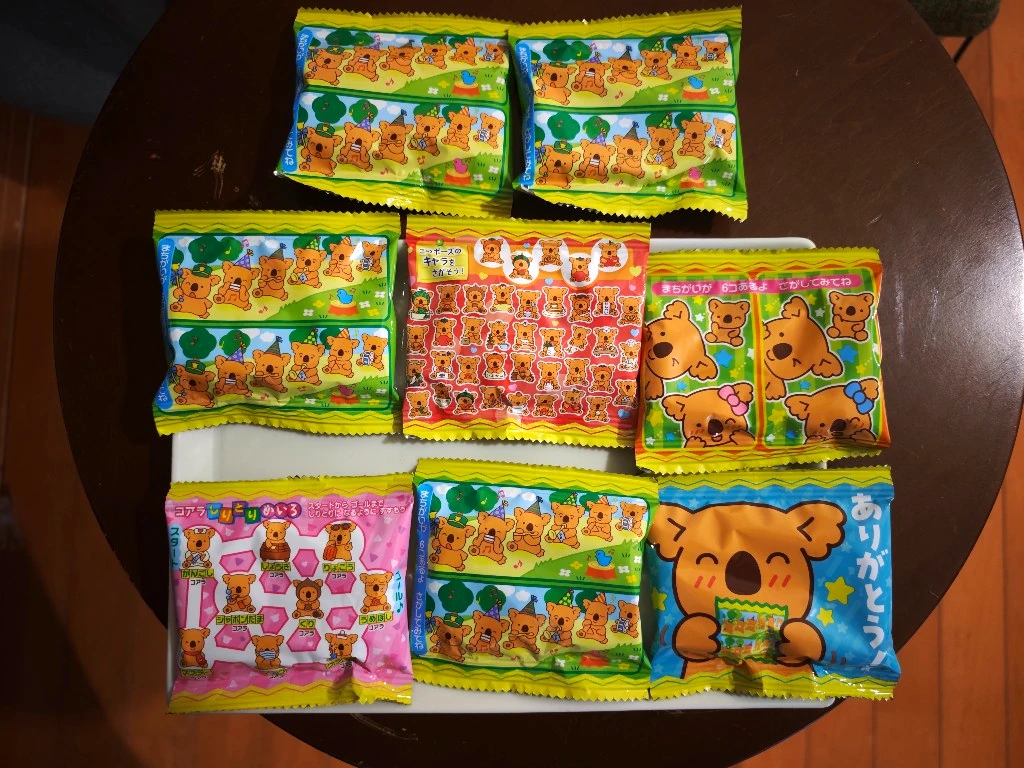
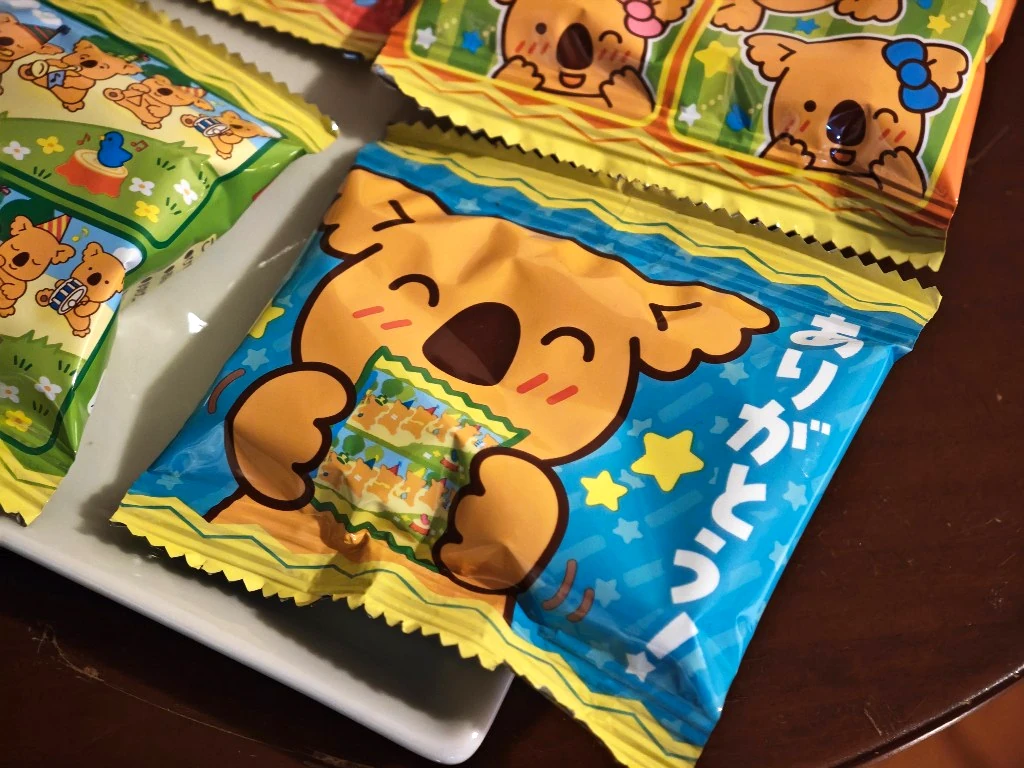
One wrapper says simply ありがとう—“Thank you.” This is a recurring pleasure in Japanese family packs. The individual bag is designed not only to preserve food but to travel from one person to another. Kit Kat and other brands also use writable or message-bearing wrappers for the same social moment.
Another wrapper contains the answer to a spot-the-difference game. The snack can keep a child looking, comparing, and talking after the main outer bag is open.
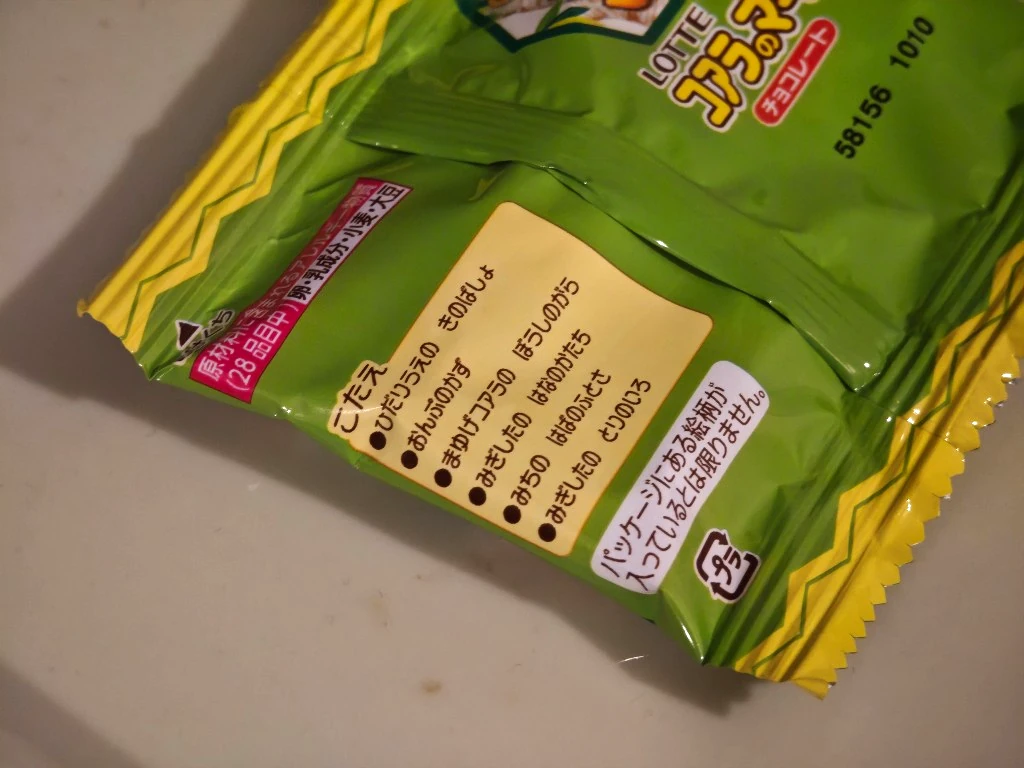
The exact games and wrappers can change by production run. That changeability is the point: packaging gives a stable snack a fresh conversation.
Flavors worth looking for
Koala’s March is a format as much as one flavor. Lotte can change the chocolate, biscuit, print, and package while preserving the recognizable hollow koala.
Official listings checked in August 2026 included:
- Chocolate — the classic photographed here
- Strawberry — strawberry-flavored filling
- Whole Grain in Uma-Bisu — whole-grain flour, hazelnut, and cinnamon in the biscuit with moderately sweet chocolate
- Fantasy Soda — a purple biscuit with blue soda-flavored chocolate, launched July 7, 2026
The 2026 birthday campaign also introduced a Happy Happy Shortcake edition using a cream-containing biscuit and strawberry-flavored chocolate. Limited products may disappear even while their idea survives in the next seasonal package.
For the current range, use Lotte’s official Koala’s March product list.
Flavor names and specifications above were checked against Lotte’s official product catalog on August 7, 2026; limited products and package designs can change.
Where to buy Koala’s March
In Japan, the standard box is widely sold through convenience stores, supermarket snack hooks, drugstores, and snack retailers. Share packs are more common in larger stores. Stock, package art, and campaign prints rotate.
For US readers, exact Amazon.com listings exist but stock and country-of-origin details rotate. Start with Lotte’s US store locator or an in-stock US retailer; use Amazon Japan only after the exact offer confirms delivery to your address.
- Official: Koala’s March Chocolate
- US route: Koala’s March store locator
- Japan / eligibility-checked fallback: Koala’s March Chocolate 48g × 10 on Amazon Japan
- Rakuten Ichiba (Japan): Koala’s March carton multipack
Check the item label you receive, especially when ordering a specific campaign, flavor, or print set.
Affiliate disclosure: links above may be affiliate links. If you buy through them, I may earn a commission at no extra cost to you.
Frequently Asked Questions
Why is the Koala’s March box hexagonal?
Lotte says the six-sided package evokes a eucalyptus tree. The shape is part of the koala world, not merely a structural carton choice.
Are there 365 or 500 koala designs?
Both numbers can be correct in different contexts. Lotte’s current character catalog lists 365 designs. The photographed 2026 birthday-profile campaign contains 500 prints built from dates, years, zodiac signs, and blood types.
Is the empty space inside a sign of too little chocolate?
Not by itself. Koala’s March uses a hollow biscuit injected with chocolate through the back. The cavity helps create the shell-versus-filling contrast, although filling amount can naturally vary slightly in manufacturing.
Can I eat Koala’s March in summer?
The enclosed filling is tidier than exposed chocolate, making it convenient in warm weather. It is not heat-proof: follow the package instruction to store it below 28°C.