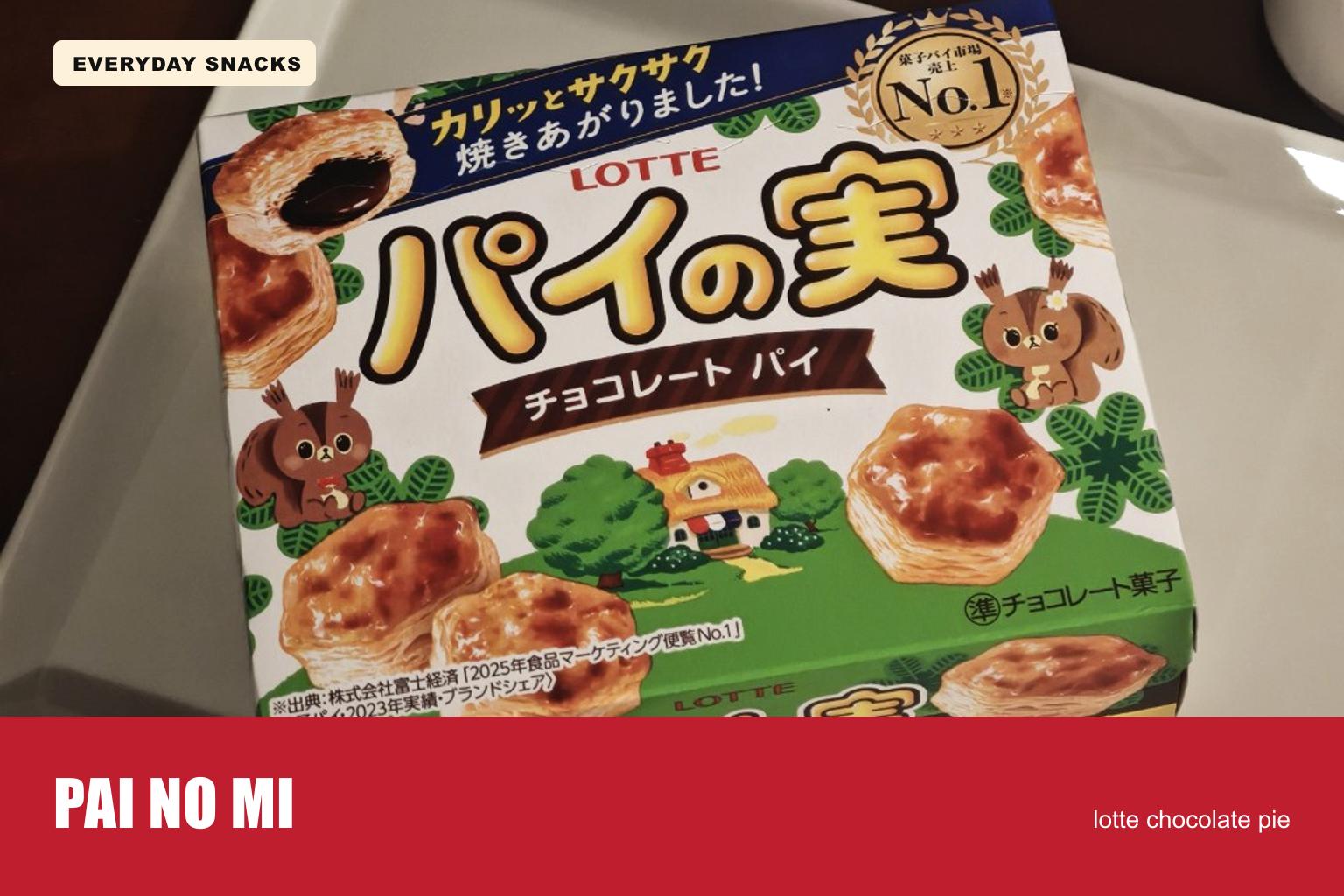
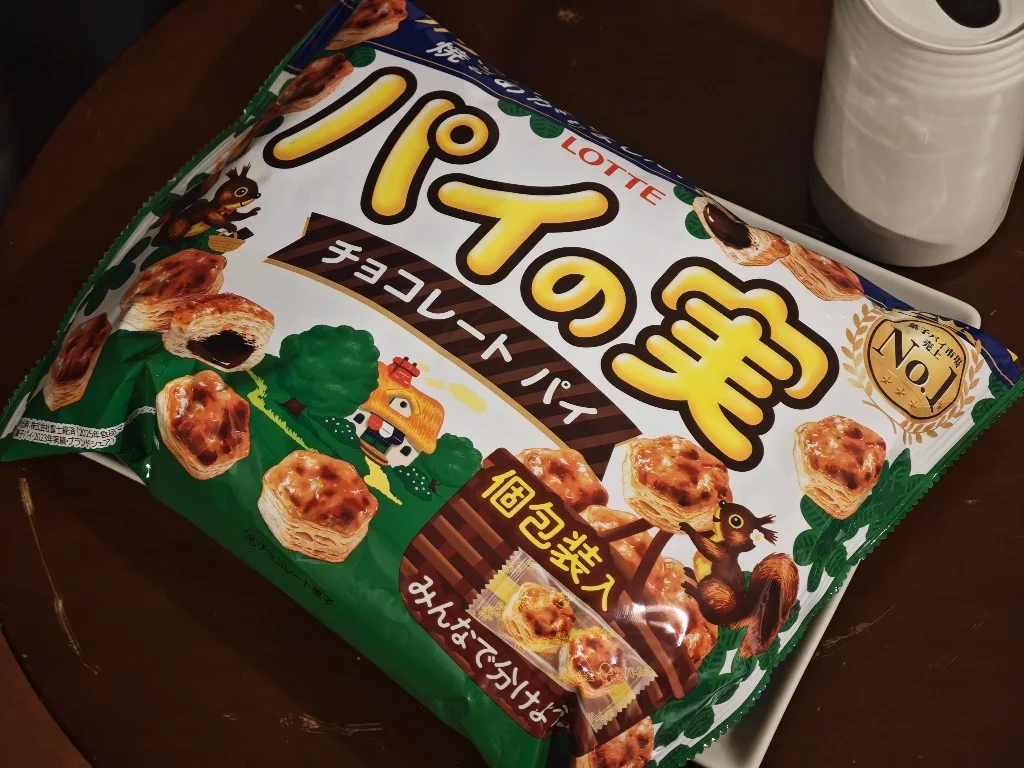
Pai no Mi looks like a small forest souvenir: squirrels, clover, a cottage, and glossy hexagonal pies. Eat one piece and the story changes. The first hit is pastry—thin layers that shatter—and only then does soft chocolate catch up.
That sequence is deliberate. Lotte builds the snack as folded pastry first, chocolate second, then wraps the result in packaging that still wants to be opened carefully, closed halfway, and read on the underside of the lid.
Quick guide: Tear along the marked perforation. Notice the glossy top, then the flaky layers, then the chocolate. Split a piece horizontally if you want two textures. Share packs use individual wrappers (kohousou). Store below 28°C.
What is Pai no Mi?
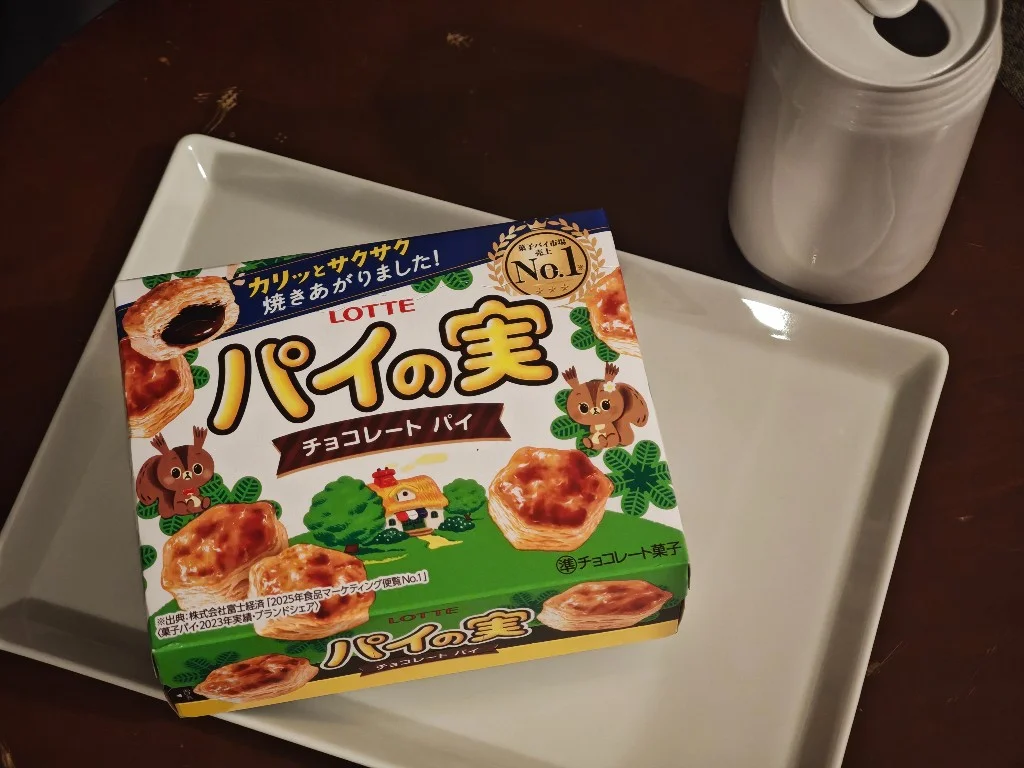
Pai no Mi (パイの実, often written “Pie no Mi” in older English mentions) is Lotte’s long-running chocolate pie snack: a bite-size hexagon of laminated puff pastry with chocolate sealed inside.
Lotte launched it in September 1979, when “pie” in Japan still felt closer to a specialty bakery purchase than a convenience-store habit. The company wanted bakery-style layered pastry in an everyday chocolate format. Engineers brought in laminated-pastry equipment after seeing overseas machines, then spent the hard years learning how to bake many thin layers high without collapsing them—and how to inject chocolate afterward without crushing the shell.
Lotte “Shall we Lotte” pastry feature and PR TIMES STORY brand history.
Why “fruit of the pie”?
The name is not a fruit filling. A Lotte designer tasting early prototypes remembered childhood magazine images of the tropical breadfruit tree (パンノキ), whose fruit is said to smell bread-like when cooked. The designer sketched a dream forest where pies grow like fruit—and the product became Pai no Mi.
That fantasy still drives the package: squirrels, trees, cottages, and a picture-book mood that has outlived many redesign cycles.
Lotte brand hub — Pai no Mi history.
Who is Lotte?
For overseas readers, Lotte is one of Japan’s major confectionery houses—chocolate, gum, biscuits, ice cream, and character snacks such as Koala’s March. The photographed Pai no Mi carton lists Lotte Co., Ltd. in Shinjuku, Tokyo. The brand’s English-facing identity is still “the lover of your mouth” (お口の恋人), a line you will see across Lotte sites.
Pai no Mi is a national everyday snack, not a prefecture souvenir. Even though the manufacturer is based in Tokyo, Nippon Snacks keeps Everyday profiles free of `region` tags unless the product itself is sold as local specialty.
Official brand entry point: lotte.co.jp/products/brand/painomi/.
How the package wants to be opened
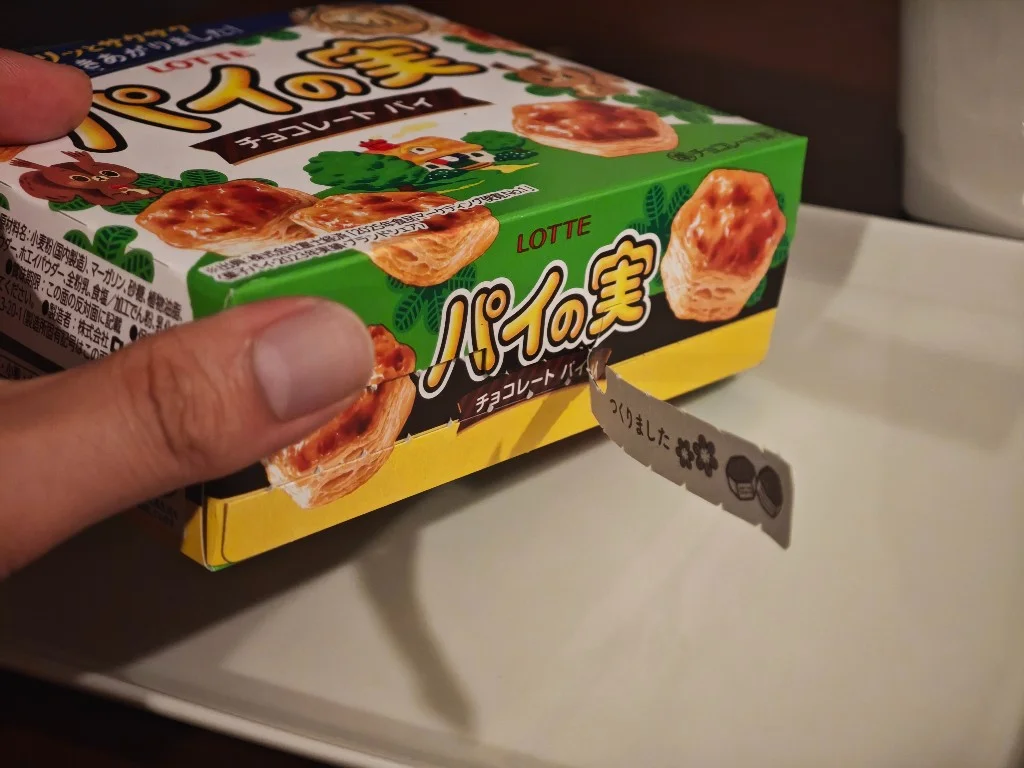
The carton does not ask you to rip randomly. A perforated strip (piripiri) marks the intended tear. On this box, peeling that strip reveals a small inner message—つくりました (“we made it”) with tiny pie icons—exactly the kind of Lotte micro-detail that rewards slow hands.
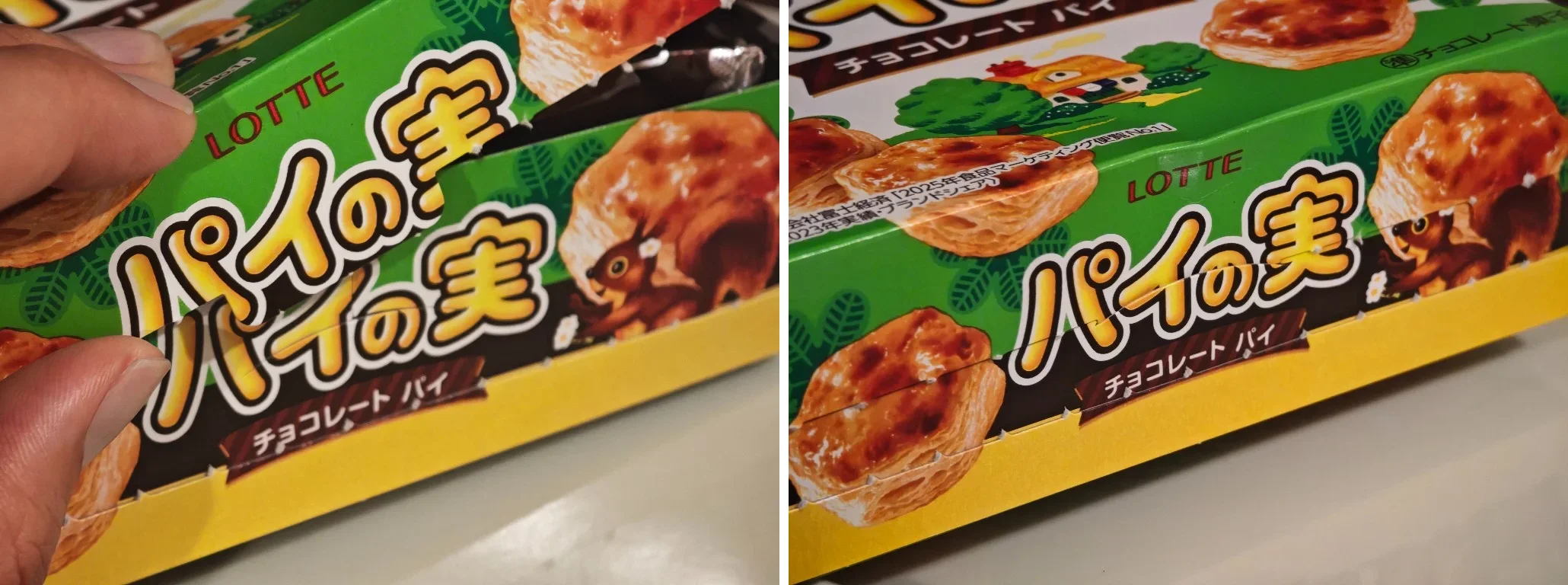
Like Koala’s March, the carton is also designed to pause. A small claw/tab lets you stop mid-box instead of leaving a torn mouth that spills crumbs. Lotte packaging often feels over-specified for a ¥200 snack—and that is the charm.
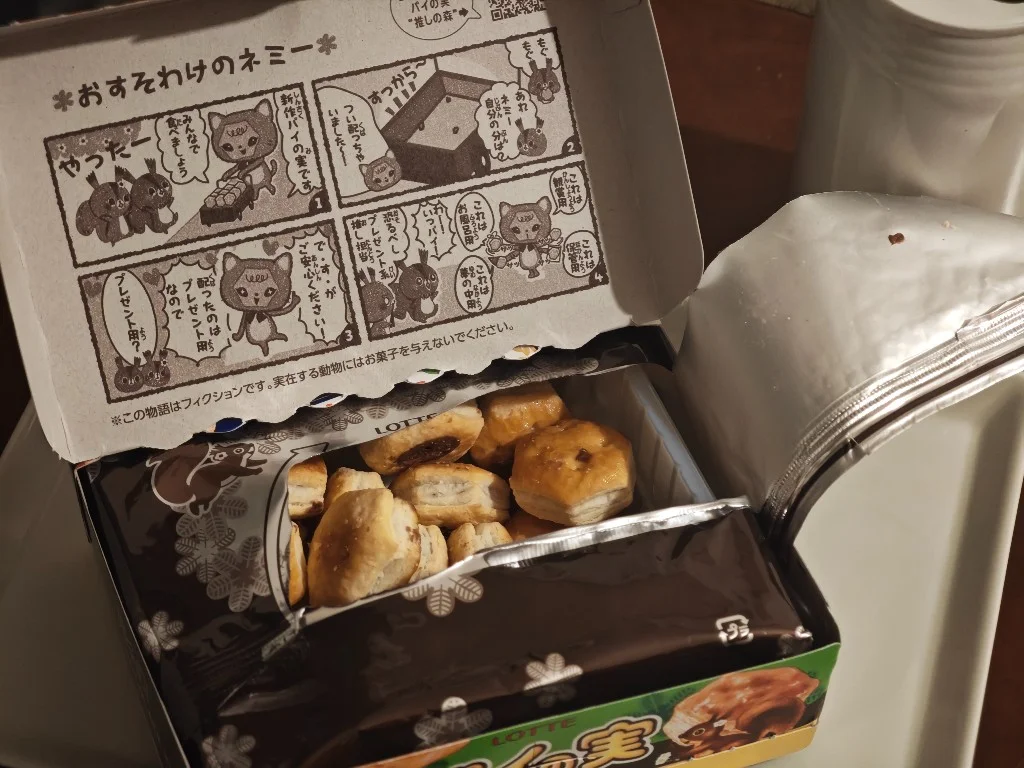
Open fully and the forest continues inside. On this production run, the underside of the lid carried a short comic strip. Package art changes by era and campaign; some boxes emphasize picture-book scenes, games, or seasonal characters. Treat the lid as content, not waste cardboard.
Labels: 73g, 395 kcal, quasi-chocolate
The photographed box lists:
- Category: 準チョコレート菓子 (quasi-chocolate confection)
- Net weight: 73g
- Energy: 395 kcal per box
- Protein: 3.9g · Fat: 22.6g · Carbohydrate: 43.9g · Salt equivalent: 0.5g
- Allergens marked: milk, wheat, soy (shared equipment with egg products)
- Storage: cool place below 28°C
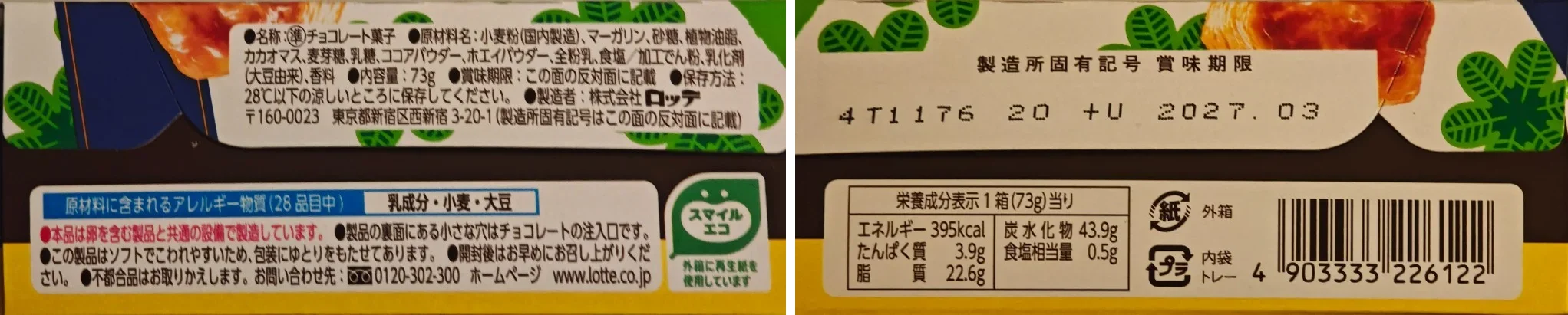
The label calls this jun-chokorēto kashi (準チョコレート菓子), or quasi-chocolate confectionery. That category describes the finished snack under Japanese labeling rules; it is not a quality score.
Inside the hexagon: 64 layers and injected chocolate
Lotte’s process story is unusually concrete:
- Dough rests, then margarine is laminated in.
- Folding continues until about 64 layers.
- Pieces are cut into hexagons; four holes vent steam so the pastry rises evenly instead of ballooning.
- A thin maltose glaze goes on before baking—the glossy, extra-crisp top many people assume is butter or egg wash.
- A long oven bake sets the layers.
- Chocolate is injected with a thick needle-like tool, then cooled to a pastry-friendly firmness.
Lotte manufacturing feature. The same pages explain why hexagons were chosen: close enough to a circle for even lift, while wasting less dough than round cutters.
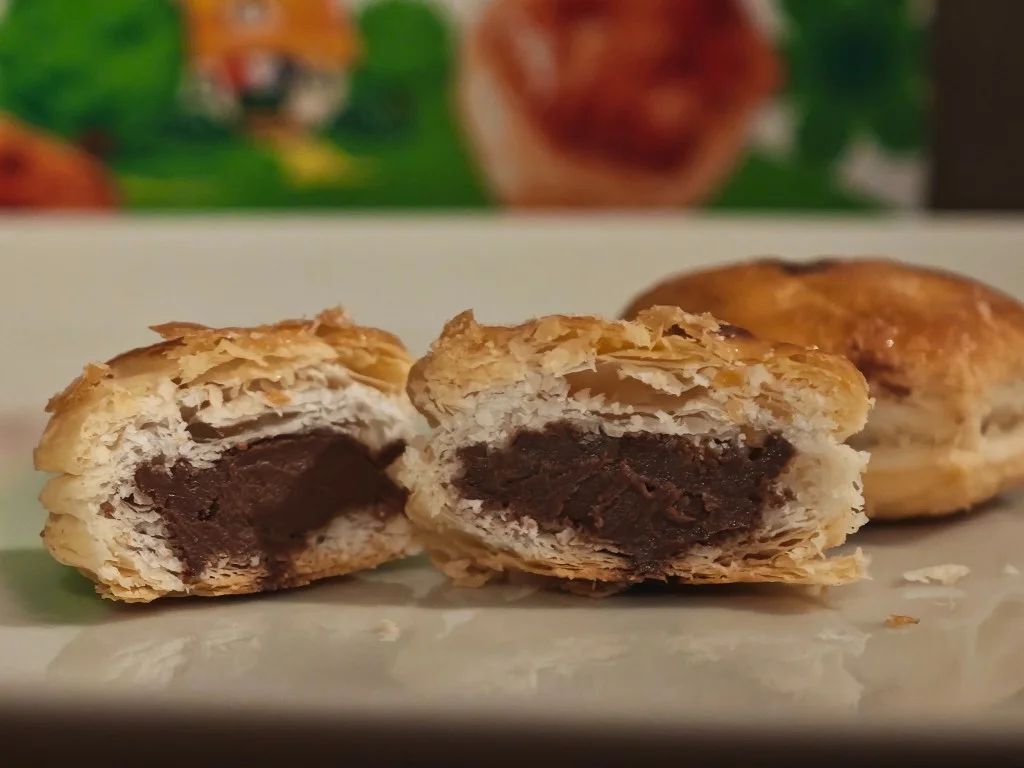
A clean cross-section shows the design: dark chocolate occupying the center, pale flaky layers around it, toasted top crust outside.
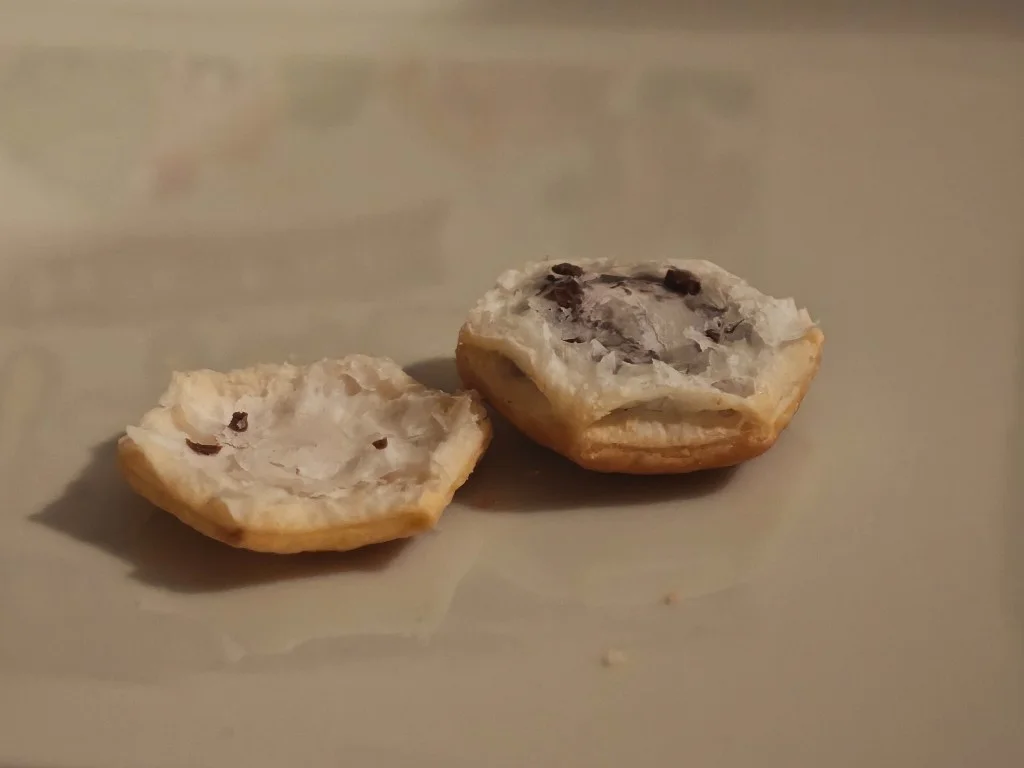
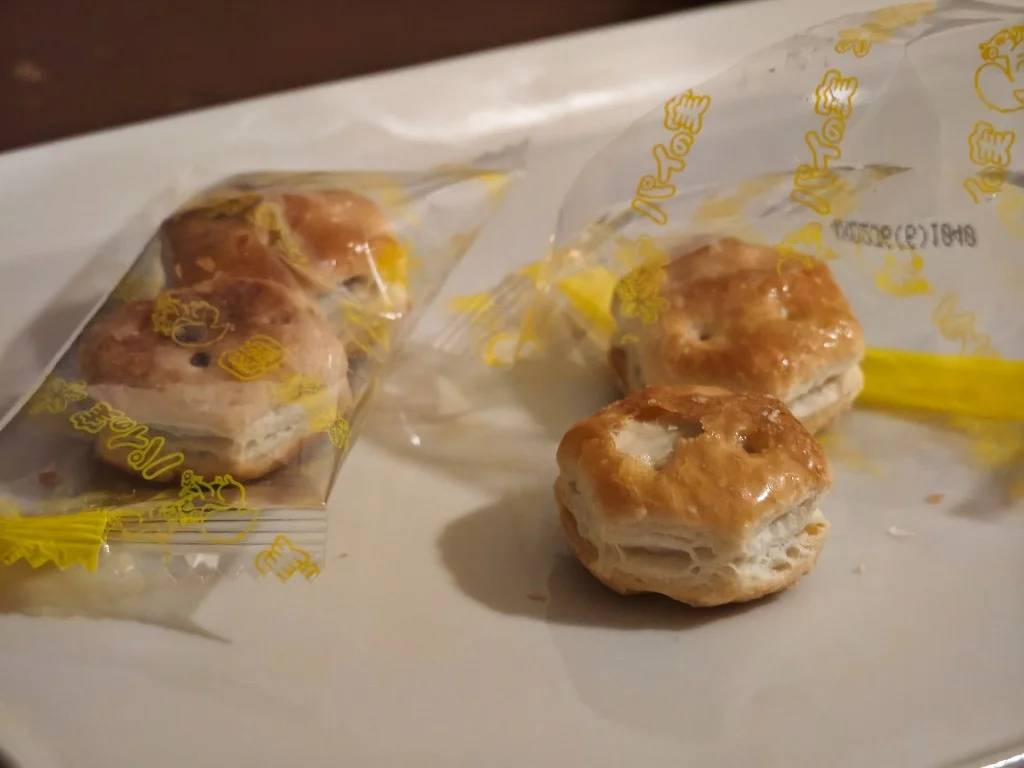
Because the pastry is laminated, you can sometimes split a piece along the layers and open it like a tiny book. The chocolate stays as a soft island; the sheets separate more cleanly than a dense cookie would.
Share packs and kohousou
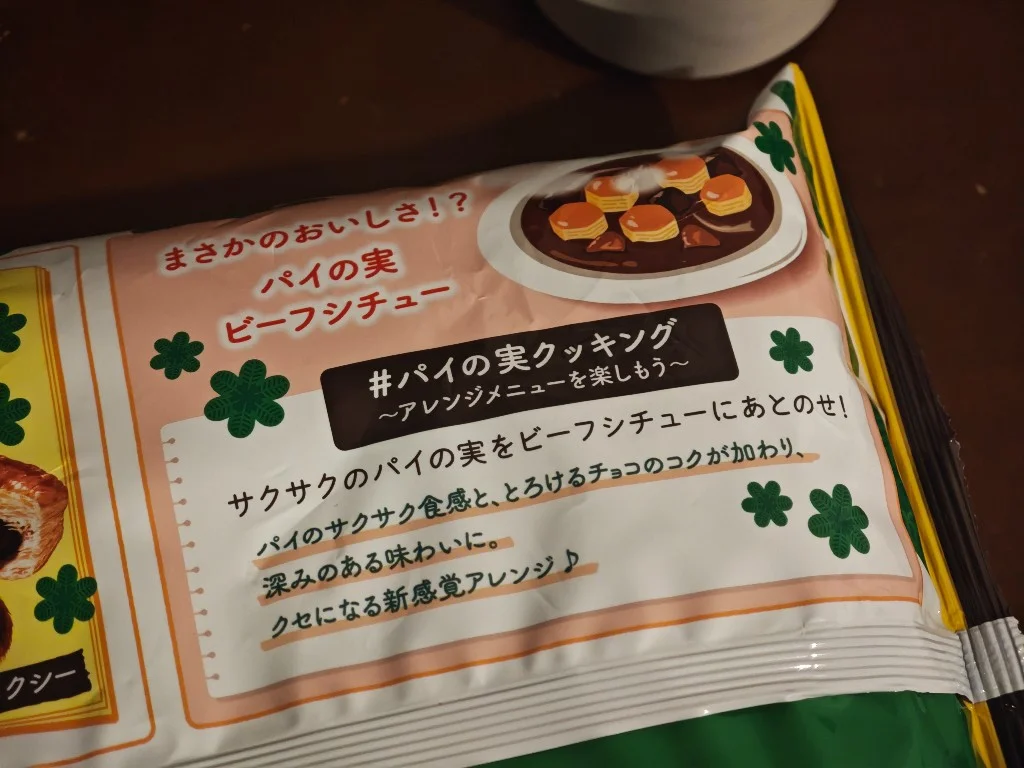
The larger bag—often sold as a share / family format—keeps the same forest branding at a different scale. The back of the photographed pack carried an arrange tip: finish beef stew with Pai no Mi on top. Official recipe calendars also wander into gratin, pinchos, and dessert plays. Pastry-plus-savory is not as strange as it sounds once you taste the toasted layers.
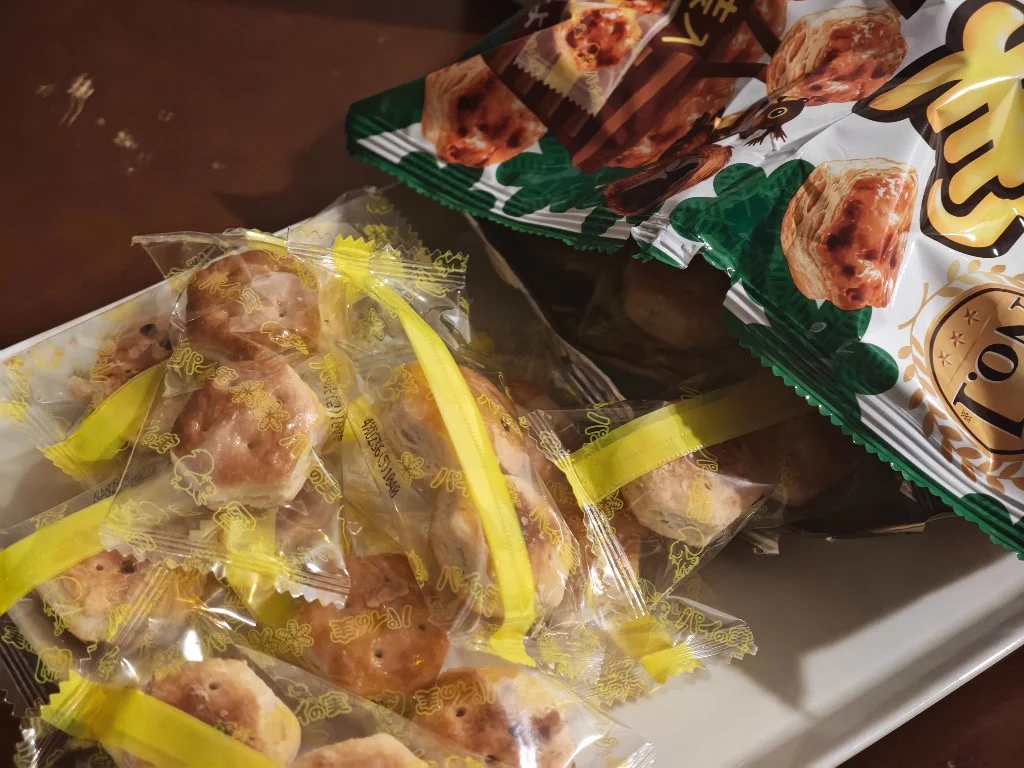
Open the bag and you get **個包装 (kohousou)**—small clear wrappers, often holding one or two pies. That is how the format supports parties, desk drawers, and “just two more” stops without exposing the whole bag.
Flavors and how the brand evolves
Classic chocolate remains the identity. Around the 40th anniversary (2019), Lotte pushed pastry aroma harder and confirmed a second permanent pillar: Deep Chocolate (深みショコラ)—cocoa-leaning pastry with a deeper cacao filling.
From the 2000s onward, limited and seasonal flavors became a regular brand tool: fruit, matcha, caramel-leaning, and occasional regional or airport editions appear and disappear. Treat the flavor wall as a rotating catalog, not a fixed menu. For the live lineup, use Lotte’s Pai no Mi brand page.
PR TIMES STORY history on the shift from mostly one SKU to planned flavor rotations after 2001, and Deep Chocolate in 2019.
My tasting notes
The first pleasure is the top crust. Officially it is a maltose glaze, not butter or egg, but the mouthfeel is that sharp, glassy pastry snap—pieces that crackle and almost pop as the layers collapse.
Then the chocolate arrives soft. Because it is sealed inside, the outside stays pastry-dry; in warm weather this feels tidier than a naked chocolate piece, though the carton still says below 28°C. Splitting a pie top-and-bottom makes a two-act bite: pure shatter first, then chocolate-and-pastry mixing slowly on the tongue. Milk would suit that contrast.
I also tried Vacuum Bite because the structure looks complex enough to compress into something new. The piece mostly flattened. The texture became curious; the flavor did not improve. I do not recommend it as a tasting method—but if you enjoy snack experiments, you already know what kind of reader you are.
Where to buy Pai no Mi
In Japan, the standard carton is easy to find in convenience stores, supermarket snack aisles, drugstores, and snack specialty shops. Share packs and limited flavors show up more often in larger stores and online.
For US readers, exact Amazon.com pages existed in an August 15, 2026 check, but stock was unstable. A US-facing importer showed a current share pack. Amazon Japan is a fallback for shoppers in Japan or buyers who confirm international eligibility for the exact seller.
- Official: Pai no Mi brand page
- US-facing importer: Pai no Mi 124g share pack at Japanese Taste
- Japan / eligibility-checked fallback: Pai no Mi 73g × 10 on Amazon Japan
Check the label on the item you receive. Carton art, lid comics, and limited flavors change often.
Affiliate disclosure: links above may be affiliate links. If you buy through them, I may earn a commission at no extra cost to you.
Frequently Asked Questions
Why is Pai no Mi hexagonal?
Lotte’s process articles say hexagons rise evenly like near-circles while wasting less laminated dough than round cutters—and they look like “fruit.” Both engineering and naming sit in the same shape.
Is the chocolate filling “cheap” because there is pastry around it?
Not as a rule. The product is designed as pastry-plus-chocolate contrast. Lotte also states the filling is a dedicated chocolate tuned to melt and mix with the pastry in the mouth.
Does packaging always include a manga lid?
No. Lid art, games, and messages rotate by campaign and era. The photographed box included a comic; earlier or later runs may differ.
Is Pai no Mi heat-proof?
No. Enclosing chocolate helps with handling, but follow the package: store in a cool place below 28°C.