At first glance, Menbei looks like a round senbei wearing Fukuoka’s favorite flavor. Look closer and that description falls apart—in a useful way.
This is not an ordinary rice cracker dusted with mentaiko powder. Menbei is built from starch with squid, octopus, and real mentaiko kneaded into the cracker. Its own development story begins with the idea of putting mentaiko into a tako senbei, or octopus cracker.
That makes Menbei an unusually good doorway into Japanese snack culture. One package can lead from Hakata mentaiko to modern souvenir design, seafood-cracker manufacturing, the meaning of senbei, and the very contemporary pleasure of menta-mayo.
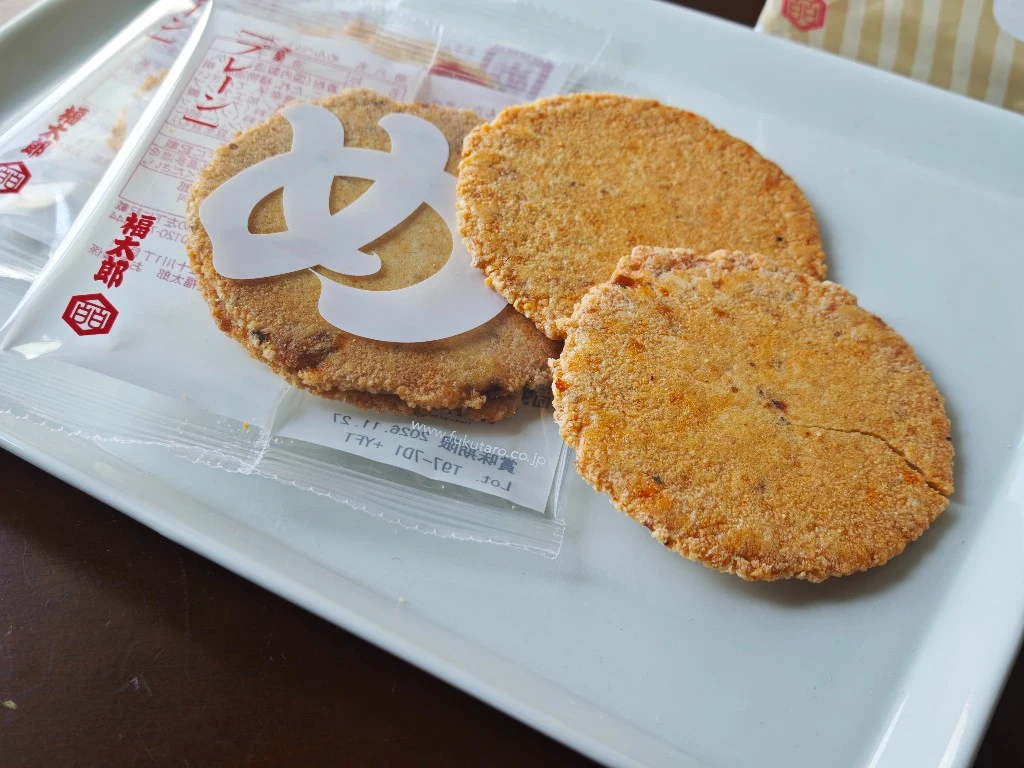
Quick take: Menbei (めんべい) is a Fukuoka seafood senbei launched by Yamaguchi Aburaya Fukutaro in 2001. It combines mentaiko—spicy seasoned pollock roe—with squid and octopus in a thin, firm cracker. Start with Plain to understand the original seafood-and-chili base. Try Mayonnaise Flavor second when you want a tangier, rounder, menta-mayo-like variation.
What is Menbei?
Menbei is the signature shelf-stable souvenir cracker of Yamaguchi Aburaya Fukutaro, a Fukuoka company closely associated with mentaiko.
The name is a compact Japanese wordplay:
- men comes from mentaiko
- bei comes from senbei
Mentaiko is pollock roe seasoned with chili and other flavorings. It is one of Fukuoka’s best-known food identities, but fresh mentaiko normally needs refrigeration. Menbei translates that savory, spicy direction into an individually wrapped cracker that can travel more easily.
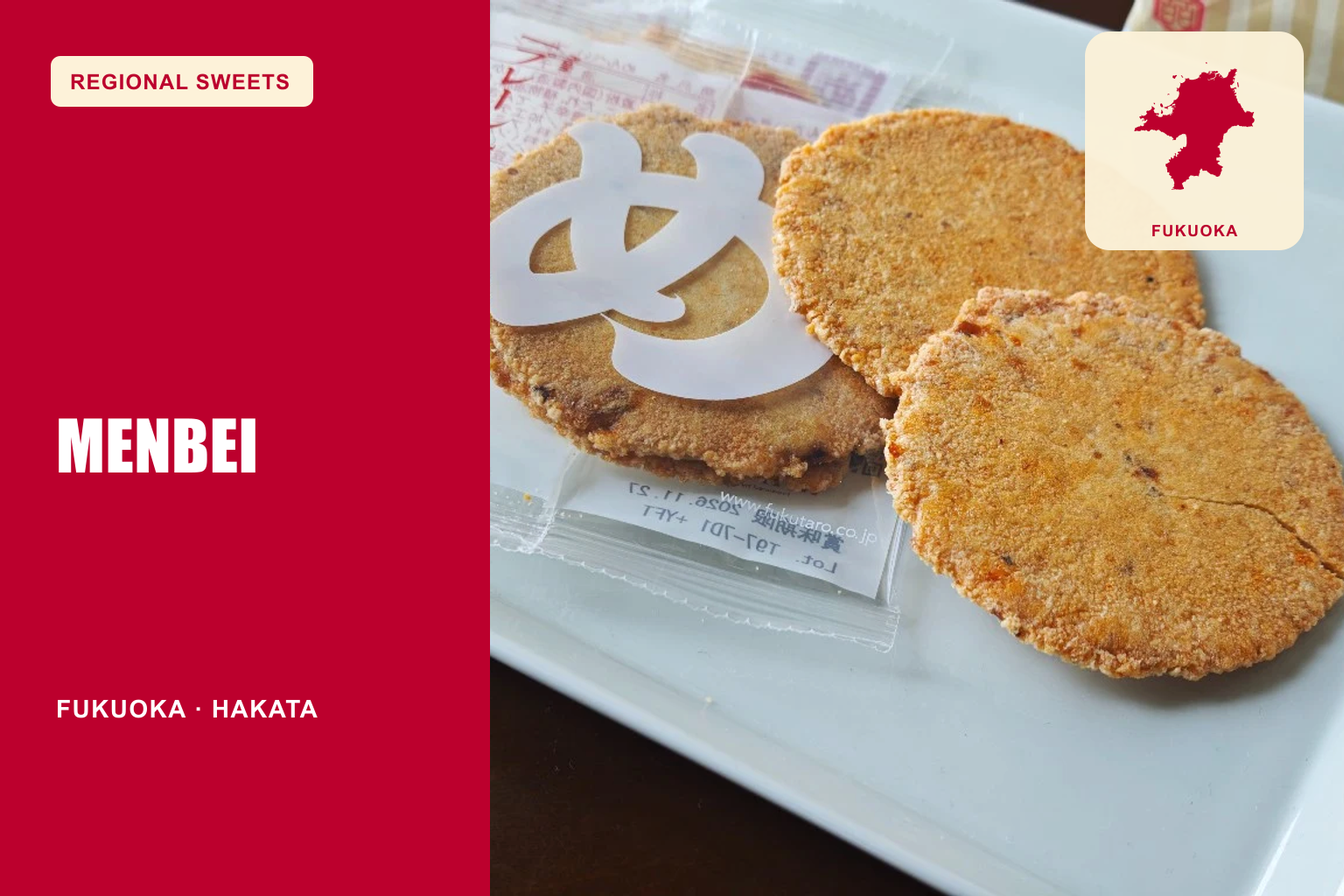
The large white め on the wrapper is only one Japanese character, but it does a surprising amount of branding work. Even travelers who cannot read the full package can learn to recognize that oversized shape in a station souvenir shop.
What comes in the box?
The photographed box shows how Menbei is divided into individual two-cracker packages, making it easy to share among coworkers, friends, or relatives—the social arithmetic behind many Japanese omiyage gifts.
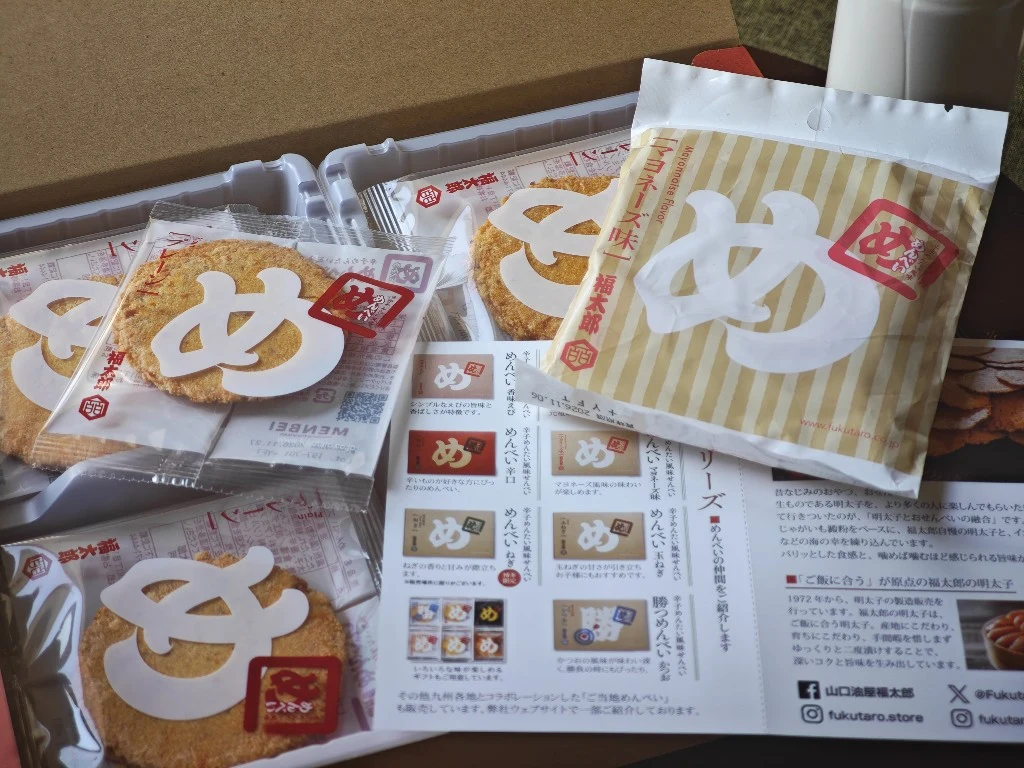
Fukutaro introduced the current kraft-style box and large め logo in 2015. The design feels deliberately uncomplicated: cardboard color, white lettering, and a red seal-like mark. It looks modern, but not so polished that it forgets it contains something meant to be eaten with beer or tea rather than displayed under glass.
Open a wrapper and the logo disappears, leaving two thin, rough-edged discs.
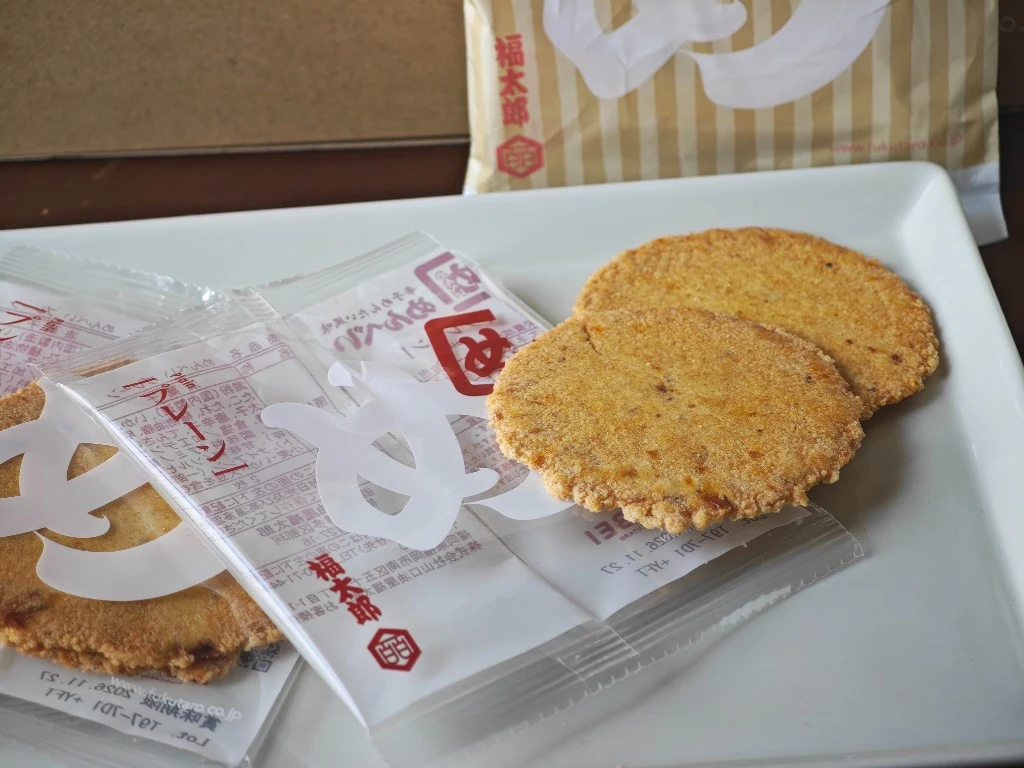
The surface is golden, lightly uneven, and dotted with darker points. It looks denser than a puffed rice cracker, and it feels denser too.
Why was Menbei created?
Fukutaro had sold mentaiko since the 1970s, but fresh roe is not the easiest souvenir to carry for a long train ride or flight. The company wanted a room-temperature product that could communicate its mentaiko identity to more travelers.
According to Menbei’s official 25th-anniversary history, the development team tried ideas such as mentaiko karukan and mentaiko shiratama manju. Shelf life remained a problem. Then a staff member suggested adding mentaiko to a tako senbei.
That idea became the route forward. Squid, octopus, and mentaiko were worked into a starch-based dough, followed by a process involving Fukutaro’s sauce. After about eight months of development, Menbei launched on June 12, 2001.
The product did not begin as an ancient Hakata cracker passed down unchanged for centuries. It is a modern regional invention designed around a real travel problem: how do you make mentaiko easier to share?
Senbei does not always mean a rice cracker
For overseas readers, senbei is often translated simply as “Japanese rice cracker.” That is a useful beginner definition, but it is not the whole cupboard.
In formal Japanese rice-cracker terminology:
- crackers made primarily from non-glutinous rice are generally called senbei
- those made from glutinous rice are generally classed as arare or okaki
Everyday Japanese snack vocabulary is broader. Nanbu senbei is made with wheat flour. Other crackers use potato or sweet-potato starch with shrimp, squid, octopus, or fish paste. Some seafood crackers press a small whole octopus or squid into a thin sheet.
So Japan does not have only two neat boxes labeled “rice senbei” and “seafood senbei.” The family includes overlapping regional materials and methods. Japanese crackers, like Japanese relatives at New Year, do not always cooperate with a simple seating chart.
The coastal tradition behind seafood senbei
Seafood crackers make practical sense in coastal regions. Small seafood catches that spoil quickly can be mixed with starch, seasoned, pressed, and dried or fried into a lighter, more durable food.
One well-documented example comes from Isshiki in Aichi Prefecture, where shrimp-cracker processing developed around the middle of the Meiji period as a way to use and preserve locally landed shrimp. Coastal Aichi later became strongly associated with ebi senbei.
Similar starch-and-seafood crackers are now made in many regions, including octopus and squid products sold as tourist souvenirs. Their recipes are not identical, and not every seafood senbei descends directly from Aichi’s industry.
Menbei belongs in this broad culture for a more specific reason: its maker says the development idea was “put mentaiko into a tako senbei.” It takes an established seafood-cracker concept and gives it a Fukuoka center of gravity.
What the cross-section shows
Held close, Menbei has a compressed, grainy surface rather than the airy bubbles of a light rice cracker.
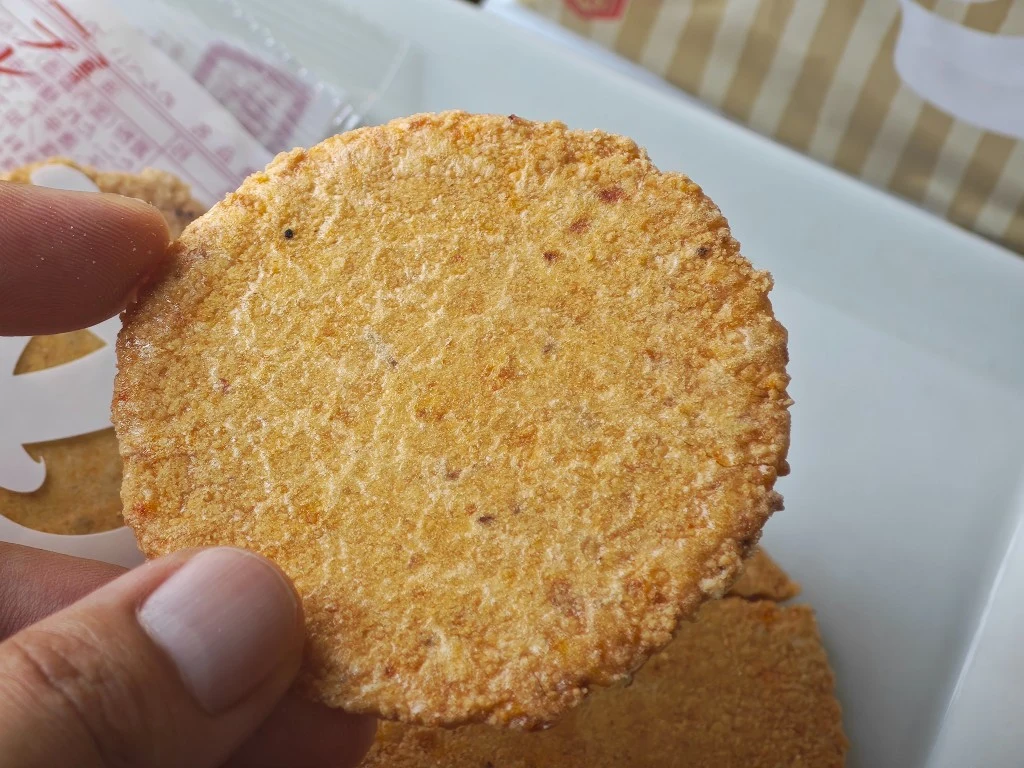
Snap one across the middle and the cracker stays thin but looks tightly packed.
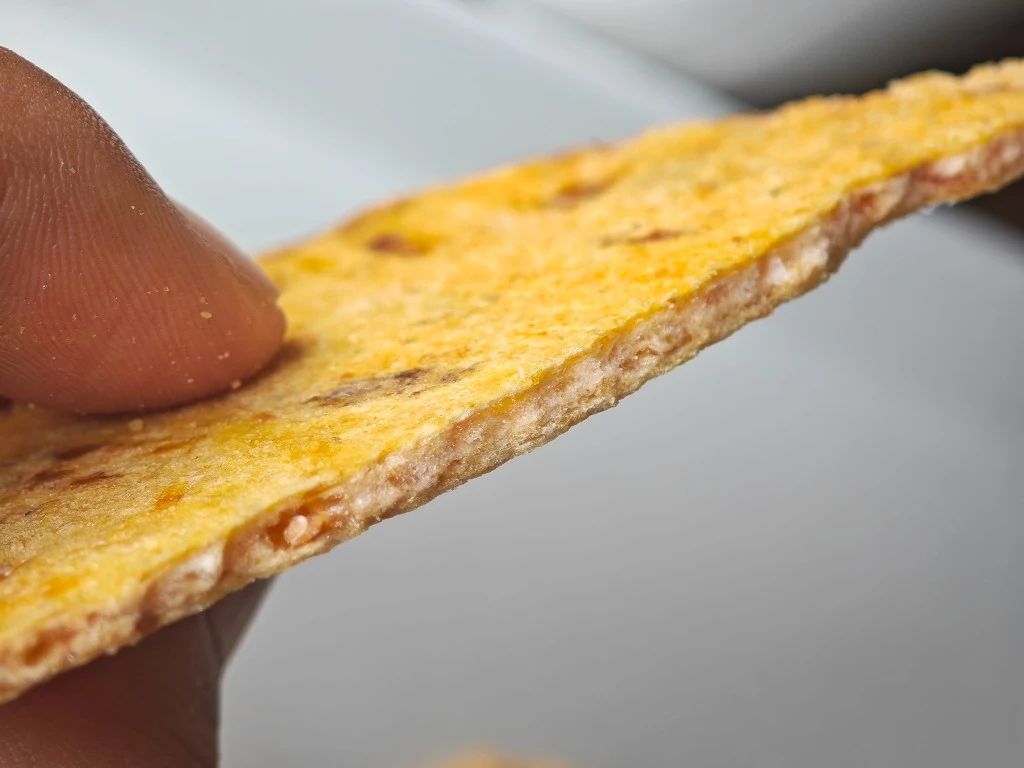
Breaking it further reveals small embedded pieces and darker flecks throughout the interior.
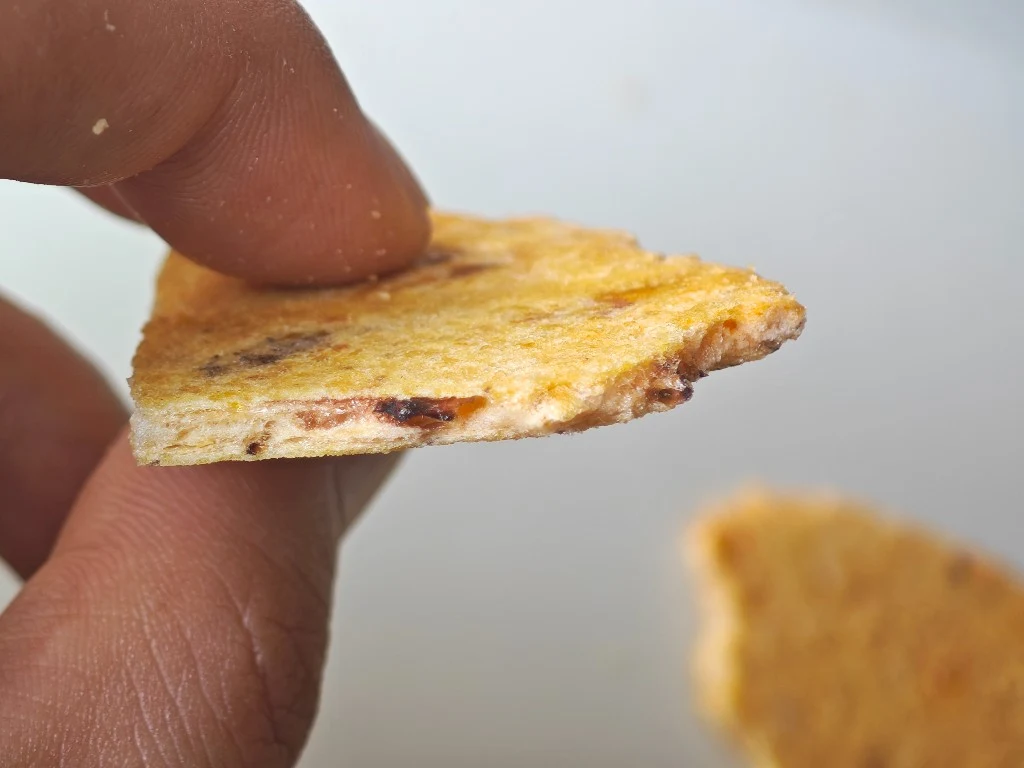
The ingredient list confirms squid and octopus are kneaded into the product, so the visible inclusions are consistent with its seafood construction. A photograph cannot reliably identify each individual fleck as squid or octopus, however. The honest conclusion is more interesting than pretending to perform marine biology with a cracker: the seafood is structurally inside the dough, not merely printed as a flavor name on the box.
Taste and texture
Plain Menbei begins with salt and seafood umami, followed by a controlled chili warmth. The heat is present, but it does not erase the squid-and-octopus base.
The texture is deliberately firm. It snaps cleanly and asks for more chewing than a light puffed cracker. Fukutaro’s manufacturing explanation presents that hardness as intentional: flavor becomes more noticeable as you chew.
The result is:
- crisp rather than airy
- dry enough to travel well
- savory and marine without tasting like a soft fish cake
- mildly spicy in Plain, with a separate Spicy edition for more heat
This is also why “cracker flavored like mentaiko” undersells Menbei. Mentaiko, squid, and octopus are part of the construction and the chew, not just a dusting.
Which flavor should a first-time buyer choose?
Start with Plain.
That is an editorial recommendation, not a rule from the manufacturer. Plain is the 2001 original and gives the clearest baseline for Menbei’s three defining ingredients: mentaiko, squid, and octopus.
Once that baseline is clear, the other editions become easier to understand as variations rather than interchangeable boxes.
The pamphlet in the photographed box introduces multiple members of the series, including Plain, Mayonnaise, Spicy, Green Onion, Onion, Aromatic Shrimp, and a bonito-flavored Katsu Menbei.
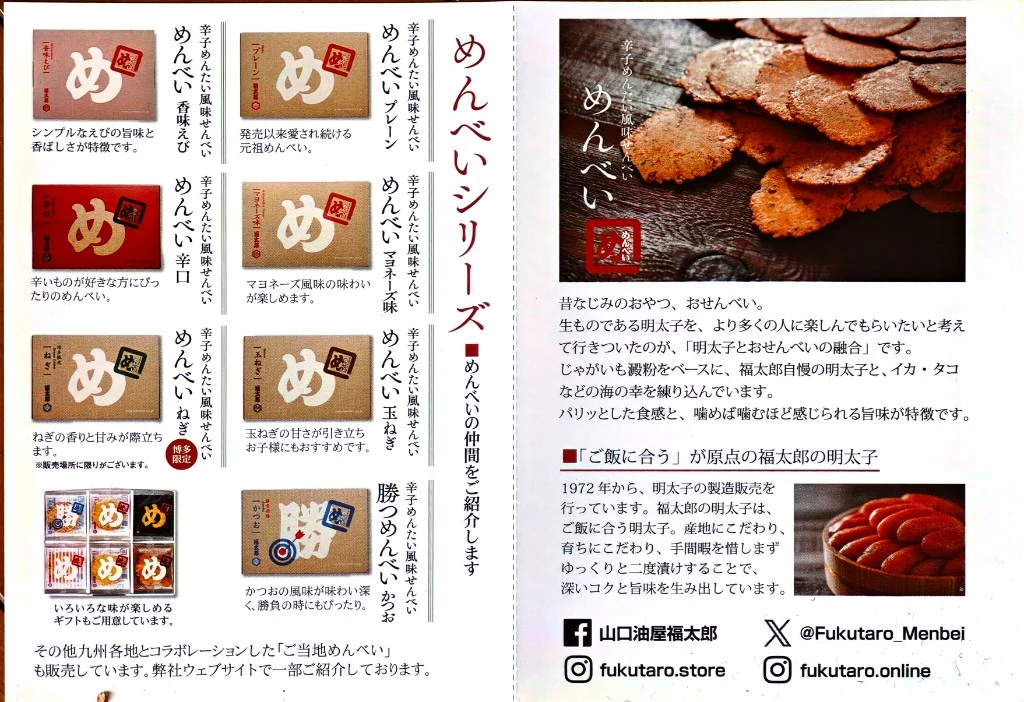
The current wider family also includes regional, premium, collaboration, and limited products. Treat the photographed pamphlet as the lineup guide included in this box, not a permanent catalog of every Menbei ever made.
Mayonnaise Flavor and Japan’s menta-mayo idea
Mayonnaise Flavor looks close enough to Plain that an unfamiliar shopper might assume it is simply the original made creamier.
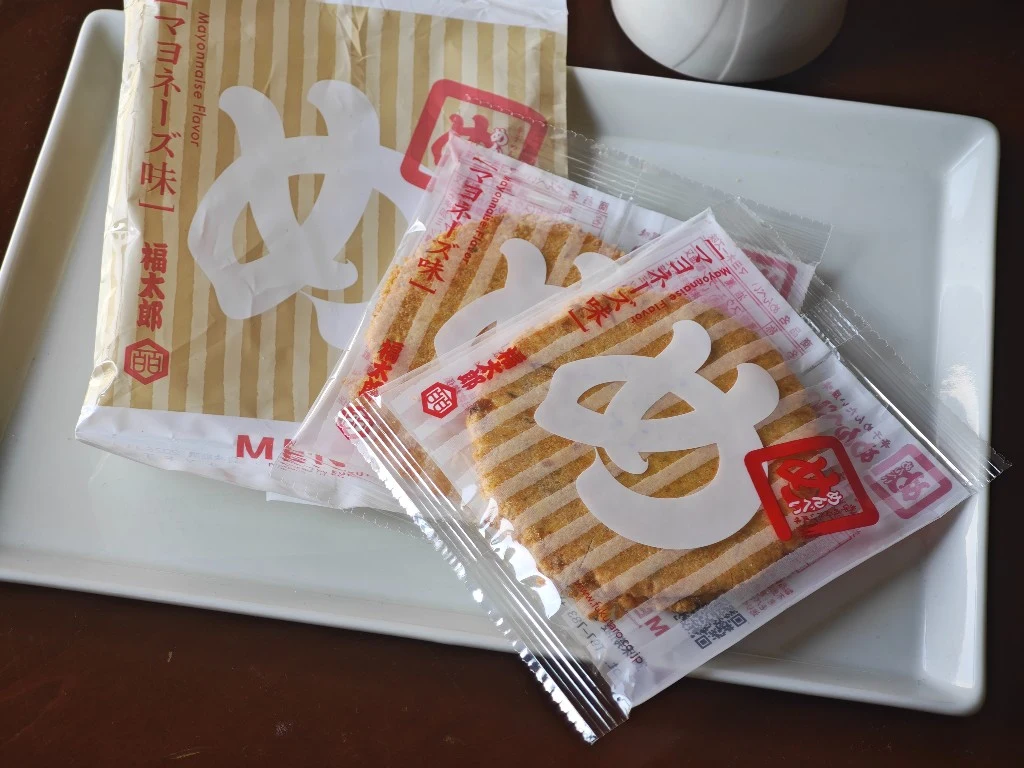
In tasting, it moves in a more distinct direction. Mayonnaise-like tang and rounded richness soften the sharp edges of the chili and seafood. The result resembles the flavor logic of menta-mayo—mentaiko combined with mayonnaise.
Menta-mayo is recognizable in contemporary Japan in rice balls, bread, pasta, egg dishes, and convenience foods. It should not be presented as a centuries-old Japanese sauce or an ancient Hakata tradition. One documented commercial example is Yamaya’s launch of a mentaiko-mayonnaise-type product in 1998.
Menbei’s official product name remains Mayonnaise Flavor, and its label uses mayonnaise-flavor seasoning. “Menta-mayo-like” therefore describes the taste direction without falsely claiming that ordinary mentaiko mayonnaise has simply been spread across the cracker.
If you already enjoy menta-mayo, this flavor may be immediately appealing. For a first Menbei purchase, Plain still makes more sense. Mayonnaise Flavor does not merely amplify the original; it changes the balance enough to become its own interpretation.
Ingredients, allergens, and nutrition
The photographed Plain wrapper is the best evidence for the exact package reviewed here.
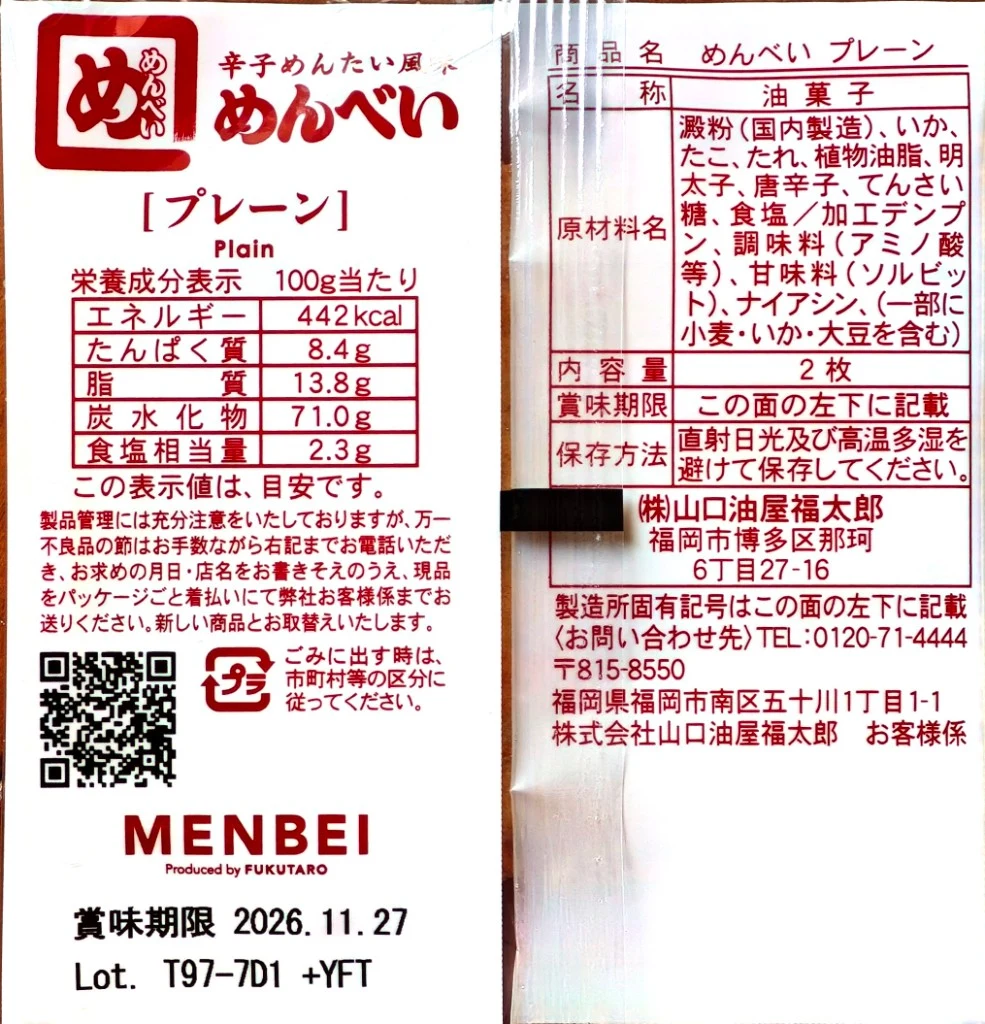
The label lists:
- starch made in Japan
- squid
- octopus
- sauce
- vegetable oil
- mentaiko
- chili pepper
- beet sugar
- salt
- modified starch, seasoning, sorbitol, and niacin
Declared allergens are wheat, squid, and soy. The photographed package gives approximate nutrition per 100 g as 442 kcal, 8.4 g protein, 13.8 g fat, 71.0 g carbohydrate, and 2.3 g salt equivalent.
These numbers are not “per cracker.” Package sizes and formulations can change, so travelers with allergies should always read the wrapper they actually buy.
Mayonnaise Flavor has a different formula and additional allergen considerations, including egg, milk, and apple in the current official information. Do not use the Plain label to judge another flavor.
The package advises avoiding direct sunlight, high temperatures, and humidity.
Where to buy Menbei in Fukuoka
Menbei is easy to encounter in Fukuoka’s major souvenir routes, but flavor selection varies by store.
Convenient starting points include:
- JR Hakata Station: Fukutaro’s Hakata Ming and Hakata Deitos stores
- Hakata Hankyu: Premium Menbei counter in the basement food floor
- Fukuoka Airport: Hakata Souvenir by Kikuhira before security
- Fukuoka Airport: ANA FESTA Gate 8 after security, with airport-specific selections
- Central Fukuoka: Tenjin, Iwataya, Canal City Hakata, and other official sales locations
- Dazaifu and other visitor areas: selected Fukutaro and souvenir outlets
- Online: Fukutaro’s official shop
Check the official Fukutaro store list before making a special trip. Opening hours, stock, and location-exclusive flavors can change.
Why Menbei is a useful cultural starting point
Menbei is not “traditional” because it is old. It is culturally useful because it shows how regional food traditions continue to generate new products.
The chain runs like this:
- Fukuoka develops a strong modern identity around mentaiko.
- Japanese coastal regions already have many ways to turn seafood and starch into durable crackers.
- Fukutaro combines the two ideas to solve a souvenir problem.
- Individual wrapping and bold packaging make the result easy to recognize and share.
- New flavors connect it to other contemporary Japanese tastes, including menta-mayo.
That is a richer story than simply calling it a spicy rice cracker. Menbei is a modern Fukuoka souvenir, a member of Japan’s broad seafood-senbei family, and proof that a product launched in 2001 can still lead a traveler deep into older food-processing traditions.
Frequently asked questions
What is Menbei?
Menbei is a thin, firm seafood cracker from Yamaguchi Aburaya Fukutaro in Fukuoka. It contains mentaiko, squid, and octopus in a starch-based dough and was launched in 2001.
Is Menbei made from rice?
Its current Plain label begins with starch, not rice. It is better understood within Japan’s starch-based seafood-cracker tradition than as a conventional rice senbei.
Is Plain Menbei very spicy?
Plain has noticeable but moderate chili heat in my tasting, balanced by salt and seafood umami. People have different heat tolerances, and a separate Spicy flavor is available.
Should I try Plain or Mayonnaise Flavor first?
Start with Plain to understand the original mentaiko, squid, and octopus base. Mayonnaise Flavor is a good second choice if you like tangy, rounded menta-mayo-style flavors.
Can I identify squid and octopus in the cross-section?
You can see embedded pieces, and the ingredient label confirms both squid and octopus. It is not possible to identify every visible fleck by species from a photograph alone.
Where can tourists buy Menbei?
JR Hakata Station and Fukuoka Airport are convenient places to start. Fukutaro also lists department-store, city, Dazaifu, factory, and online options. Check current stock and store hours first.
Affiliate disclosure: Some links above may be affiliate links. If you buy through them, I may earn a commission at no extra cost to you.