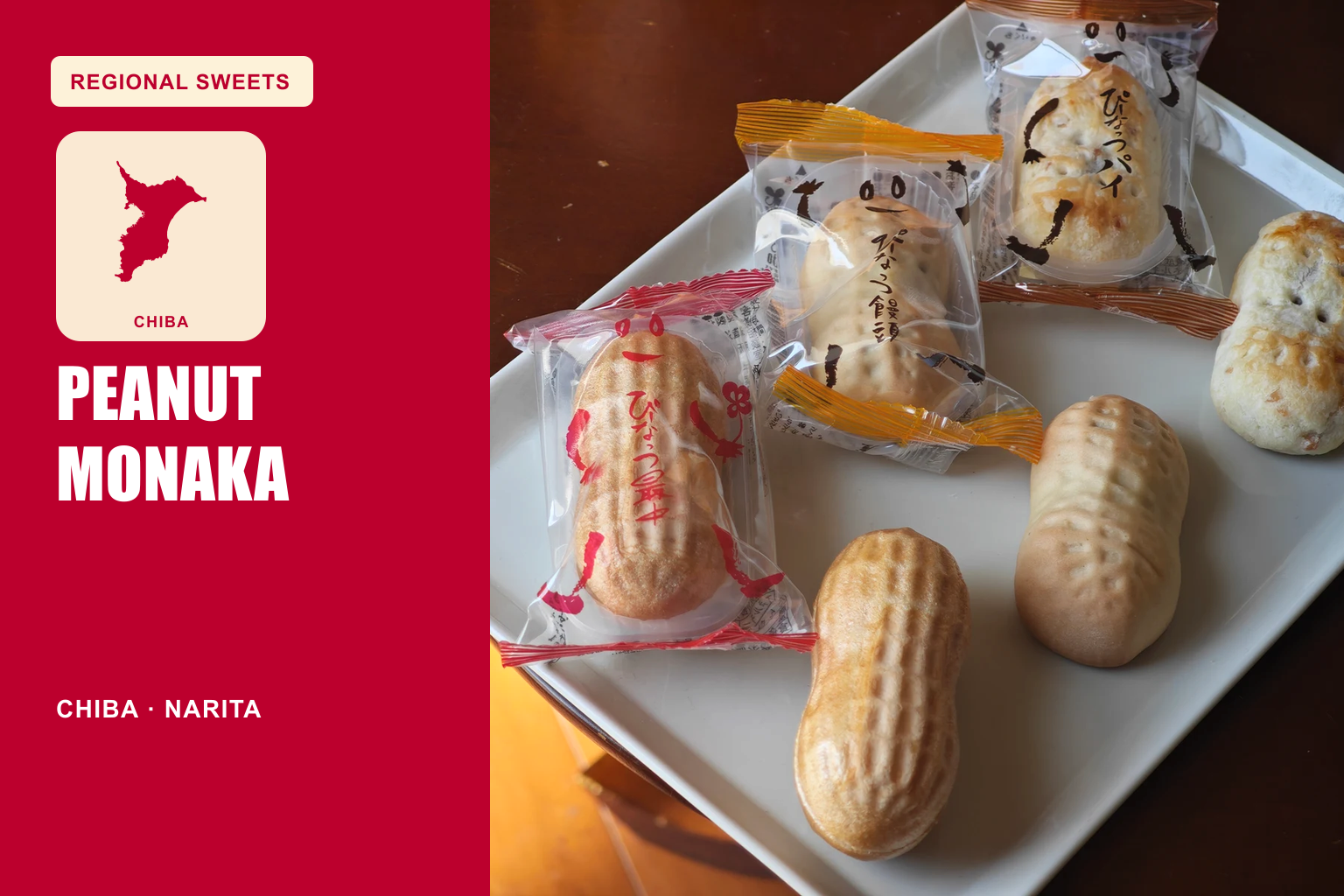
Peanut Monaka looks like a joke that a souvenir shop decided to take seriously: a crisp wafer shaped exactly like a peanut shell, sold in Chiba, the prefecture most associated with peanuts in Japan.
Then you bite into it and discover that the joke has a thesis. Nagomi Yoneya, a Narita confectioner founded in 1899, did not simply print a peanut on a box. It developed a peanut bean paste, put it inside one of Japan’s classic wagashi formats, and then carried the same filling into a manju and a pie.
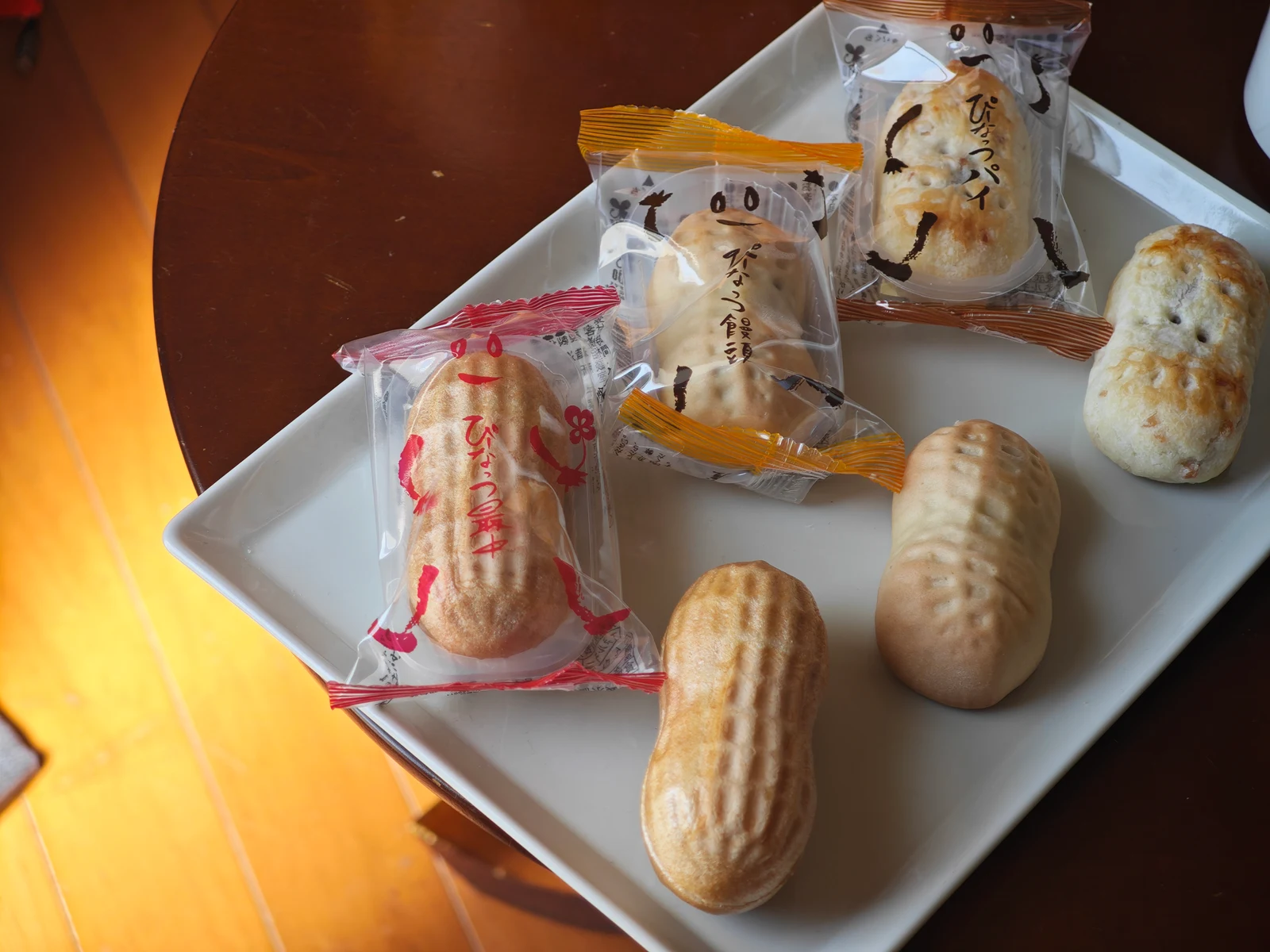
Quick take: Peanut Monaka (ぴーなっつ最中) is a Chiba souvenir made by Nagomi Yoneya in Narita and launched in October 1998. Inside the peanut-shaped rice wafer is a sweet bean paste built around sweet-simmered peanuts and peanut paste. It is a modern sweet in an old format, and that is exactly its strength. If you buy the mixed box, eat the Monaka first: it explains the filling better than anything else in the box.
What is Peanut Monaka?
Peanut Monaka is a regional souvenir sweet from Chiba Prefecture, east of Tokyo. It is made by Nagomi Yoneya (なごみの米屋), a confectioner based in Narita, the city that also gives its name to Tokyo’s largest international airport.
A monaka is a traditional Japanese sweet made from two thin, crisp wafers of baked glutinous rice, pressed around a sweet filling, usually anko (bean paste). The wafer is light and dry; the filling is dense and moist. The pleasure lies in the contrast.
Yoneya’s version changes two things:
- The shape. The wafer is moulded as a peanut in its shell, ridges and waist included.
- The filling. Instead of standard red-bean or white-bean paste, the bean paste is built around sweet-simmered peanuts and peanut paste.
The maker’s current ingredient list for the monaka starts with sugar, white kidney beans, reduced starch syrup, sweet-simmered peanuts, azuki beans, the glutinous-rice wafer, and peanut paste. In other words, this is still bean paste, not peanut butter. The peanut is the lead voice, but the choir is Japanese.
Why peanuts mean Chiba
Ask people in Japan what Chiba is known for and peanuts (rakkasei) will be near the top of the list.
According to Chiba Prefecture, peanut cultivation in Chiba began in February 1876, when farmer Makino Man’emon brought seeds back from Kanagawa and began growing them in what is now Sanmu City. That makes 2026 the 150th anniversary of peanuts in Chiba, and the prefecture is marking it with events and promotions.
The crop found good conditions in the sandy, well-drained soils of northern Chiba. Yachimata, introduced to peanuts around 1896, grew so devoted to the crop that by 1949 peanuts covered about 80 percent of its farmland. The town is still the name most Japanese people connect with premium domestic peanuts.
Today Chiba produces roughly 80 to 85 percent of Japan’s domestic peanut crop. In the Ministry of Agriculture’s 2023 harvest statistics, Chiba accounted for 85 percent of national production.
One clarification: the package does not state where its peanuts are grown, so this guide does not claim that every peanut inside is Chiba-grown. What the sweet clearly does is take Chiba’s signature crop as its theme, shape, and flavor.
So a peanut-shaped sweet from Chiba is not an arbitrary novelty. It is closer to a seafood cracker from a fishing port: the product shape points directly at the local economy.
The maker: a Narita confectioner founded in 1899
Nagomi Yoneya began in April 1899 in Narita, the temple town that grew up around Naritasan Shinshoji, one of the Kanto region’s most visited Buddhist temples.
The name Yoneya means “rice shop,” and the founder, Morooka Chozo, originally dealt in rice along the temple approach. The business turned to confectionery when he created a chestnut yokan as a souvenir for temple pilgrims. According to the company, the idea came from kurikan, a chestnut sweet served as part of the temple’s vegetarian cuisine, and Yoneya describes its chestnut yokan as the first of its kind in Japan.
That origin still shapes the company. Its main store stands on the Naritasan Omotesando, the shopping street leading to the temple, and the company opened a small yokan museum there in 2002.
This matters for Peanut Monaka because it explains the confidence behind it. The company was not a novelty manufacturer trying wagashi for the first time. It was a long-established temple-town confectioner experimenting with its own region’s best-known crop.
How a demonstration-stall wafer became a Chiba souvenir
Peanut Monaka has a surprisingly recent and well-documented origin.
In November 1995, Yoneya opened a large drive-in style store called the Yoneya Tourist Center in Narita. About a year later, the shop began a live demonstration sale of a peanut-shaped monaka. That early product was called “Pinattsu Monaka” in katakana, and the filling was smooth red-bean paste with two candied peanuts inside.
In 1998, the company decided to develop it into a proper Chiba souvenir. Yoneya says the team tested roasted peanuts and peanut oil to find the right aroma, adjusted the hardness of the peanut pieces so they suited a monaka, and even tuned the paste’s color to evoke the thin brown skin of a peanut. After dozens of trials, the new product launched in October 1998 under the softer hiragana name ぴーなっつ最中.
The company also created a peanut character, Pii-chan, for the wrappers. Its stated goal was to make the sweet approachable for people who might not think of themselves as wagashi customers. A smiling “Happy Pii-chan” variation was added in 2006.
A few details worth knowing:
- October 18 is official “Peanut Monaka Day.” The date combines the October 1998 launch and the autumn peanut harvest; in the maker’s explanation, “101” resembles filling between two wafers and “8” resembles a peanut.
- For the 25th anniversary in 2023, Yoneya renewed the recipe to strengthen the peanut flavor.
- The company lists a long run of awards, including the Kikka Eiko Award at the 25th National Confectionery Exposition (2008), the Honorary President’s Award at the 26th (2013) and 28th (2025) expositions, and the Chiba award at the Japan Gift Awards 2018.
A late arrival is not a weaker tradition
Before tasting it, I expected Peanut Monaka to sit slightly below older regional sweets in the hierarchy. It is younger than many of the famous souvenirs travelers are told to buy, and in Japan, age often carries authority.
After eating the whole family, I think that expectation was backwards.
A newer sweet has freedom that an old one may not. It can be designed for modern taste from the start, packaged for gifting, and extended into variations without anyone accusing it of betraying a century-old recipe. Yoneya used that freedom well. The central invention is not the peanut shape. It is the peanut bean paste. Once that paste existed, it could move from a monaka into a manju and then into a pie, while keeping the same identity.
That is a more interesting kind of tradition than simple preservation. Chiba’s peanut industry supplies the regional story; the monaka supplies a classic Japanese form; the peanut paste connects them and makes the whole category wider. It feels less like copying old wagashi and more like extending what wagashi can contain.
Unboxing the Chiba Meguri assortment
The sample I bought was Chiba Meguri (千葉めぐり, roughly “Around Chiba”), an assortment of Peanut Monaka, Peanut Manju, and Peanut Pie.
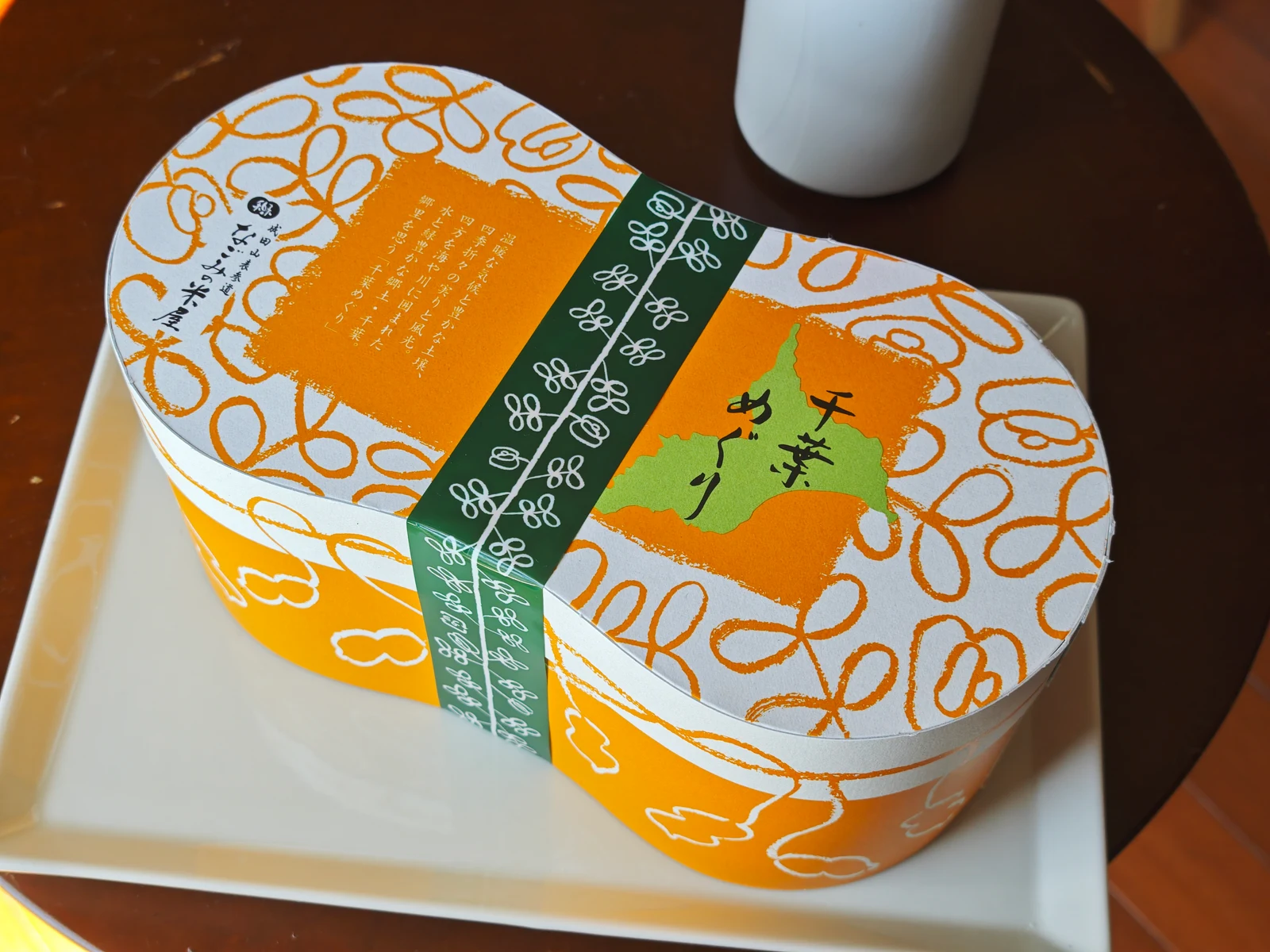
The box itself is shaped like a peanut. The lid shows the outline of Chiba Prefecture in green, surrounded by an orange pattern that looks like peanut vines and pods. Even before opening it, the package has already told you the prefecture, the crop, and the joke. Yoneya has used this box shape since 2017, and the packaging design won a Topawards Asia prize in 2018.
Around the box runs a translucent green band printed with peanut plants.
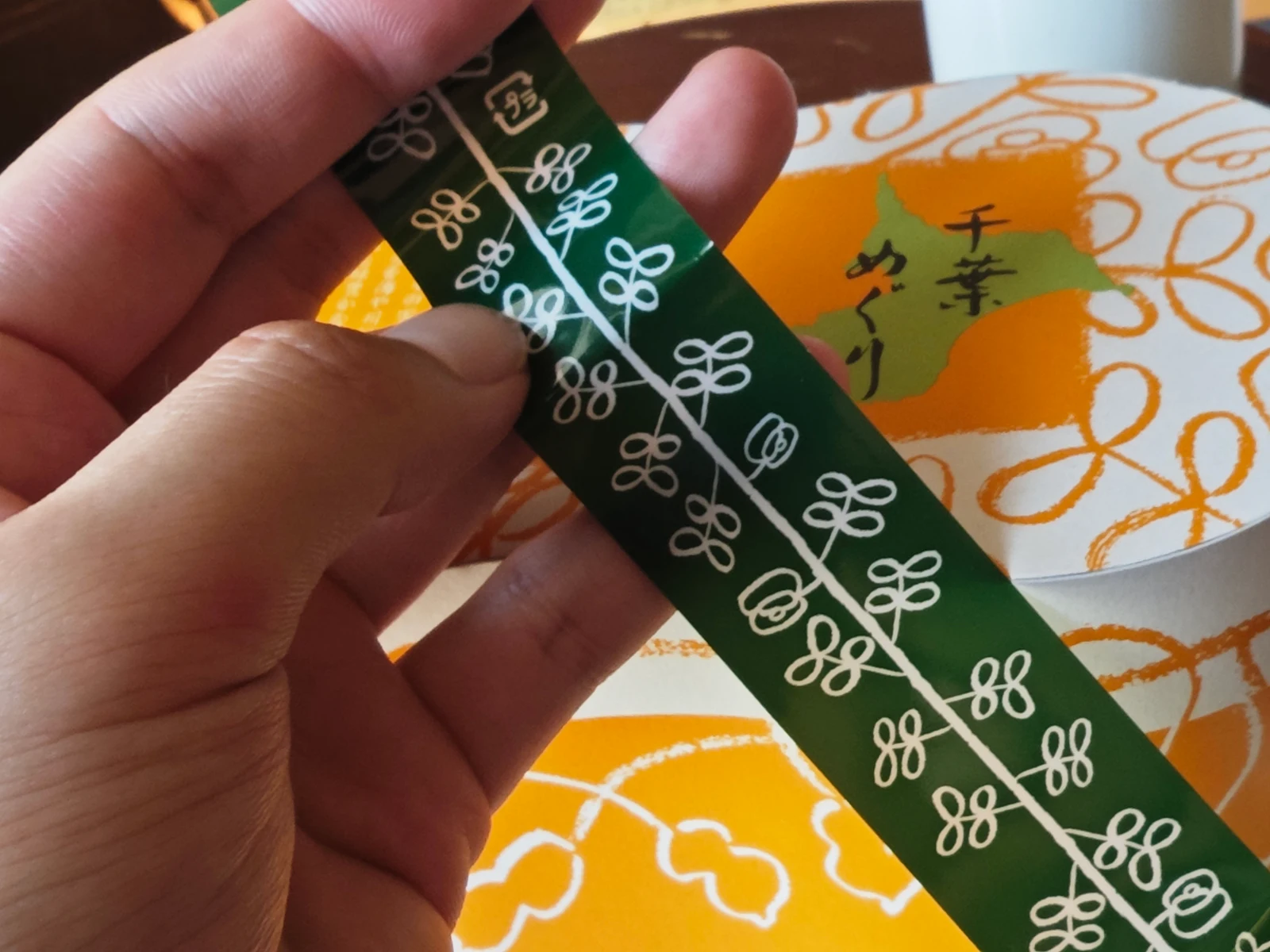
Its job is simple: keep the lid closed until you get home. I nevertheless held it up for a formal portrait. It will never receive this much attention again, and it deserves at least one moment of recognition before it meets the recycling bin. Some readers come for history. Some come for taste notes. A few, I suspect, come for respectful coverage of packaging bands.
Lift the lid and the individually wrapped sweets are packed tightly inside, with a divider down the middle of the peanut-shaped tray.
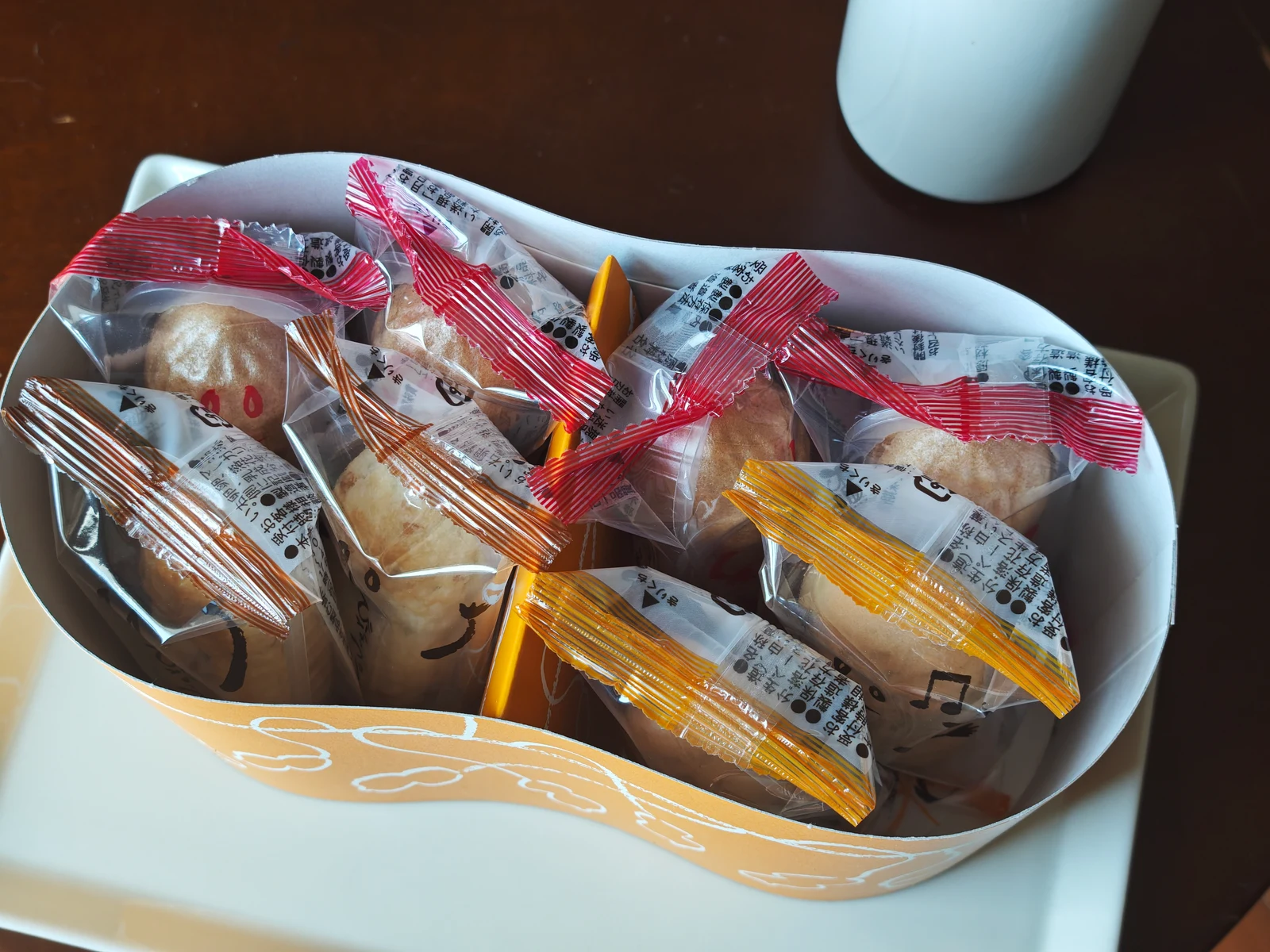
The wrapper colors make the lineup easy to read: red for the Monaka, yellow for the Manju, and copper-brown for the Pie. Each one also carries a hand-drawn face and limbs, so every sweet is technically a small peanut character waiting to be eaten.
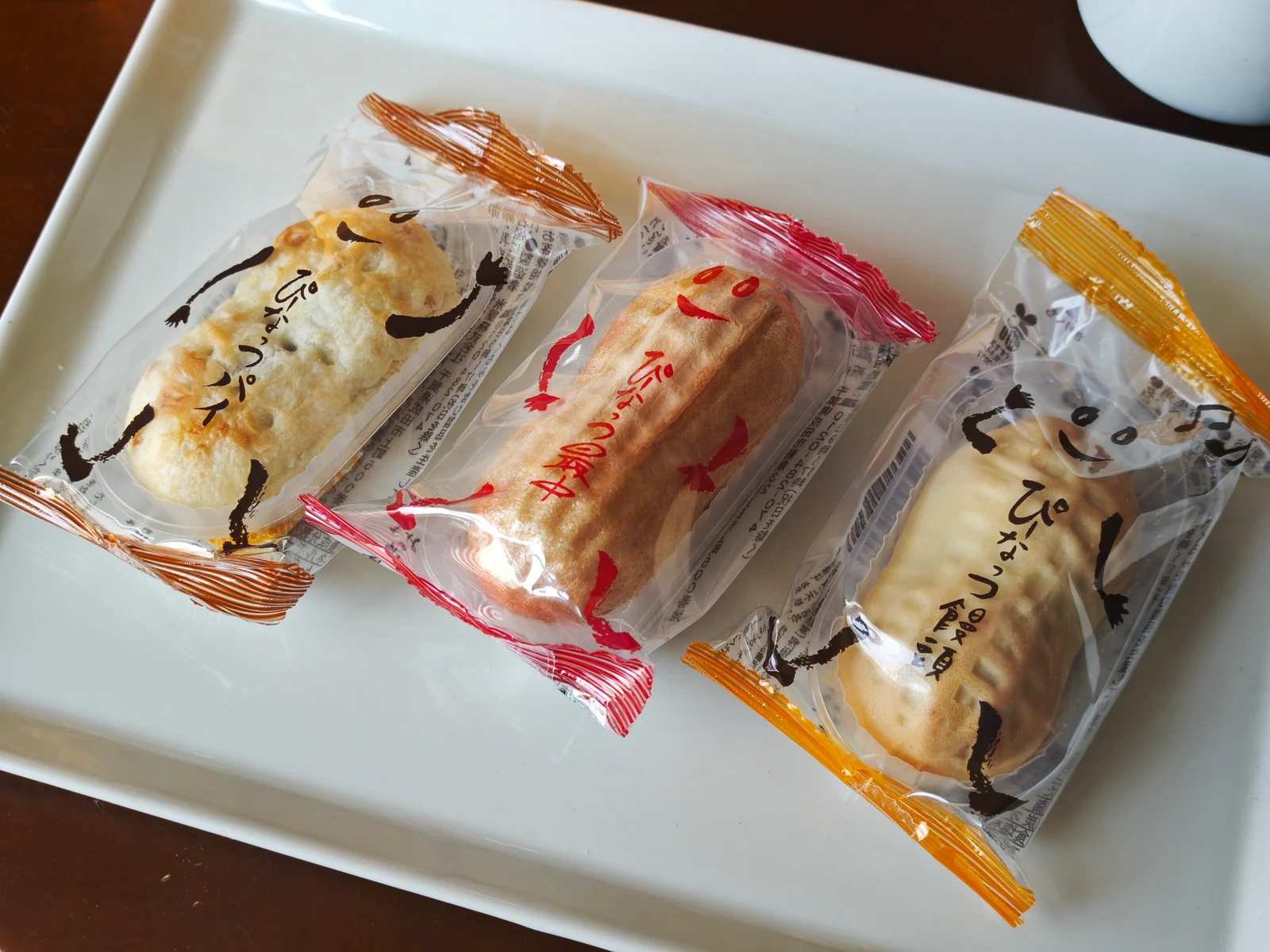
You may also find a small packet inside.
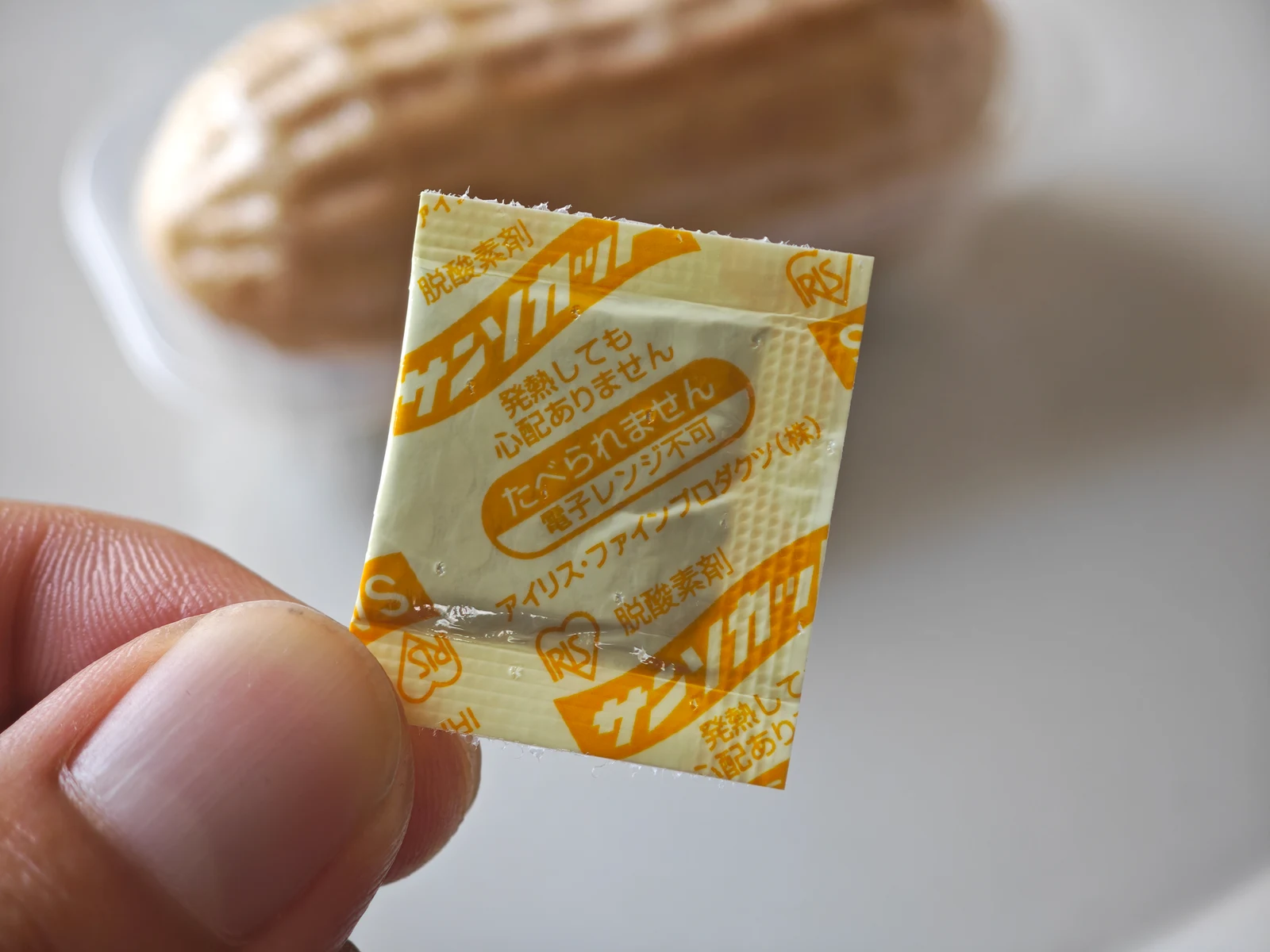
This is an oxygen absorber, not a bonus snack. It says “たべられません” (“cannot be eaten”) in large letters, and it means it. It is the only item in the box with no peanut paste, no face, and no fan club. Please leave it out of your tasting notes.
Peanut Monaka review: the original, and still the clearest
I ate the Monaka last, after the Manju and the Pie. That turned out to be useful, because by then I had something to compare it with.
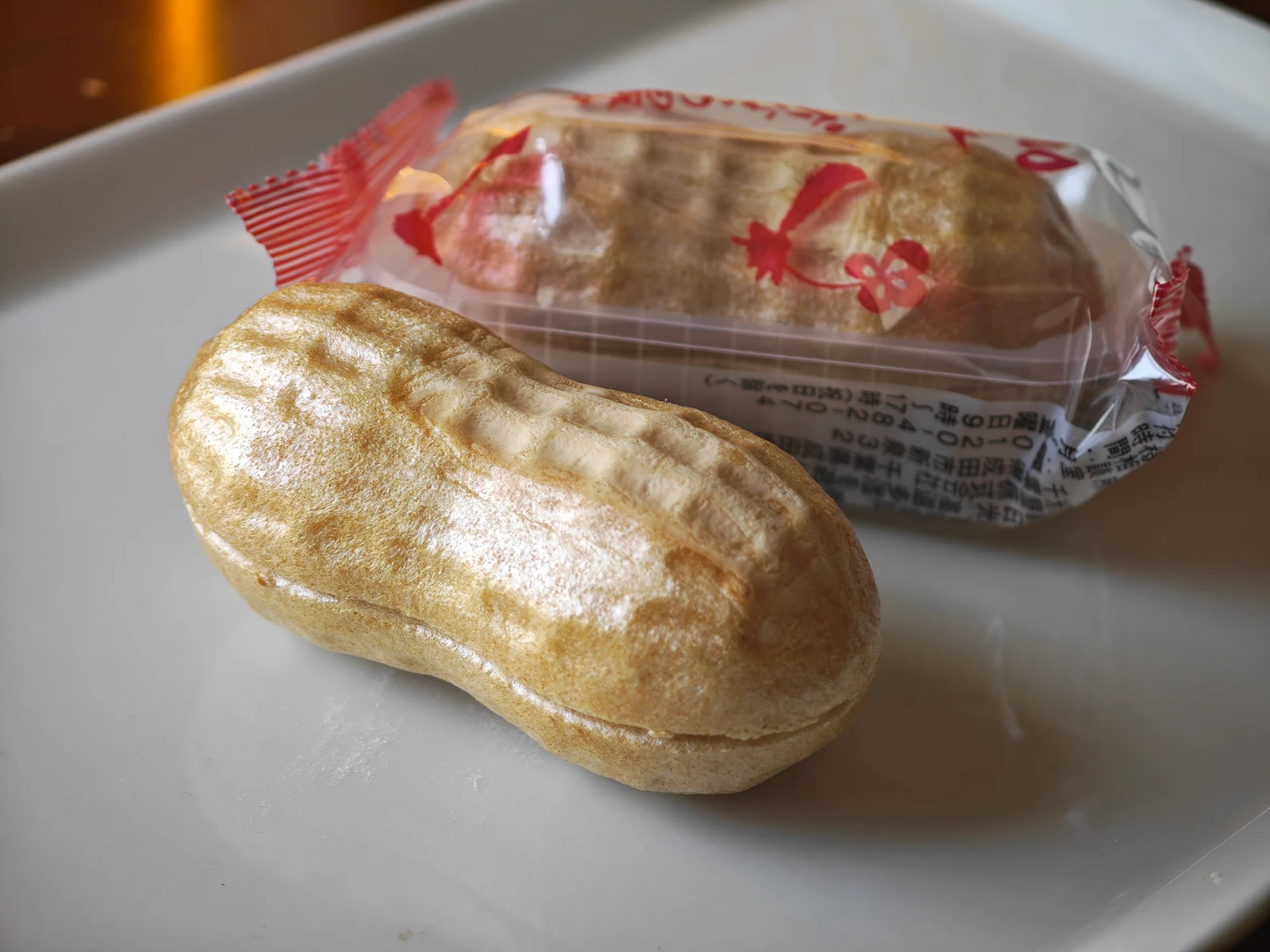
The wafer is pale gold, with peanut-shell ridges pressed into the surface. It looks almost too convincing; if it were lying among roasted peanuts, you might hesitate before cracking it.
Cut open, the shell is thin and the filling is packed right to the edges.
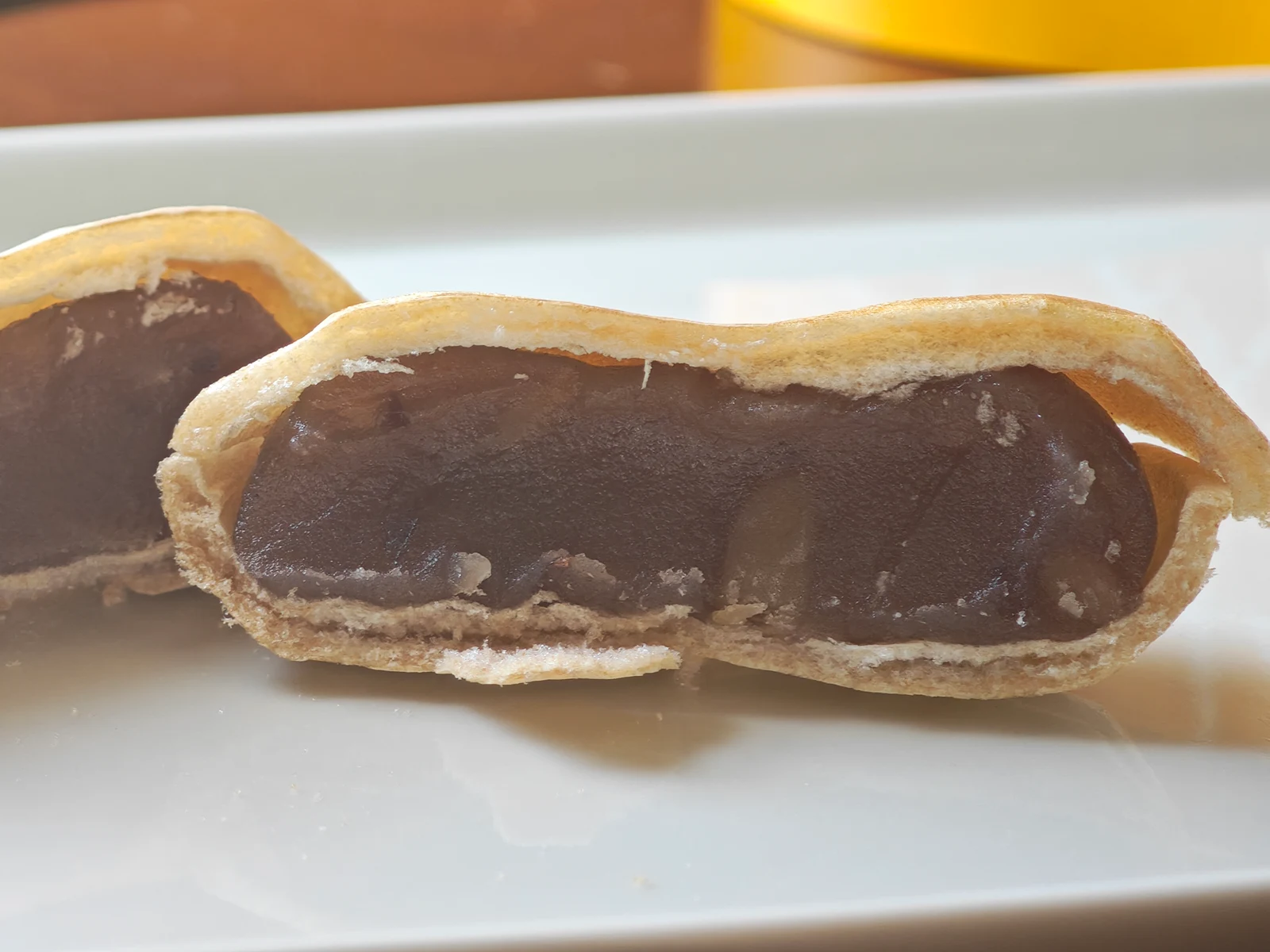
The filling is darker than I expected, a deep brown closer to the color of peanut skins than to beige peanut butter. That matches the maker’s story about tuning the color during development. Small pieces of peanut are visible inside the dense paste.
What makes the Monaka special is the way the wafer behaves. It is dry and light, but where it touches the paste, it clings like a thin skin. In the mouth, the dry wafer and the moist filling mix together rather than separating, and that changing texture is the best part of eating it.
The flavor is hard to file under existing categories. It is not shiroan (white bean paste), and it is not koshian (smooth red bean paste). It is also clearly not a Western peanut dessert. The sweetness is gentle and rounded, and the peanut appears as a roasted aroma and a quiet richness rather than as salt or oil.
If you want to understand what “peanut bean paste” means, this is the best version to eat. The wafer barely interferes. It frames the filling, adds a crisp contrast, and then steps aside. This is the original form, and it still feels like the purest statement of the idea.
Peanut Manju review: a serious manju, not a spin-off
The Manju takes the same filling and wraps it in a soft baked dough.
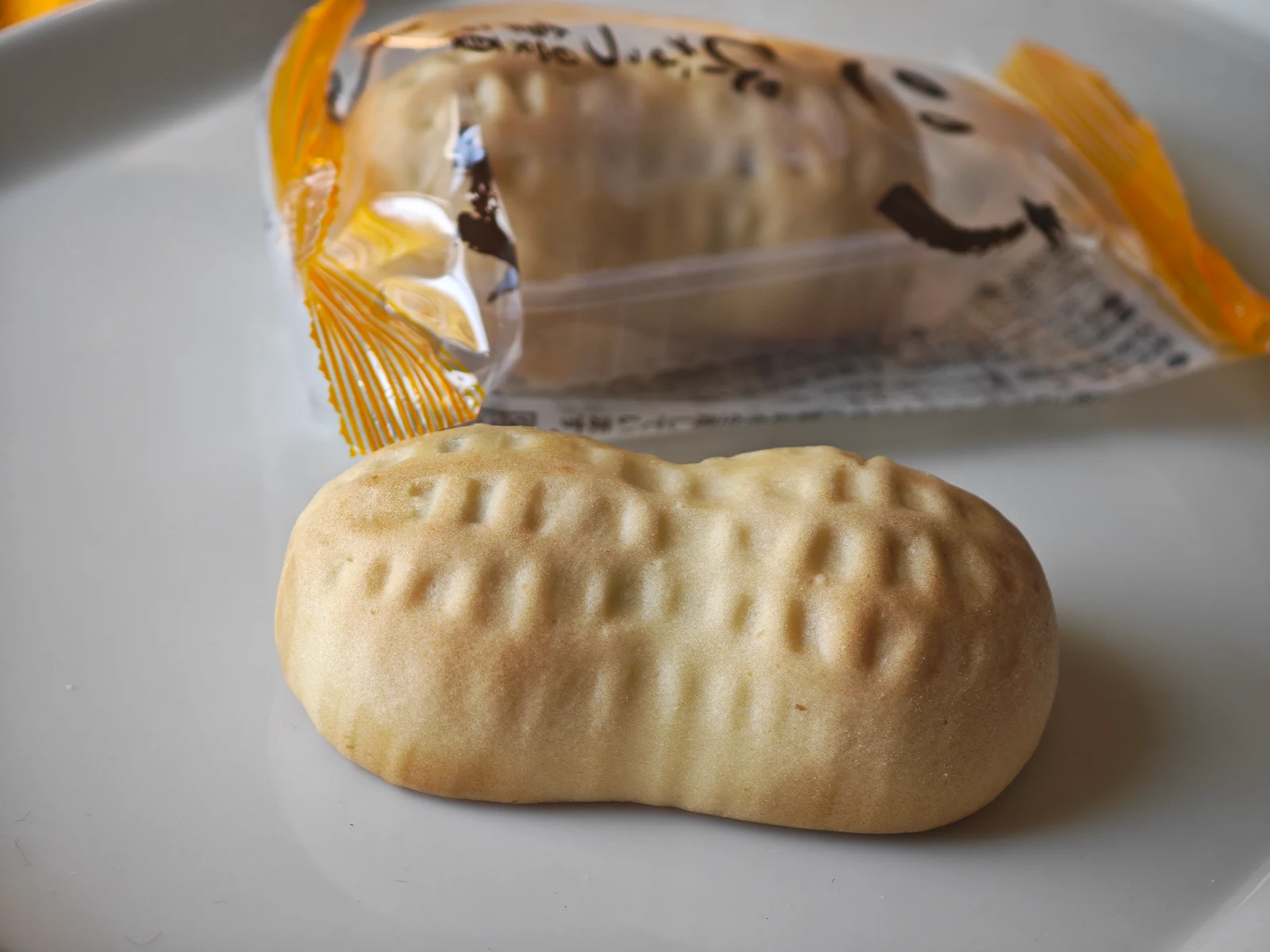
It is also shaped and ridged like a peanut shell, but the surface is smooth, matte, and cake-like. Japanese manju has many styles; this one belongs to the baked type, with a tender, moist dough. According to the maker, peanut paste is worked into the dough itself, and the ingredient list also includes egg and butter.
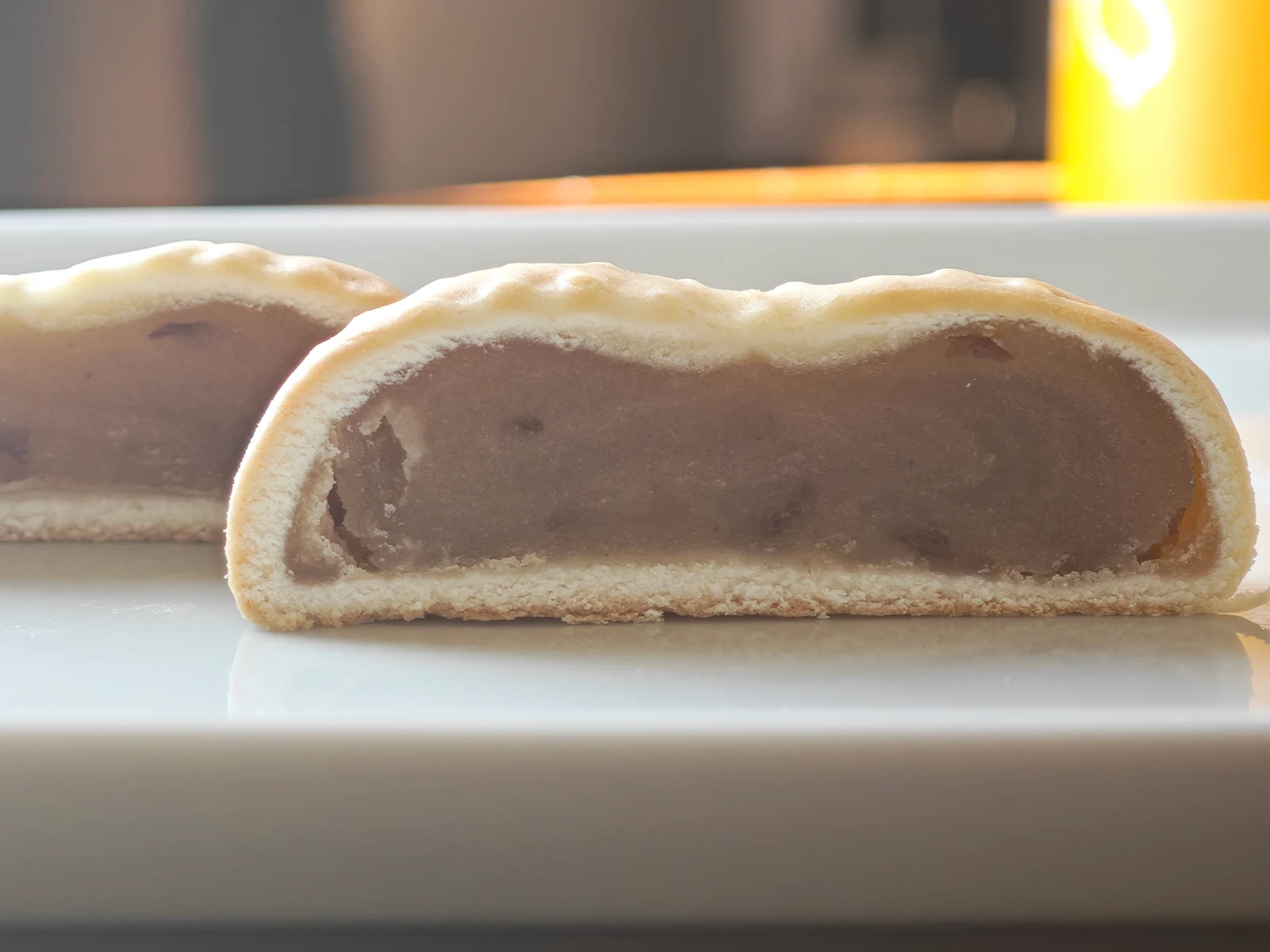
Inside, the filling looks paler and smoother than the Monaka’s, with visible peanut pieces scattered through it. Those pieces give an occasional bite that reminded me of tsubuan, chunky red bean paste, even though the base is completely different.
This is properly a manju. It does not feel like a monaka filling forced into another product. I could feel the development question behind it: if we want people to enjoy peanut paste through manju dough, what should the dough and filling do? The answer is a soft, sweet shell that carries peanut flavor of its own and a filling with enough texture to stay interesting.
It also shows a certain pride on the peanut side of the operation. Japanese confectionery has centuries of experience with azuki and white beans. Here, the peanut is asked to do similar work, and it does it convincingly.
Peanut Pie review: obviously delicious
I knew the Pie would be good before I opened it.
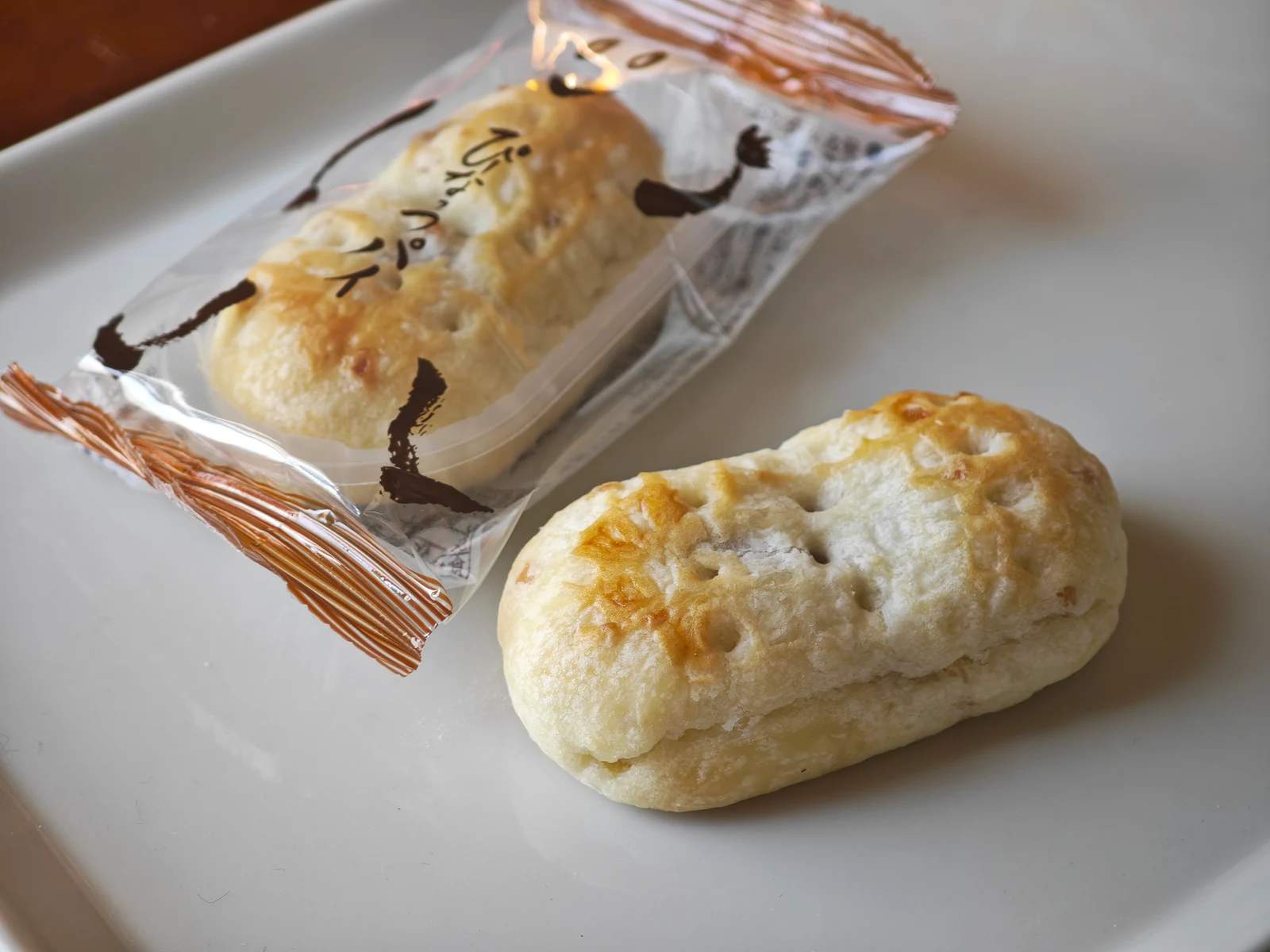
This is not a sophisticated critical insight. It is basic arithmetic. Flaky pastry plus sweet peanut filling equals a snack that has very few ways to fail. Writing a long review of whether peanut paste and pastry go together feels a bit like investigating whether warm rice goes with miso soup.
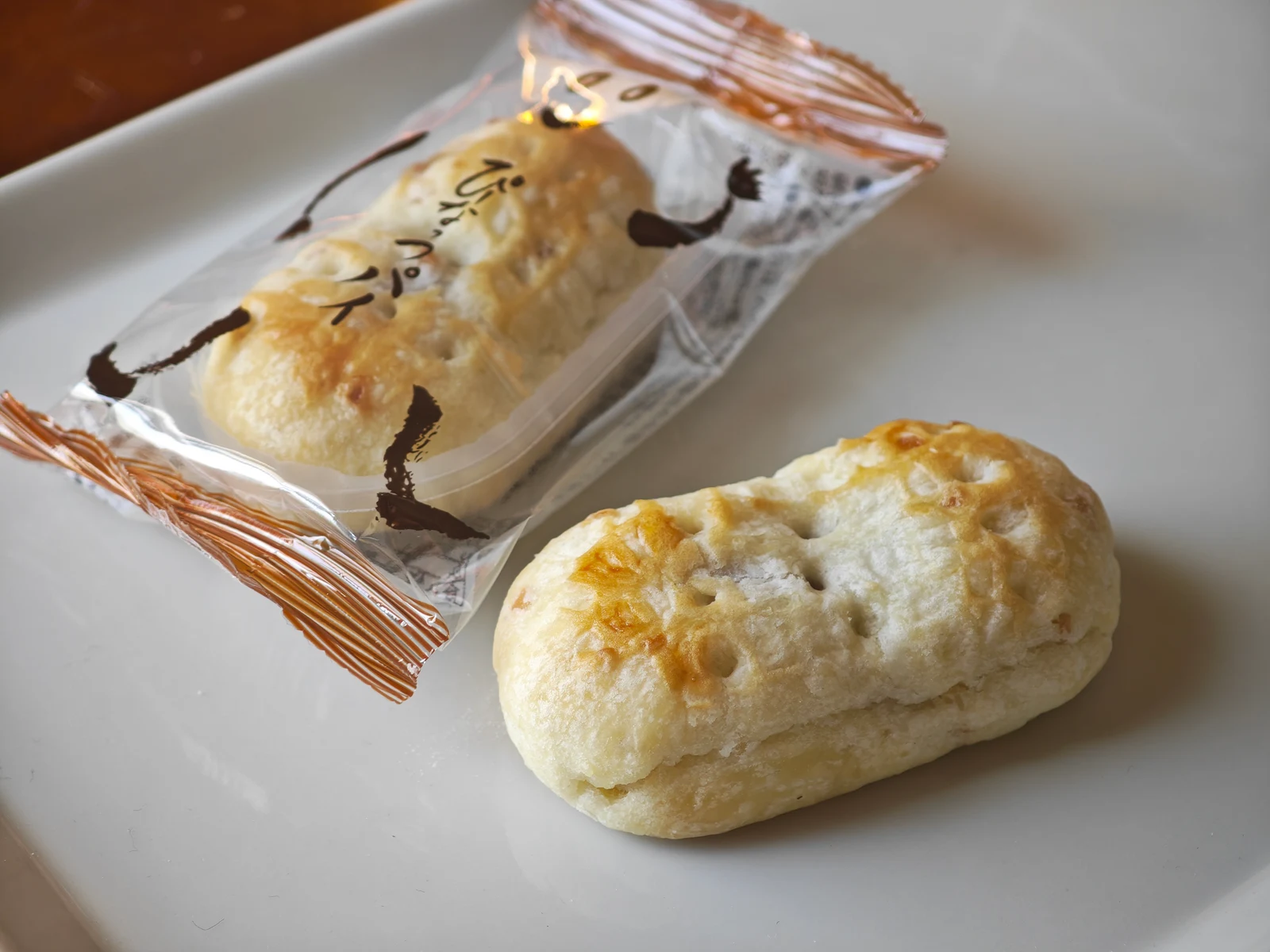
Still, the details are good. The pastry is soft and layered, lightly browned on top with small vent holes. It wraps the filling completely, so each bite combines flaky crust and peanut paste instead of meeting them one after the other.
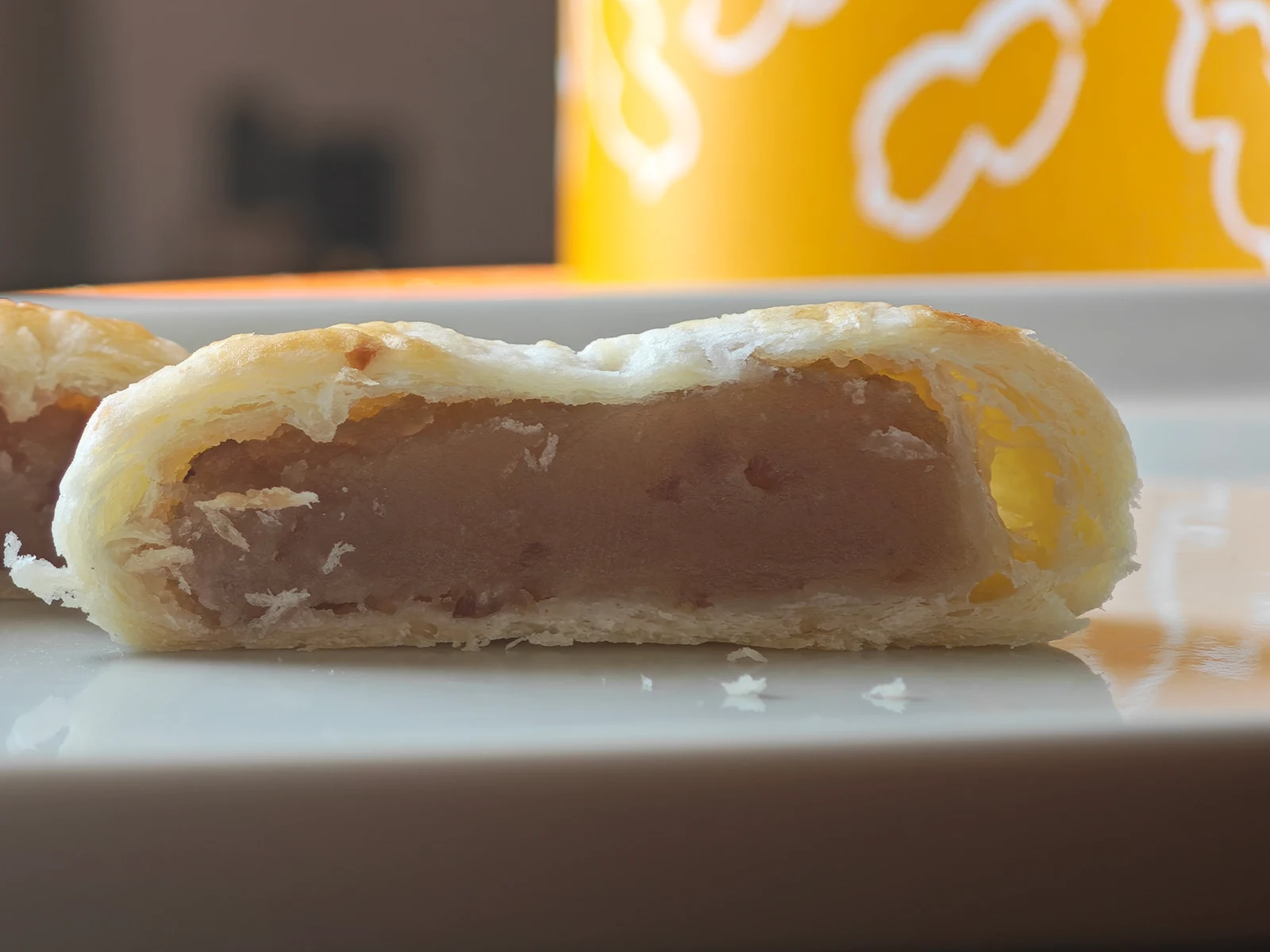
The cross-section shows a generous filling held inside thin pastry layers. The rich, buttery-tasting crust and peanut paste blend into each other, and this is clearly the most Western of the three. For a reader comparing labels: the current Pie ingredient list names margarine, not butter, so “buttery” here describes the impression, not the recipe.
If someone in your group is unsure about Japanese bean paste, start them here. It is the easiest bridge into the family.
Monaka, Manju, or Pie: which should you eat first?
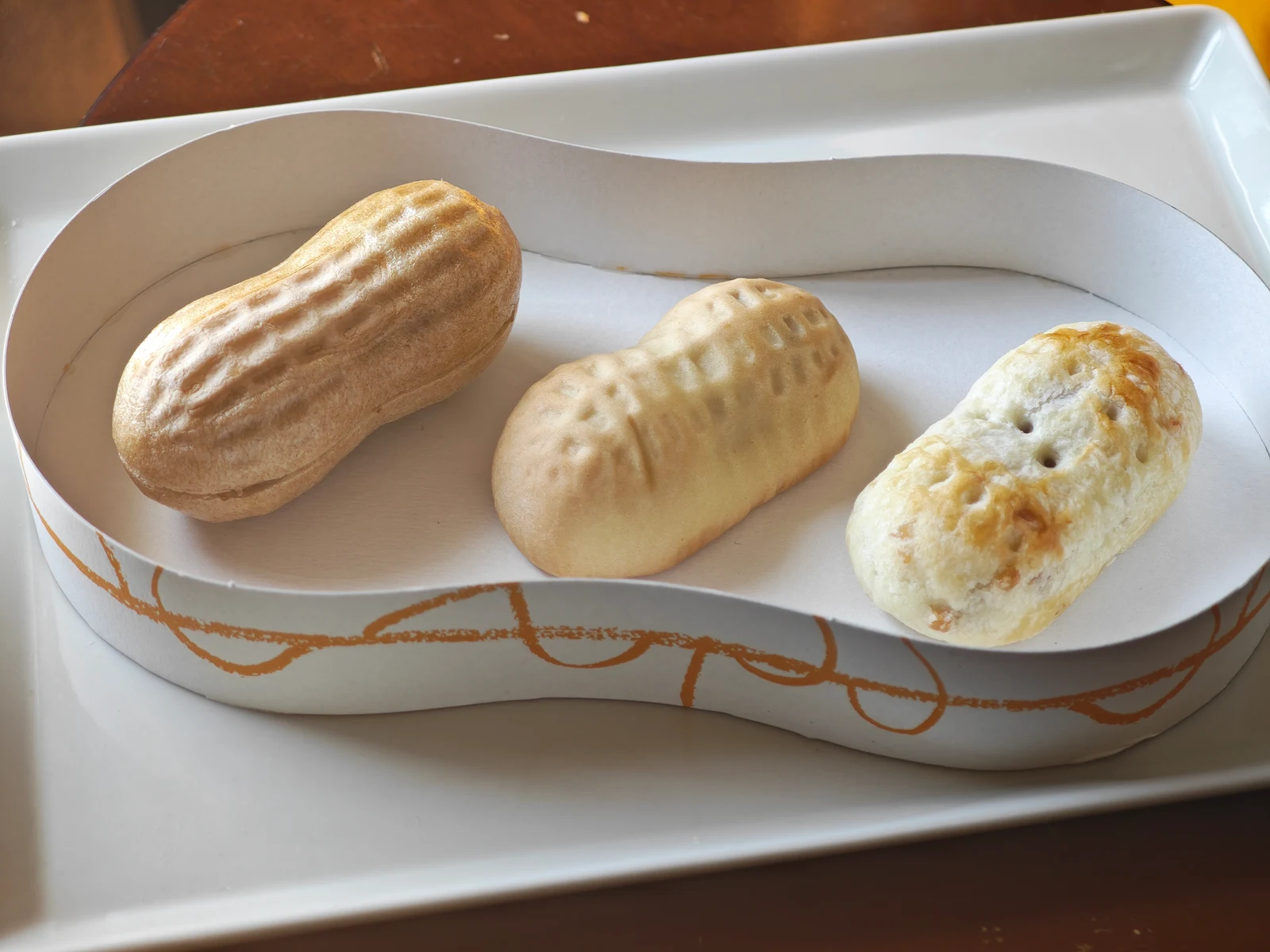
All three share the peanut shape and the peanut paste, but each one teaches something different.
- Peanut Monaka: the original and the clearest expression of peanut paste. Dry, thin wafer against moist filling. Best for understanding the idea.
- Peanut Manju: soft baked dough with peanut paste in it, and a filling that includes peanut pieces. Best for people who like cake-like wagashi.
- Peanut Pie: flaky pastry and peanut filling. The most Western, and the safest choice for anyone new to Japanese sweets.
My recommendation is simple: if in doubt, start with the Monaka. Then try the Manju and Pie and notice how the same filling changes when the shell around it changes. If you eat the Pie first, you will enjoy it; you may also miss how distinctive the paste is on its own.
The box that waves back
There is one more design detail that I only noticed after several sweets had disappeared.
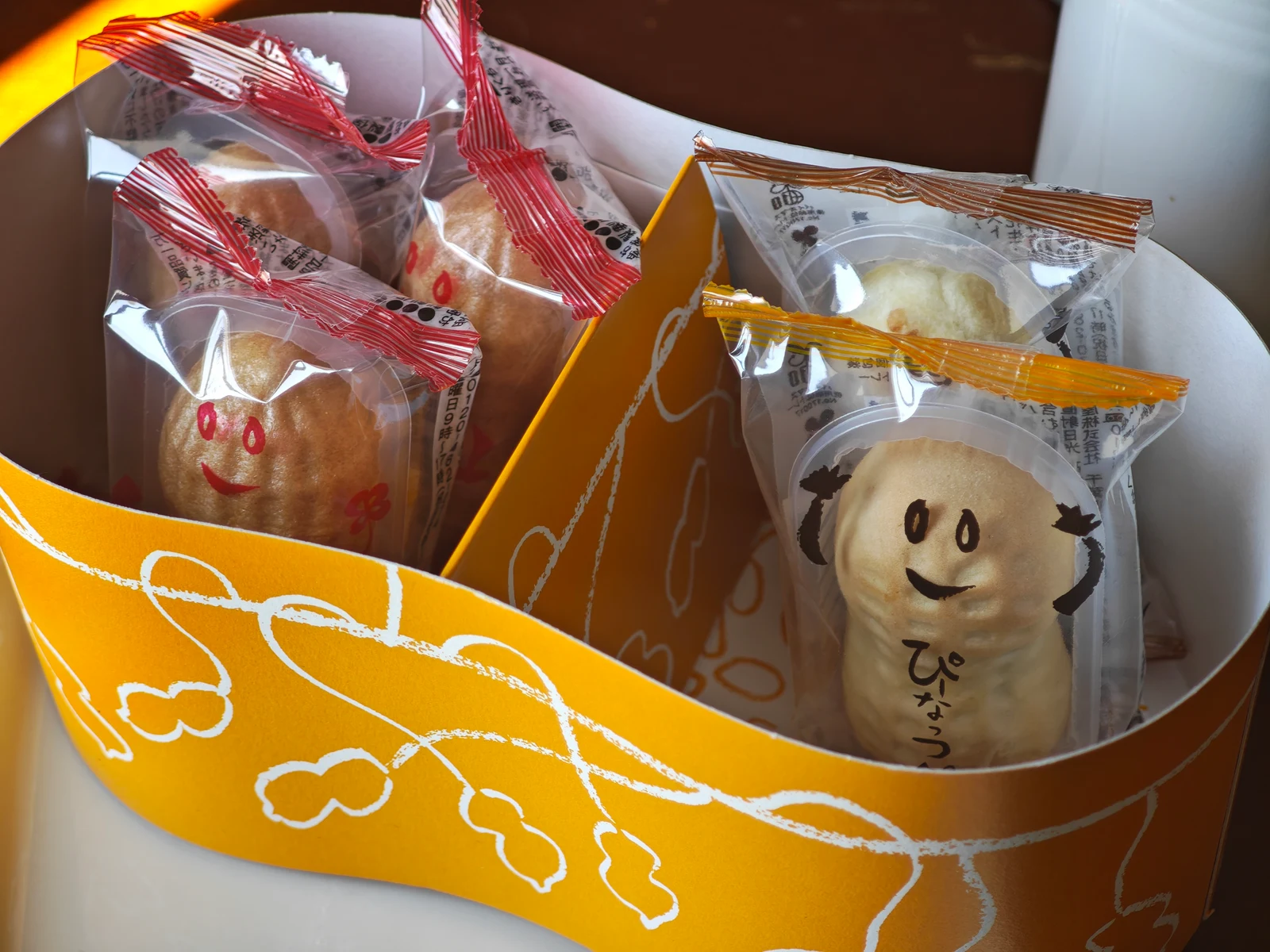
As the box empties, the remaining sweets lean against the inner wall, and the faces printed on their wrappers peek over the edge of the box. The Monaka look up with red cheeks; the Manju appears to be raising both arms.
It may be accidental, but it feels designed. The box becomes less tidy and more lively as you eat through it, as if the survivors are watching to see who is next. It is a cute final touch, and a slightly unsettling one if you are the person deciding who gets eaten.
Ingredients, allergens, nutrition, and storage
Labels change, so always read the package you actually buy. The labels below are from the photographed individual packages; ingredient lists follow the maker’s current published product information.
Peanut Monaka
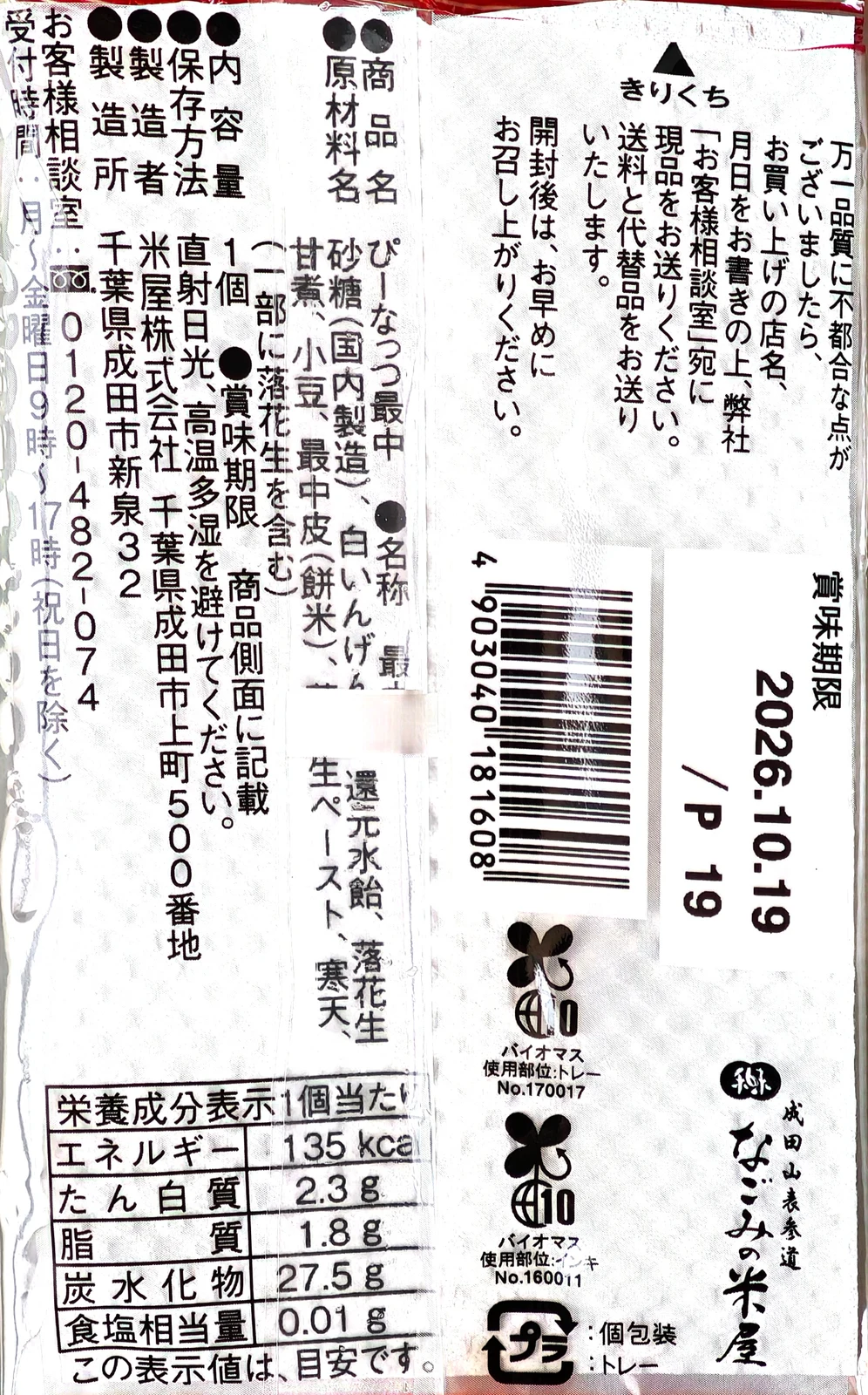
Per piece: 135 kcal, protein 2.3 g, fat 1.8 g, carbohydrate 27.5 g, salt equivalent 0.01 g.
The ingredients are sugar, white kidney beans, reduced starch syrup, sweet-simmered peanuts, azuki beans, a glutinous-rice wafer, peanut paste, and agar. The declared allergen is peanut.
Peanut Manju
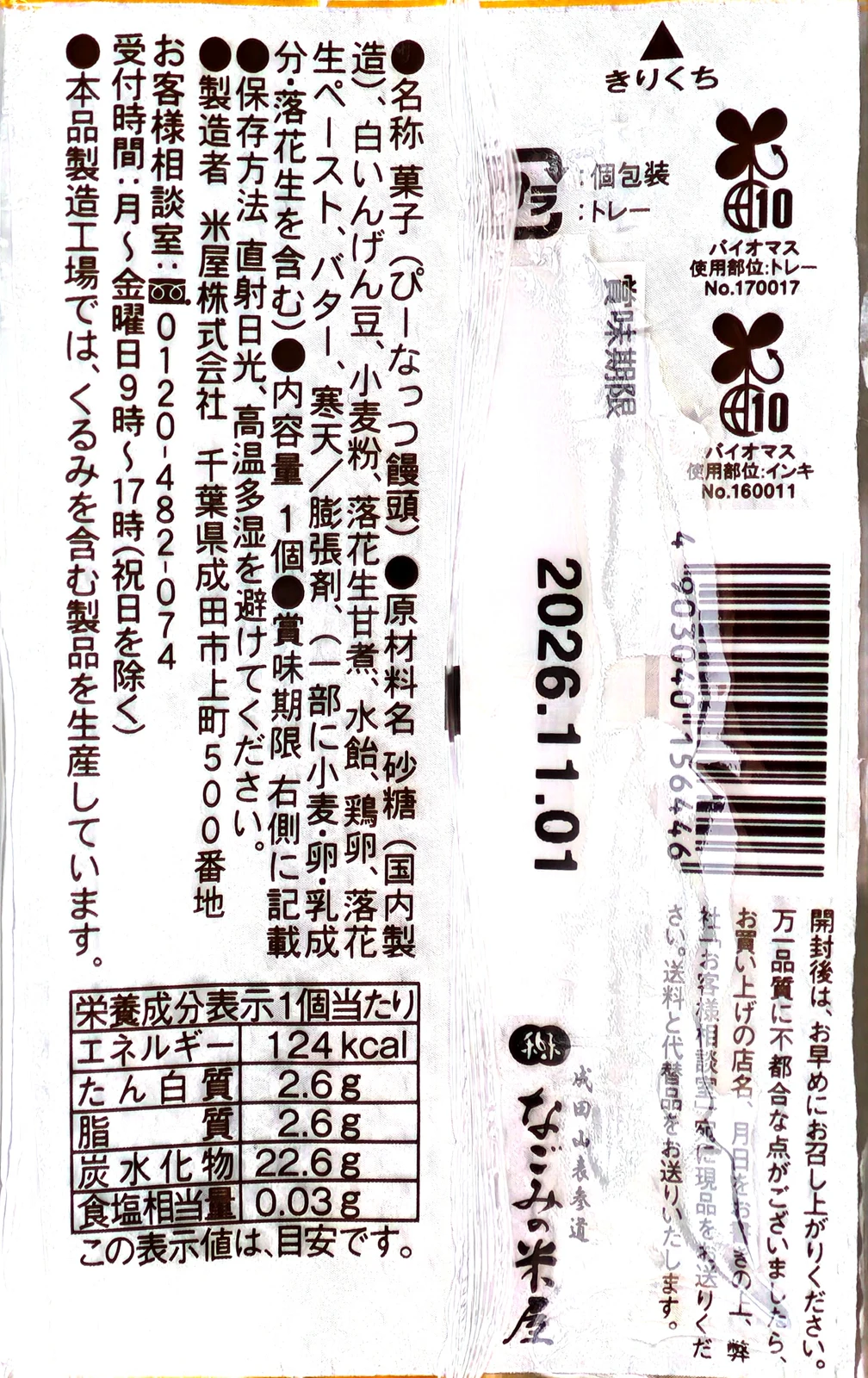
Per piece: 124 kcal, protein 2.6 g, fat 2.6 g, carbohydrate 22.6 g, salt equivalent 0.03 g.
The ingredients are sugar, white kidney beans, wheat flour, sweet-simmered peanuts, starch syrup, egg, peanut paste, butter, agar, and a leavening agent. Allergens are wheat, egg, milk, and peanut.
Peanut Pie
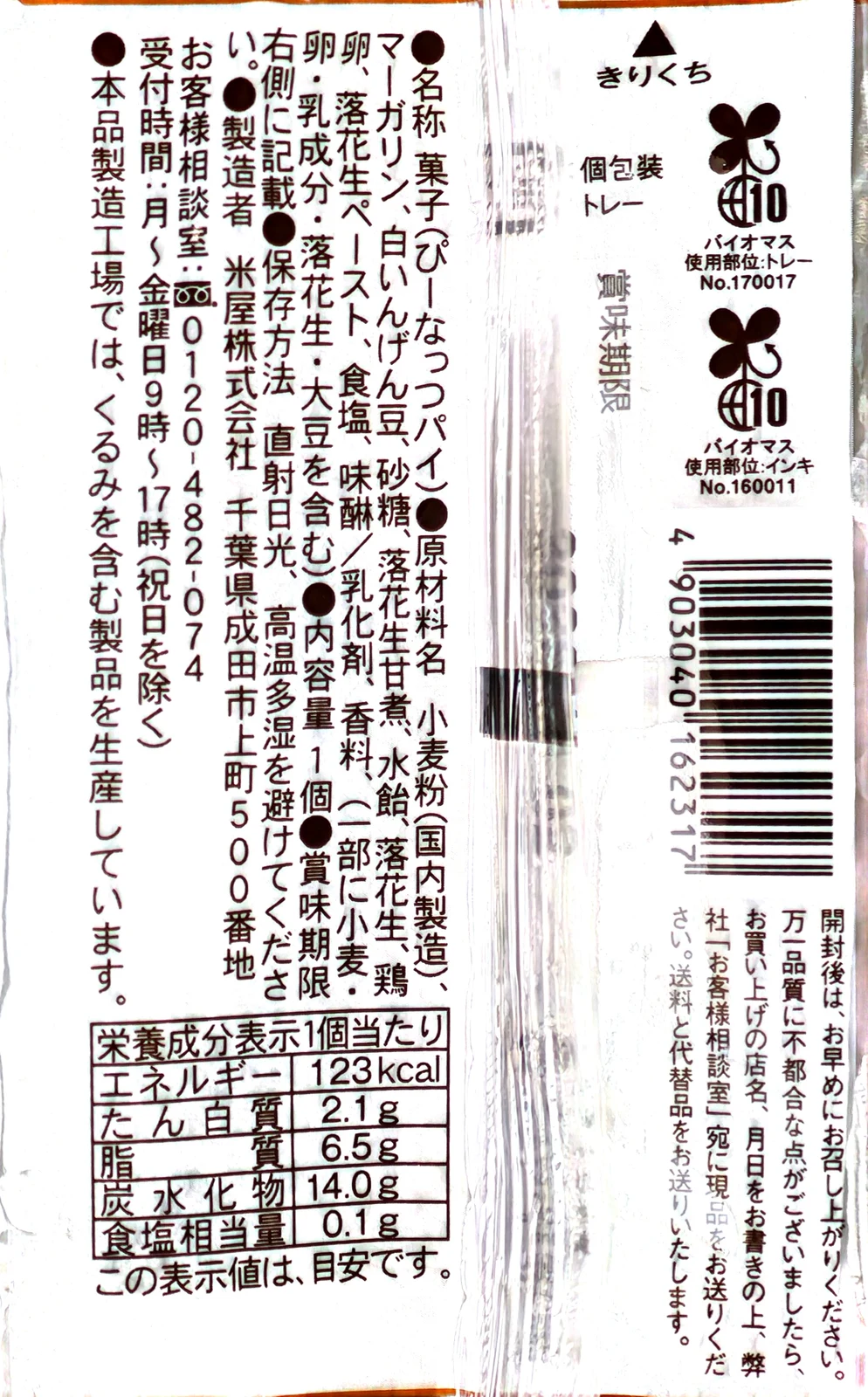
Per piece: 123 kcal, protein 2.1 g, fat 6.5 g, carbohydrate 14.0 g, salt equivalent 0.1 g.
The ingredients include wheat flour, margarine, white kidney beans, sugar, sweet-simmered peanuts, starch syrup, peanuts, egg, peanut paste, salt, and mirin, plus an emulsifier and flavoring. Allergens are wheat, egg, milk, peanut, and soy.
Unsurprisingly for a peanut family, none of these is suitable for anyone with a peanut allergy.
Store the box at room temperature away from heat and direct sunlight, and follow the printed best-before date. The official online shop gives a shelf life of about three weeks for Chiba Meguri, which makes it practical for carrying home from Narita.
Where to buy Peanut Monaka
For many visitors, the first chance to buy Peanut Monaka is not in the city at all. It is at Narita Airport.
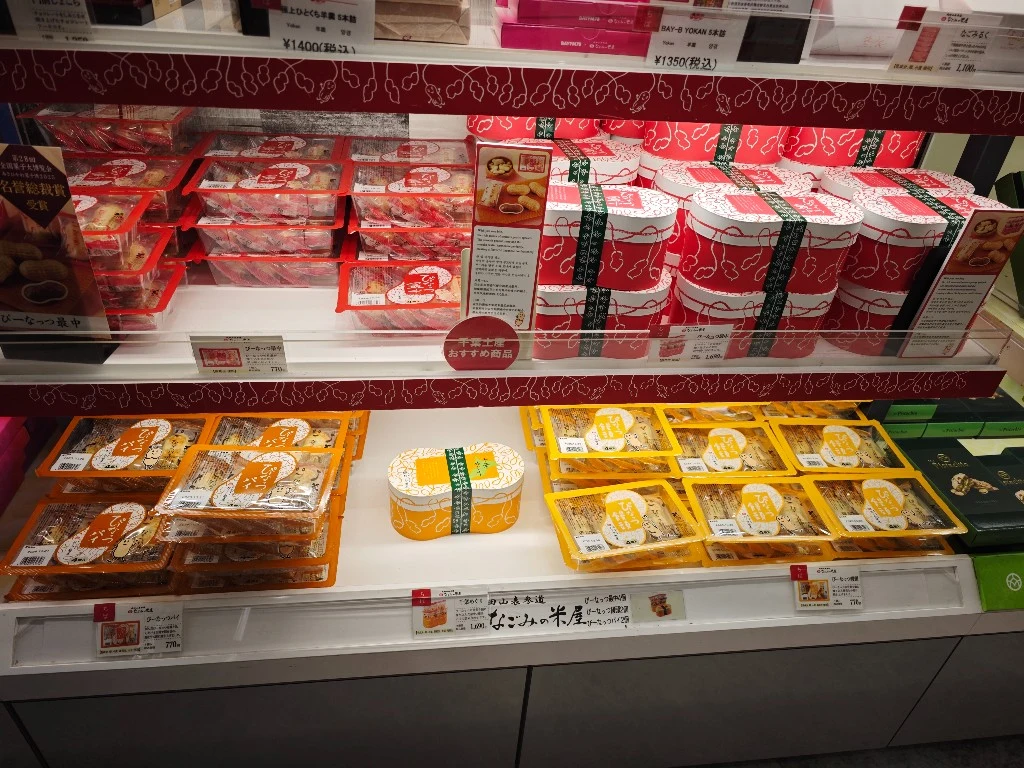
On a recent visit, Nagomi Yoneya’s peanut line was stacked in a clear airport souvenir display: peanut-shaped gift boxes of Peanut Monaka, clear packs of Peanut Pie and Peanut Manju, and a shelf sign recommending it as a Chiba souvenir. If you are flying out of Narita and do not have time for the temple approach, this is the practical last stop. Stock and exact shop locations change, so treat the photo as evidence that the product is sold at the airport, not as a permanent shelf map.
If you have a little more time in Narita itself, the easiest official shops are:
- Nagomi Yoneya Main Store (總本店) on the Naritasan Omotesando, 500 Kamicho, Narita. A good stop when visiting Naritasan Shinshoji.
- JR Narita Station Store in Skytown Narita, 1F, next to JR Narita Station.
Yoneya also operates other stores across northern Chiba, including in Narita, Chiba City, Yachiyo, Kashiwa, and Sakura, plus an official online shop. Department-store regional sweets corners may carry it as well, but availability varies.
At the time of research, the official online shop listed Chiba Meguri in 8-, 12-, and 16-piece boxes. The 12-piece box contained six Monaka, three Manju, and three Pie for 2,520 yen including tax. Peanut Monaka is also sold on its own in several box sizes. Prices, box sizes, and shop hours can change, so check the official Nagomi Yoneya store list before a special trip.
Why Peanut Monaka is a good Chiba souvenir
Peanut Monaka is easy to recommend because it works on several levels at once:
- It represents Chiba through its most famous crop.
- It uses a classic wagashi form that visitors may not have tried before.
- It comes from a temple-town confectioner with roots in 1899.
- It shows how a modern regional sweet can be invented, refined, and extended.
- It is cute enough for children and interesting enough for people who read ingredient lists for fun.
Most of all, it proves that a regional sweet does not need to be ancient to be meaningful. Sometimes the newer arrival is the one that finds a fresh way to carry the region forward.
Frequently asked questions
What is Peanut Monaka?
Peanut Monaka is a Chiba souvenir made by Nagomi Yoneya in Narita. A peanut-shaped rice wafer holds a sweet bean paste made with sweet-simmered peanuts and peanut paste.
Is Peanut Monaka a traditional Japanese sweet?
The monaka format is traditional. Peanut Monaka itself is modern: it launched in October 1998. Its maker, however, dates back to 1899 and began with chestnut yokan for Naritasan pilgrims.
Does Peanut Monaka taste like peanut butter?
Not really. The filling is a Japanese bean paste built around white kidney beans and sweet-simmered peanuts. It has a roasted peanut aroma, but it is softer, less oily, and less salty than peanut butter.
Why is Chiba famous for peanuts?
Peanut cultivation in Chiba began in 1876, and the prefecture now grows roughly 80 percent of Japan’s domestic peanuts. Yachimata is the best-known growing area.
Which should I try first: Monaka, Manju, or Pie?
Start with the Monaka. It shows the peanut paste most clearly. Then compare the soft Manju and the flaky, Western-style Pie.
Where can I buy it near Narita Airport?
Peanut Monaka is sold at Narita Airport souvenir counters. For official shops in the city, try Nagomi Yoneya’s main store on the Naritasan Omotesando approach or its JR Narita Station store. Other Chiba branches and the official online shop also sell it.
Affiliate disclosure: Some links above may be affiliate links. If you buy through them, I may earn a commission at no extra cost to you.