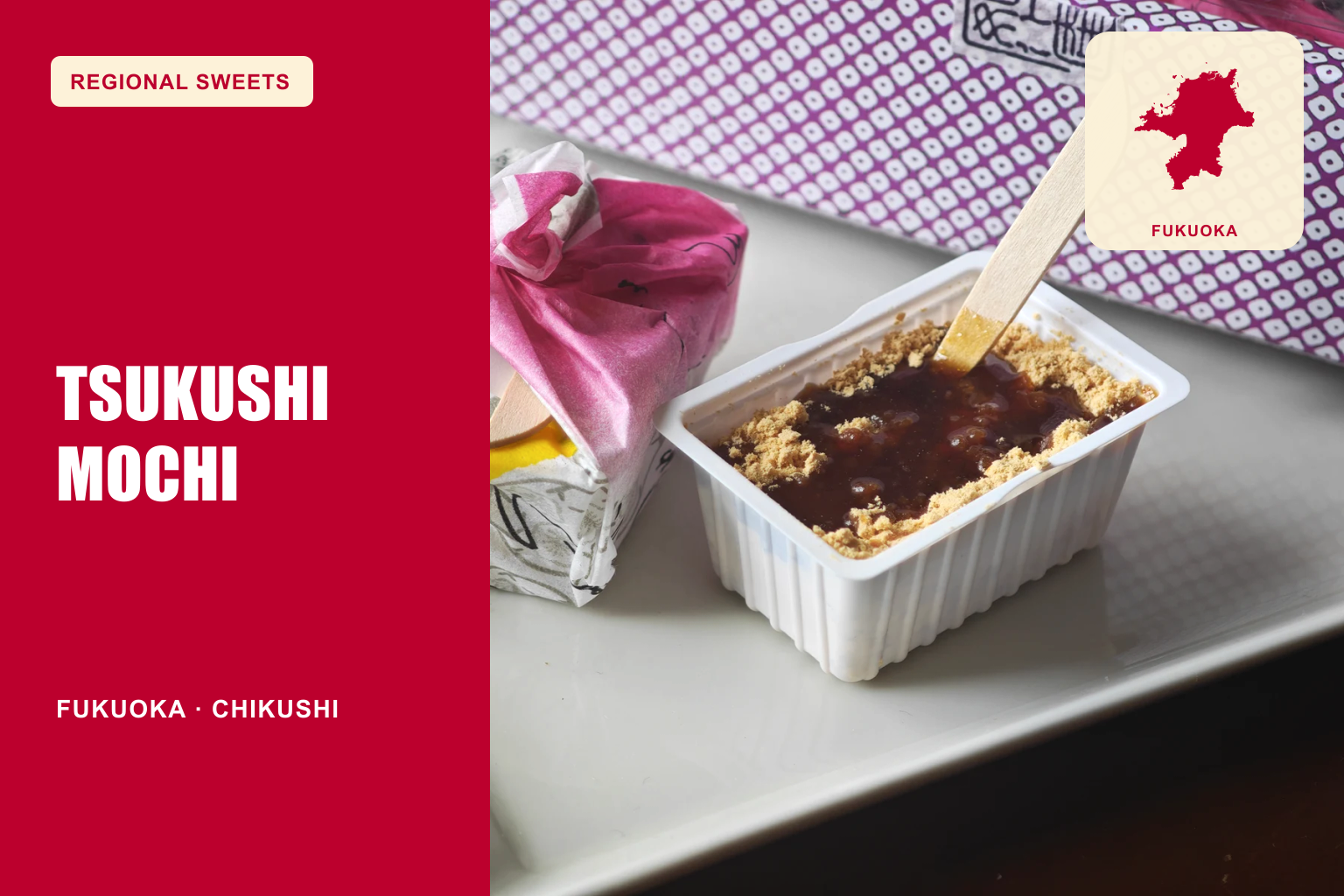
Tsukushi Mochi looks like a small tray of kinako-covered rice cakes with a packet of dark syrup. That description is accurate in the same way that “Dazaifu is an old town” is accurate: it leaves out most of the reason to care.
Josuian’s Fukuoka souvenir links a founder’s memory of his grandmother’s kinako mochi to local rice, carefully roasted soybean flour, a Shinkansen-era development story, and two plum poems from Japan’s oldest surviving poetry anthology. Then it gives you a wooden pick and quietly leaves you responsible for the powder.
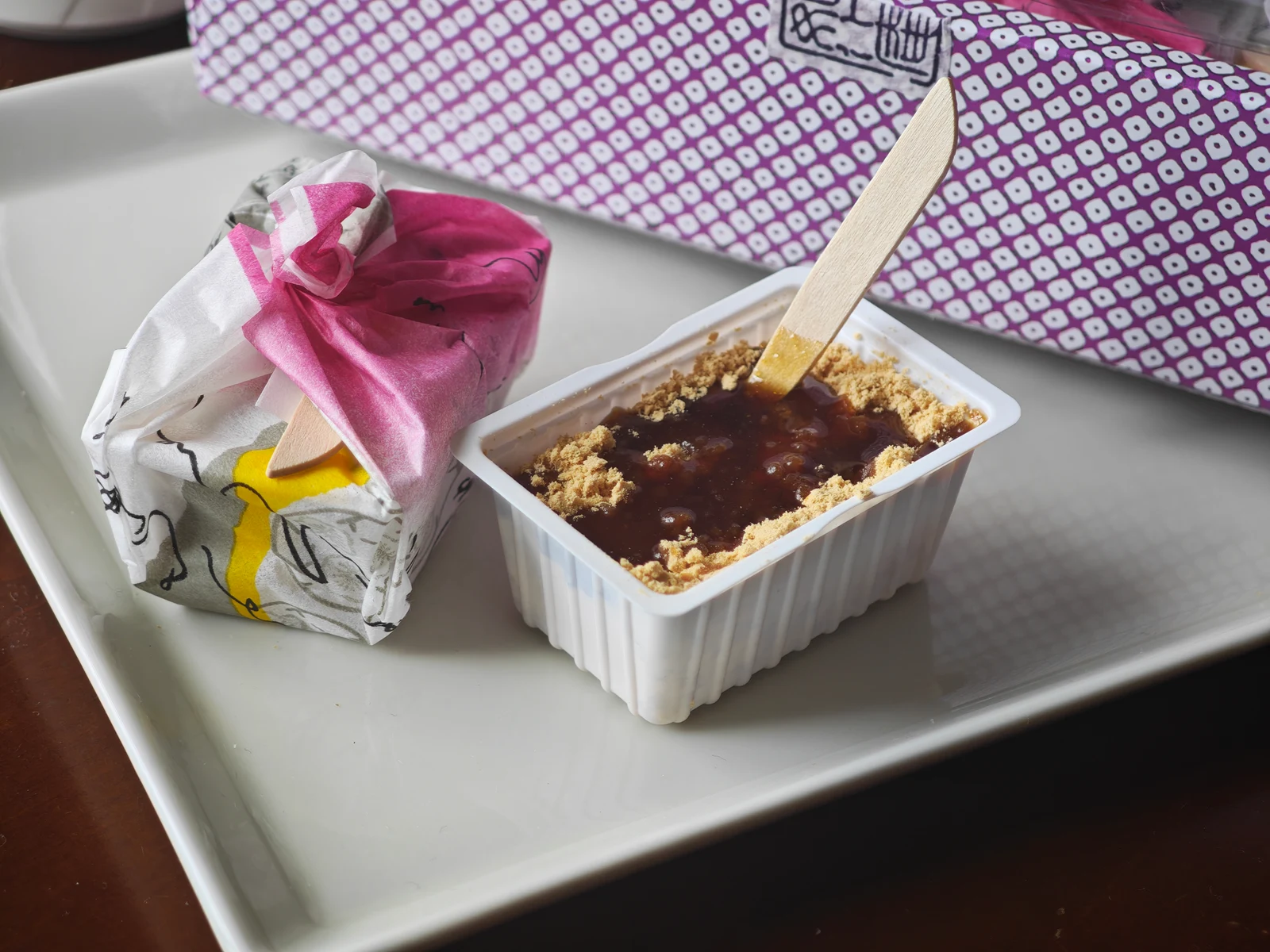
Quick take: Tsukushi Mochi (筑紫もち) is a Fukuoka wagashi launched by Josuian in 1977. Each serving contains three soft pieces of rice-blend mochi under aromatic Tamahomare kinako, plus separate kuromitsu and a wooden pick. Spread the wrapper beneath the tray before eating, loosen the surface, and open gaps between the pieces so the syrup reaches the kinako at the bottom. Your snack will taste better, and the train seat beside you will not become part of the recipe.
What is Tsukushi Mochi?
Tsukushi Mochi is a regional kinako-mochi souvenir made by Chikushi Kasho Josuian (筑紫菓匠 如水庵) in Fukuoka.
One serving contains:
- three bite-size pieces of mochi
- a generous layer of kinako, or roasted soybean flour
- a separate packet of kuromitsu, a dark brown-sugar syrup
- a small wooden pick
The photographed gift box held six individually wrapped servings.
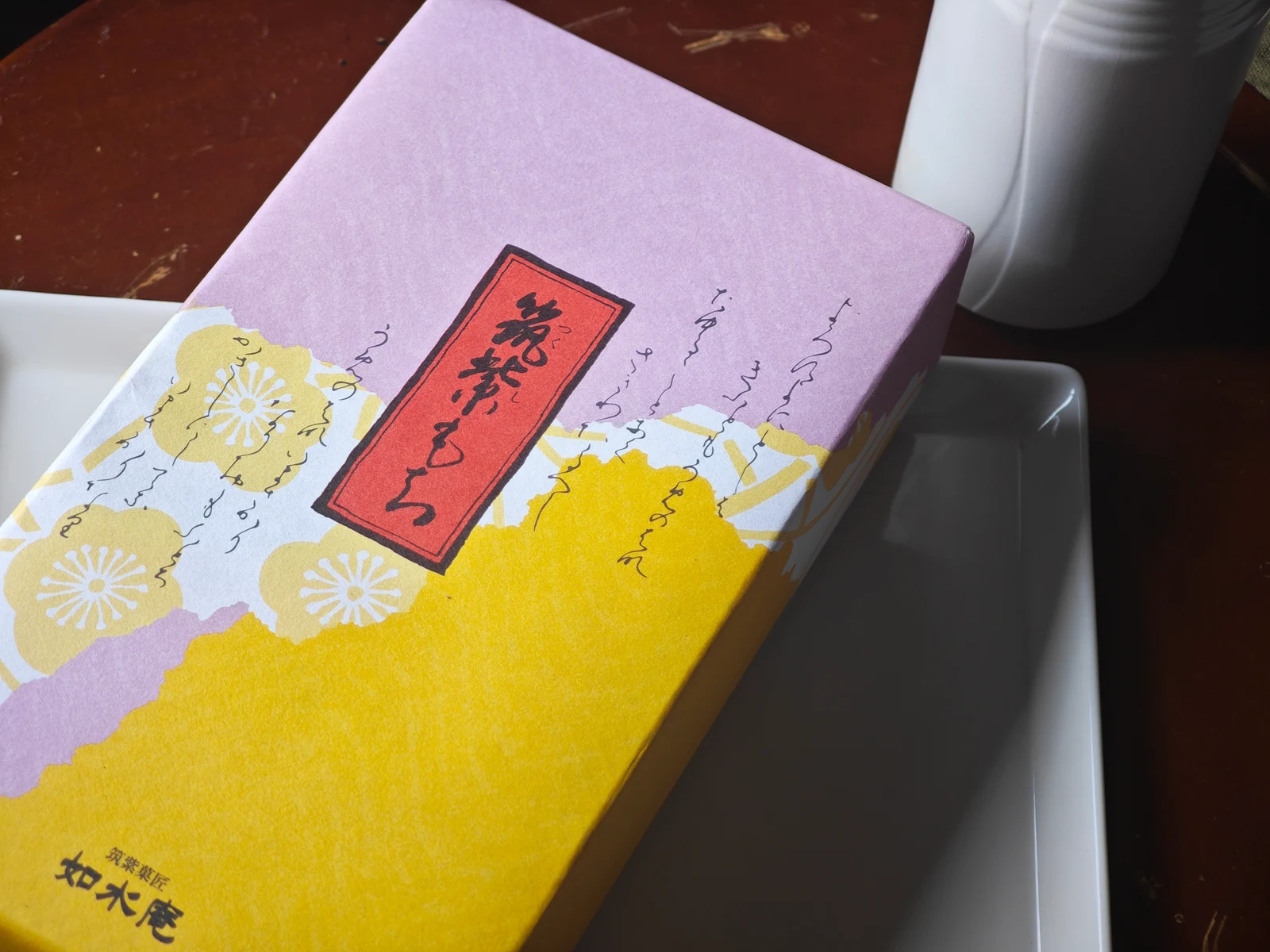
The official reading is Tsukushi Mochi. If a Fukuoka resident says Chikushi Mochi, that is not a different sweet. Josuian explains that people outside the region usually read 筑紫 as Tsukushi, while local residents commonly say Chikushi; the company accepts both.
That small pronunciation question already reveals what the product is trying to do. It is not only a portable dessert. It carries the old regional name Tsukushi into a modern station souvenir shop.
The seal makes the box feel older than 1977
Before the mochi appears, a paper seal closes the purple wrapping.
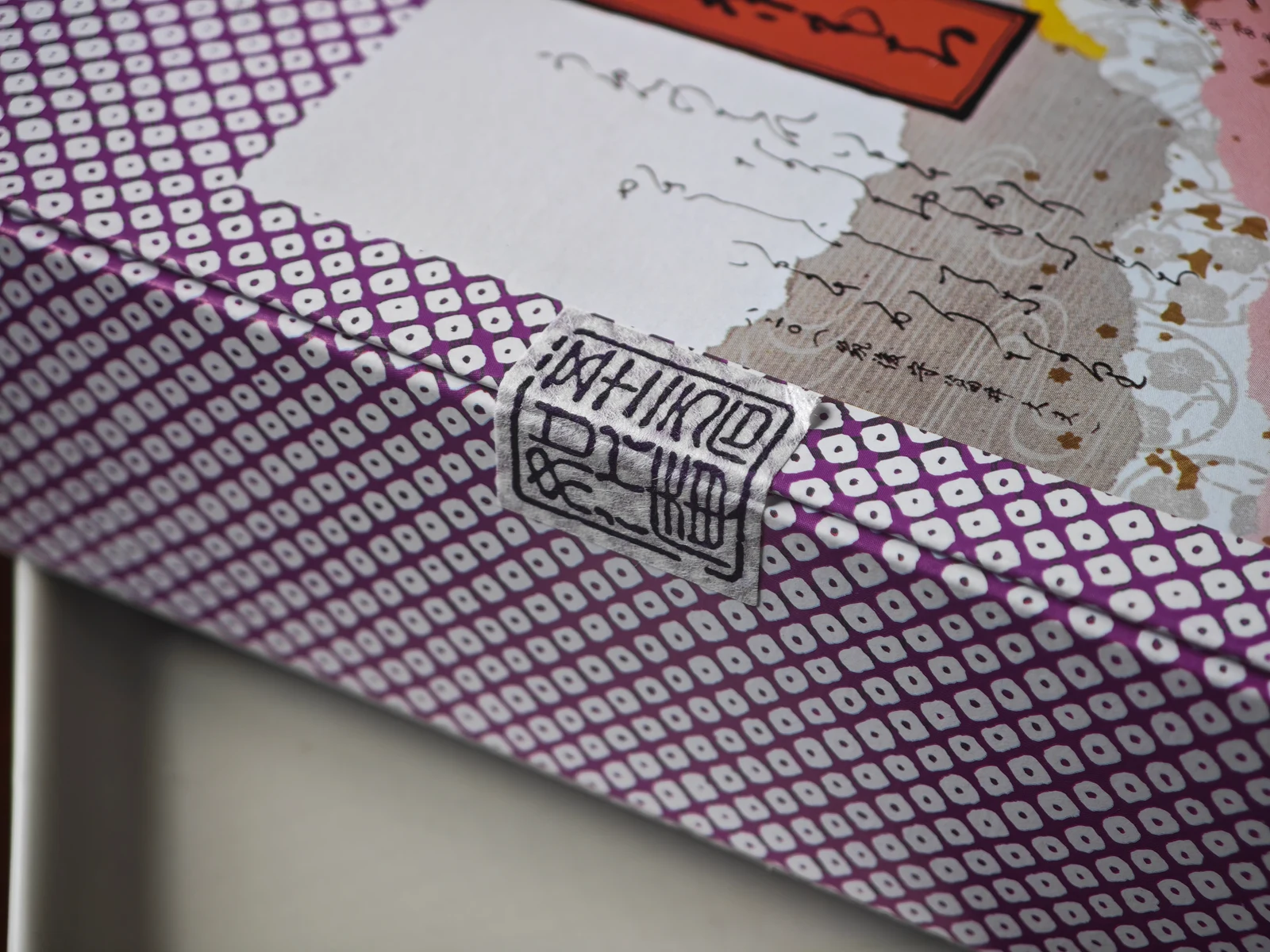
Its carved, stamp-like design gives the package a formal gravity. There is something pleasantly disproportionate about applying the visual authority of an ancient document to six trays of kinako mochi. Yet the mood is not accidental: poems, plum blossoms, old place names, and seal imagery all prepare the buyer for the cultural story inside.
The two Manyoshu poems on the package
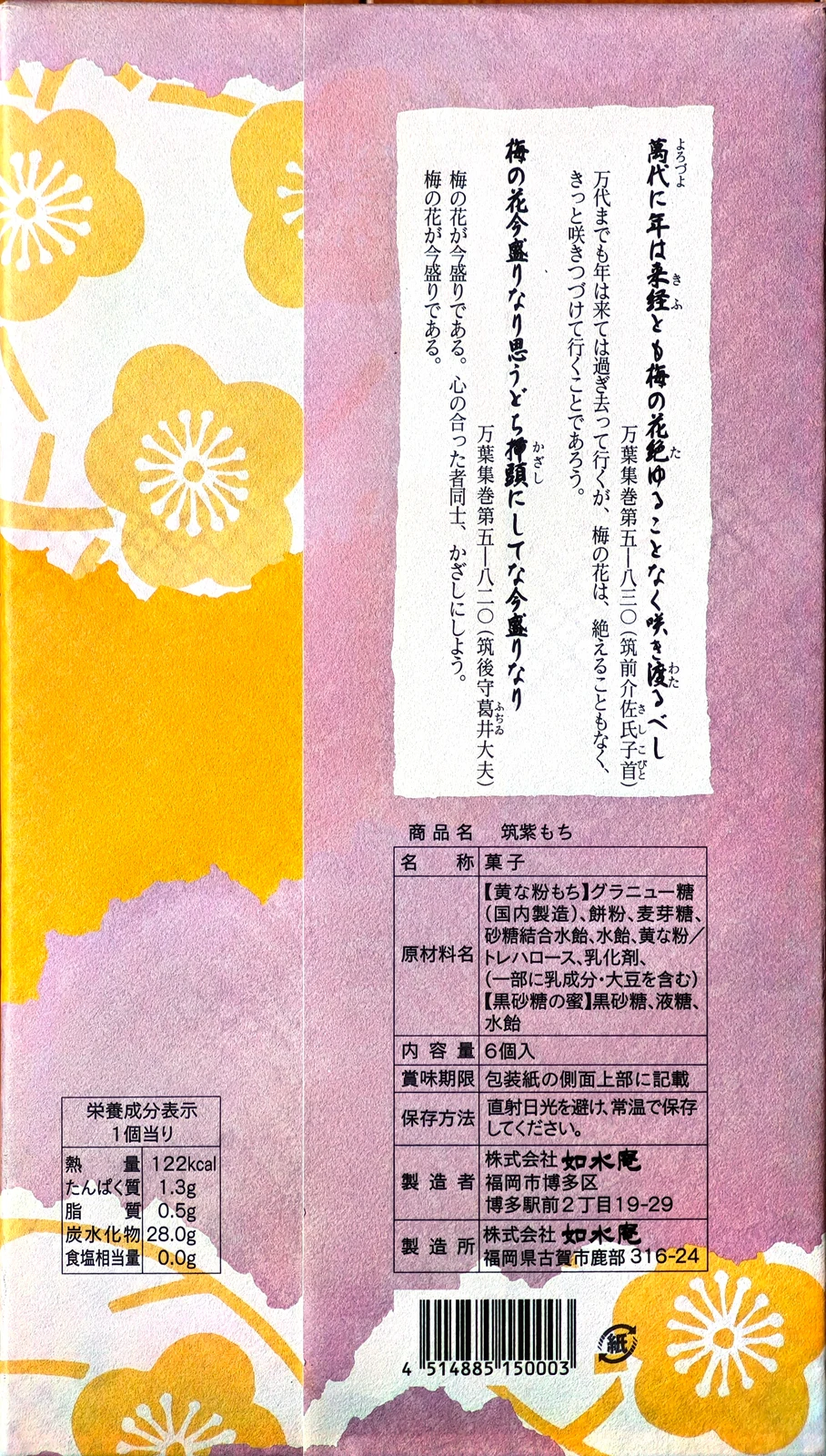
The wrapping carries two poems from the Manyoshu, compiled in the eighth century and generally regarded as Japan’s oldest surviving anthology of Japanese poetry.
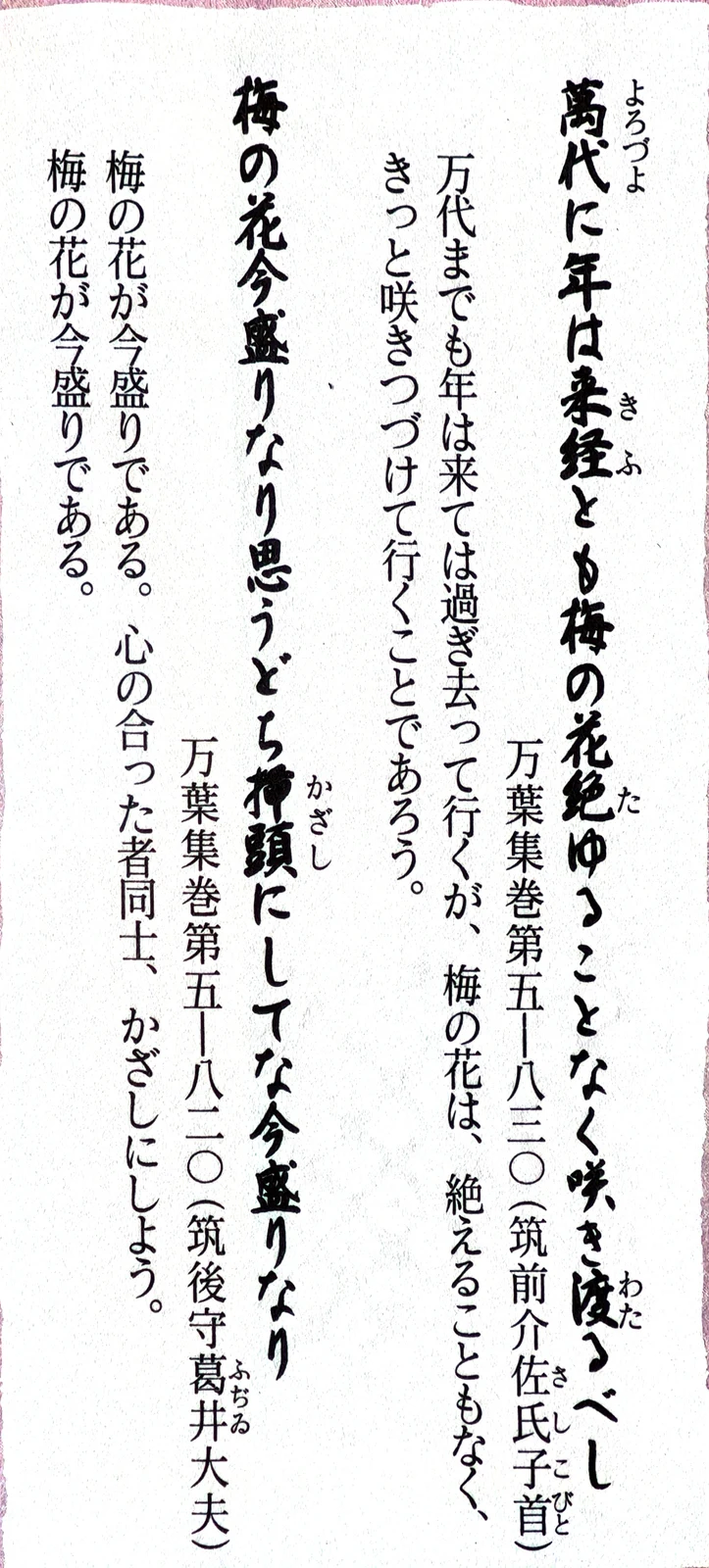
The first is attributed on Josuian’s material to Chikuzen no Suke Sa no Ujikobito:
萬代に年は来経とも梅の花 絶ゆることなく咲き渡るべし
A careful English rendering is:
Even as years come and pass through ten thousand generations, may the plum blossoms never cease, but keep blooming everywhere.
The second is attributed to Chikugo no Kami Fujii no Taifu:
梅の花 今盛りなり思ふどち 挿頭にしてな 今盛りなり
In English:
The plum blossoms are at their height. Come, kindred friends, let us wear them in our hair—now, while they are in full bloom.
These are not generic poems selected because plum blossoms look elegant on a box. They belong to the group of 32 plum poems associated with a gathering at the Dazaifu residence of statesman and poet Otomo no Tabito on January 13, 730.
Josuian says that 596 of the Manyoshu’s 4,516 poems were composed in the ancient land of Tsukushi. The company uses the poems to express the openness and simplicity it associates with the people of that world.
Why the package also speaks to modern Japan
The included history panel begins with the phrase “Hear the poems of the Manyoshu…”
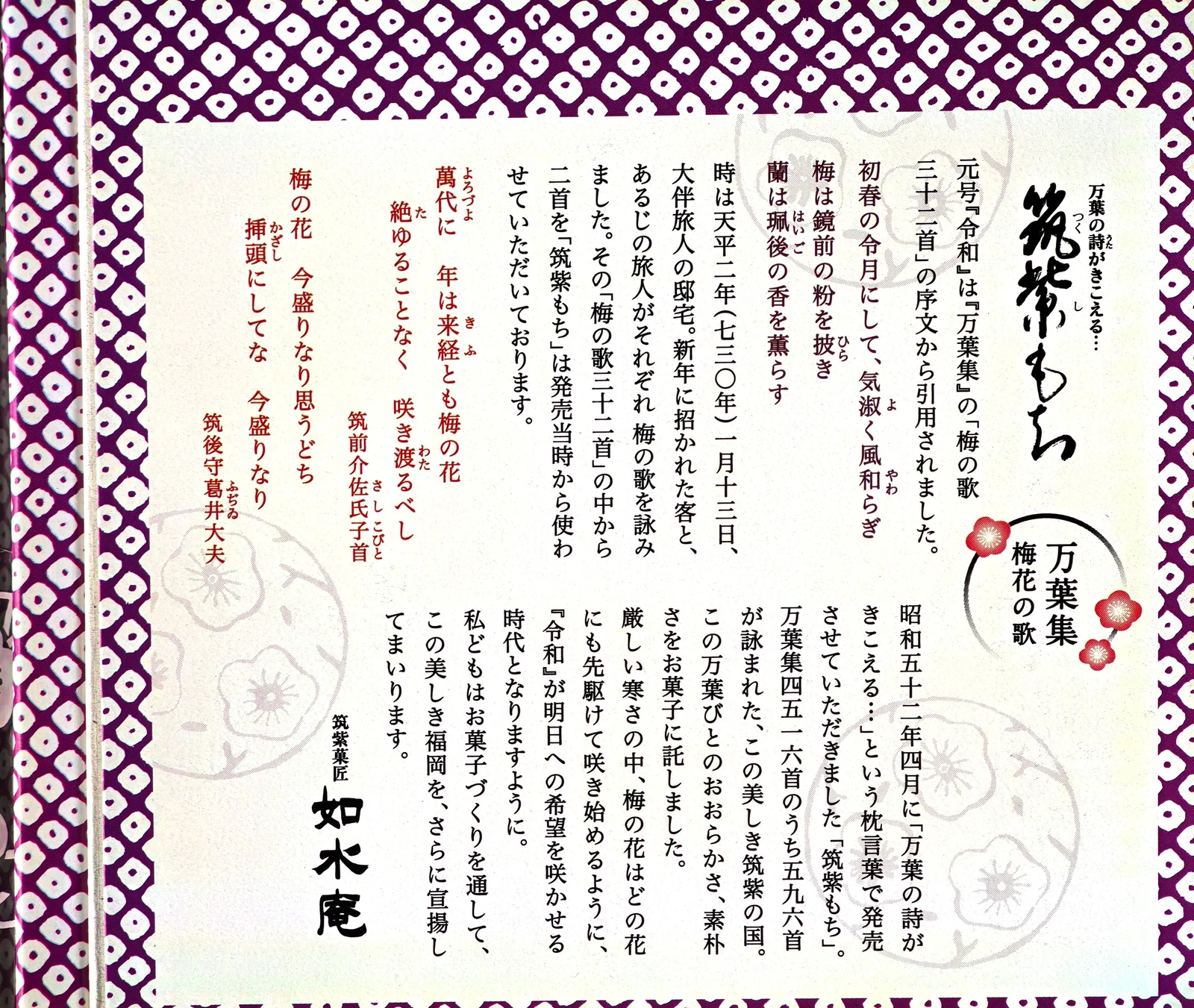
The product’s literary reference gained a new layer in 2019. Japan’s era name Reiwa was drawn from the preface to the same Manyoshu sequence of 32 plum poems.
An important distinction: the two verses printed on Tsukushi Mochi did not themselves supply the characters 令和. The source was the sequence’s preface. The connection is nevertheless close—same anthology, same plum gathering, same Dazaifu setting.
The longer heritage pamphlet places that poetry beside Josuian’s confectionery history.
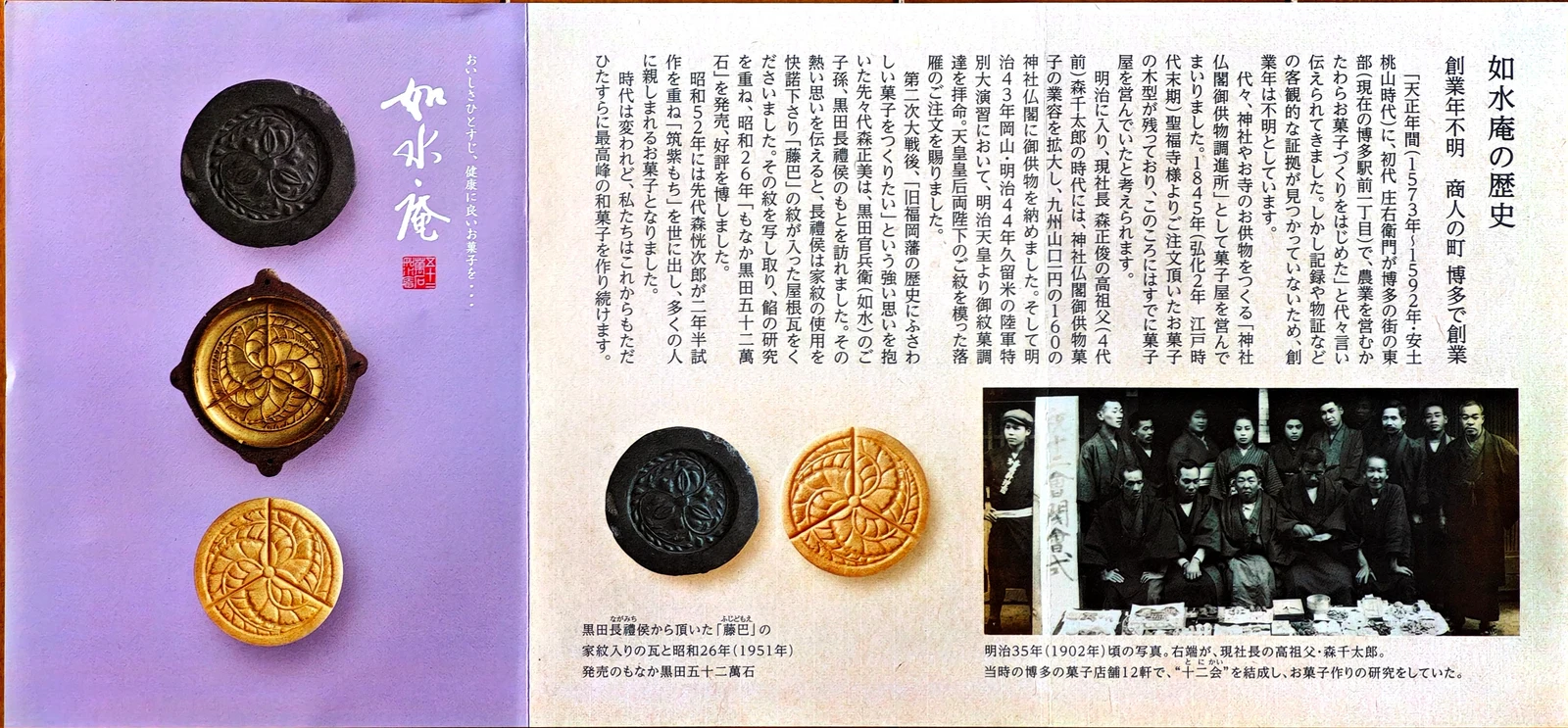
For an overseas traveler, this is a compact introduction to how Japanese souvenirs often work. The food is small, but the package may carry literature, geography, local memory, seasonal symbolism, and enough historical context to make opening dessert feel like beginning a minor archive.
A Shinkansen souvenir that arrived two years late
Tsukushi Mochi was released on April 28, 1977.
Josuian says it had originally been developed to commemorate the Shinkansen’s 1975 arrival in Hakata. The company did not believe the product was good enough to sell on schedule. After roughly two and a half years of trials, it reached stores in 1977—two years after the event it had been intended to mark.
That delay is more revealing than a perfectly timed launch. The sweet now feels ideally suited to train travel, but it did not reach the platform until the maker was satisfied with the taste.
The key idea came from Kojiro Mori’s childhood. When he was struggling with the new product, his mother advised him to make the sweet he most wanted to eat. He remembered the kinako mochi made by his maternal grandmother near Yanagawa.
Her version used mochi that had become firm, softened again by grilling and hot water, covered with kinako, and topped with crushed brown sugar. As the sugar slowly melted, mochi, soybean flour, and syrup came together. Tsukushi Mochi turns that remembered combination into an individually packed Fukuoka gift.
Opening the six-piece box
Inside the wrapping, the photographed box reveals six bundles arranged in two rows.
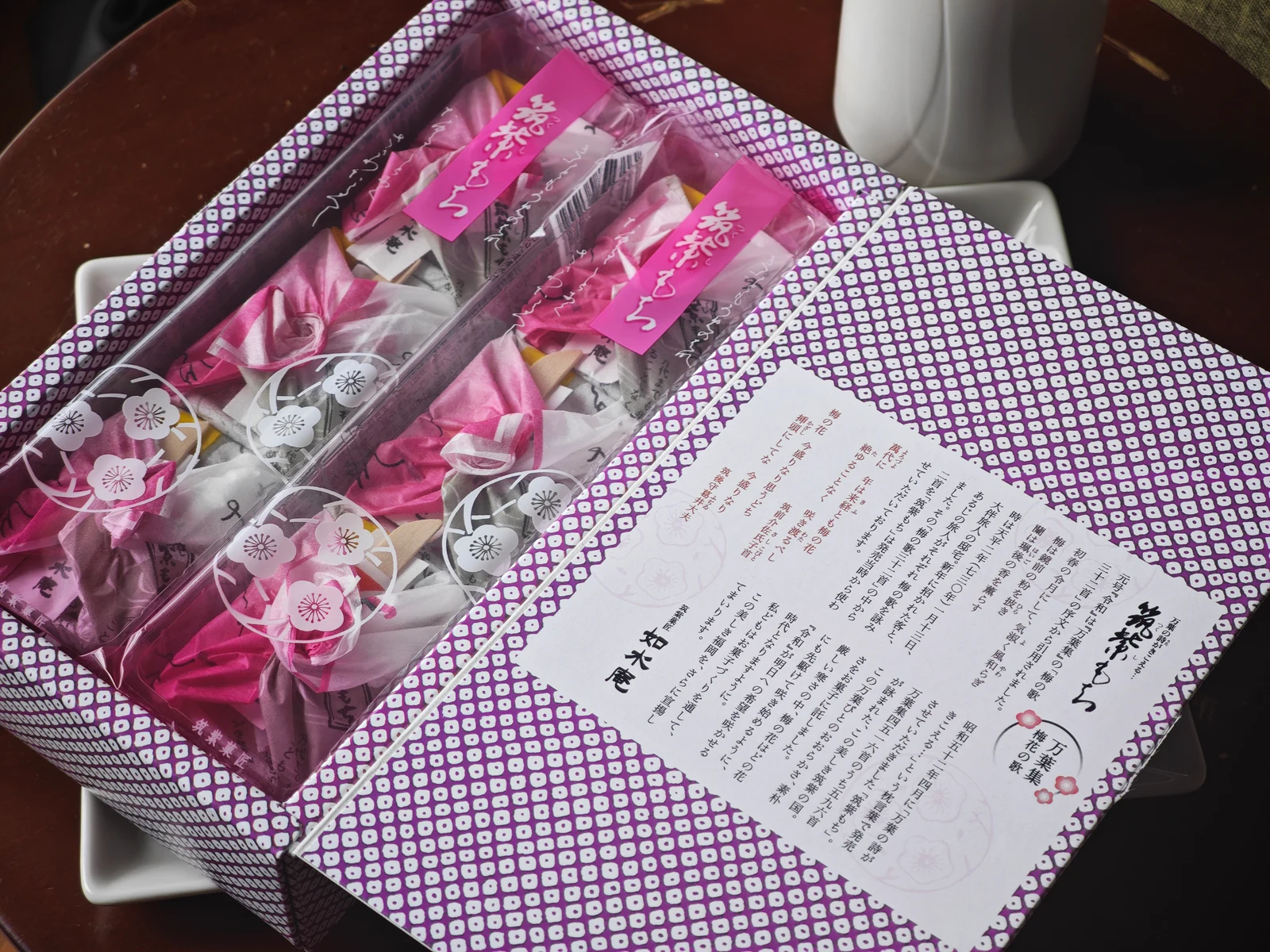
Each serving is tied visually like a tiny furoshiki parcel.
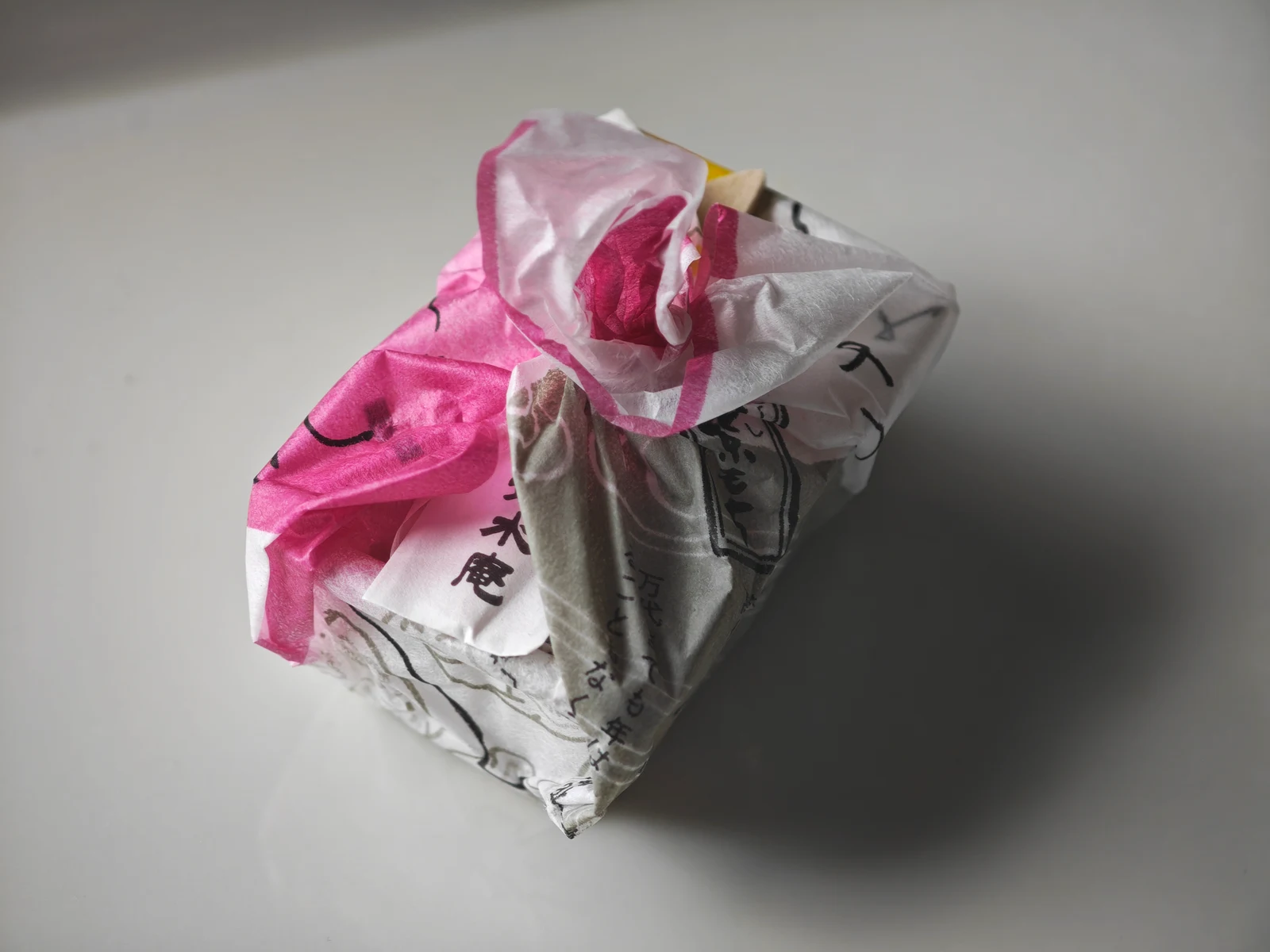
This is not a reusable cloth furoshiki, but the folding gives one portion the feeling of a personal gift. Unwrap it and three tools appear: food, sauce, and the means to negotiate between them.
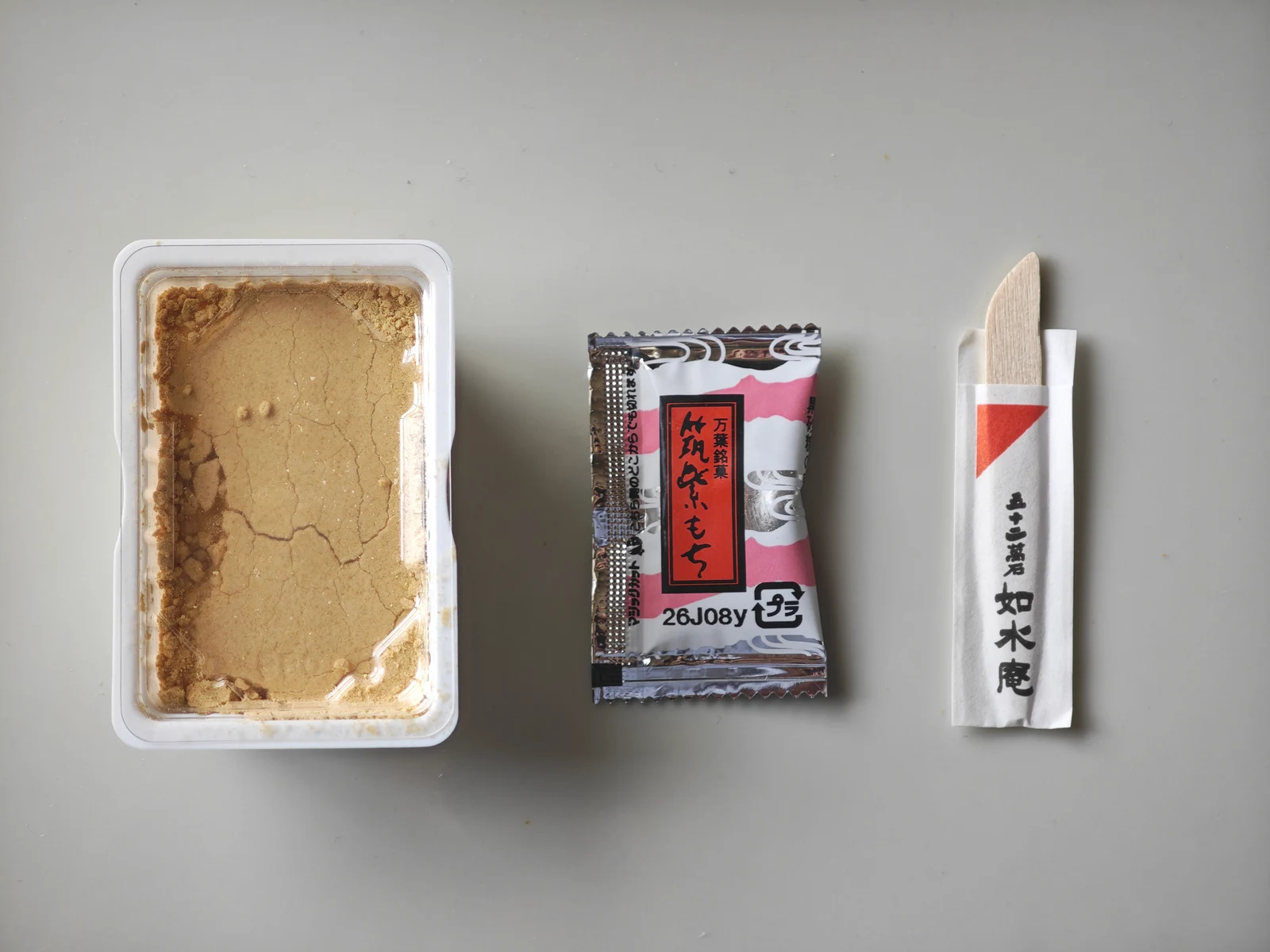
The simple inventory matters. Kuromitsu is separate, so you control the sweetness and where the syrup lands. The pick is not decorative; it can improve the distribution.
What makes the mochi and kinako distinctive?
Josuian’s product page foregrounds Hiyoku rice associated with the Tsukushi Plain. Its more detailed current materials explain that the mochi uses a blend that includes Hiyoku rice from Saga and Kumamoto as well as rice such as Kogane Mochi from Toyama. It is therefore safer to describe this as a carefully selected rice blend—not as 100 percent Hiyoku rice.
The rice flour is steamed, sweetened, kneaded, and rested overnight to develop what the maker describes as softness with a clean, springing bite. Josuian also describes using treated natural groundwater in its confectionery production.
The kinako receives an equally specific explanation. Josuian identifies the soybean variety as Tamahomare, which it says represents only about 0.5 percent of Japan’s domestic soybean harvest and has greater sweetness than many varieties. The beans are roasted to a controlled degree, their skins are removed, and then they are ground to draw out more aroma, sweetness, and a smoother melt.
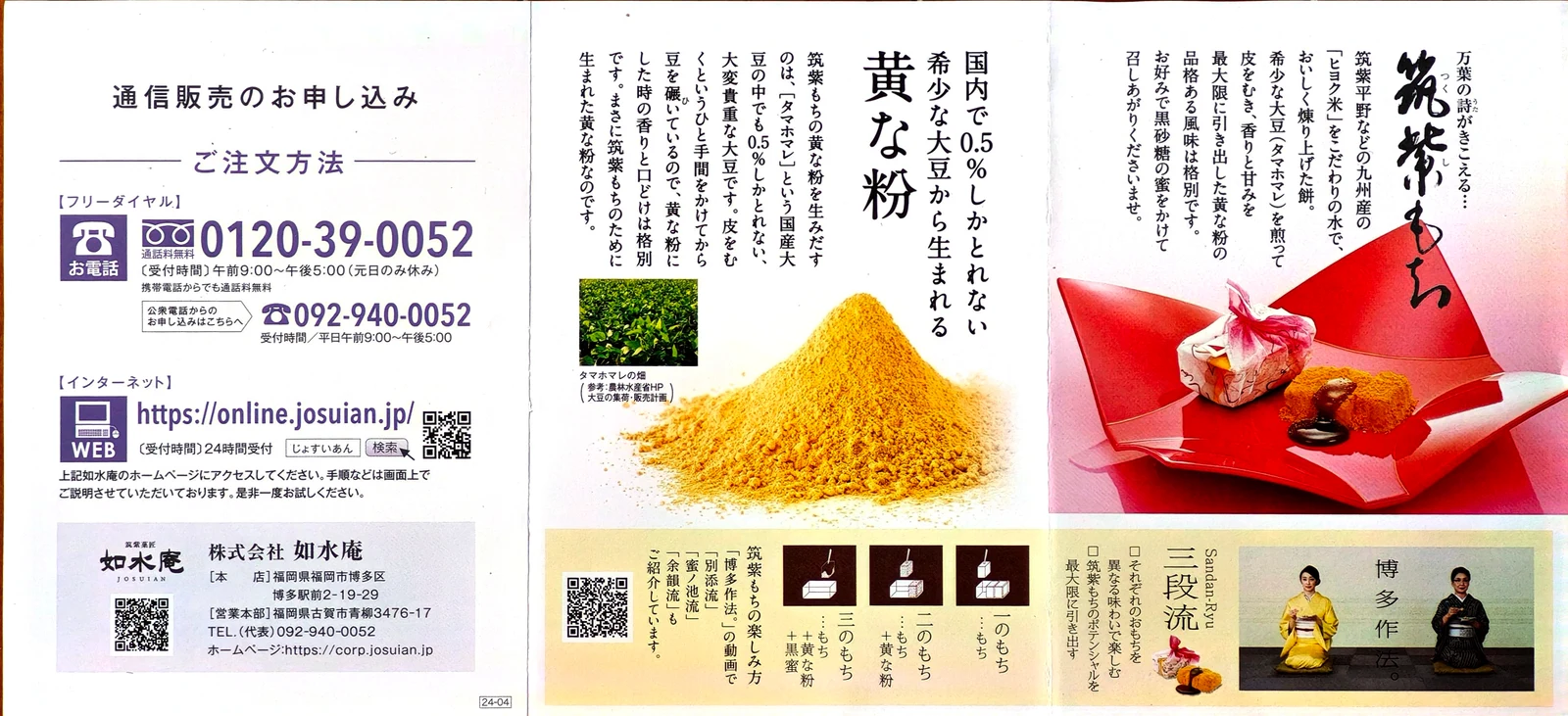
Kinako is sometimes translated as “soybean powder,” which is technically useful and emotionally hopeless. Good kinako is fragrant: warm, nutty, slightly sweet, and roasted. Here it is not a beige coating added merely to stop the mochi sticking together. It is one of the three main flavors.
The separate kuromitsu completes the remembered combination. In the photographed package, the syrup ingredients are brown sugar, liquid sugar, and starch syrup.
The best way to eat Tsukushi Mochi without redecorating the train
The individual wrapper has a second job. Spread it under the open tray before you touch the kinako.
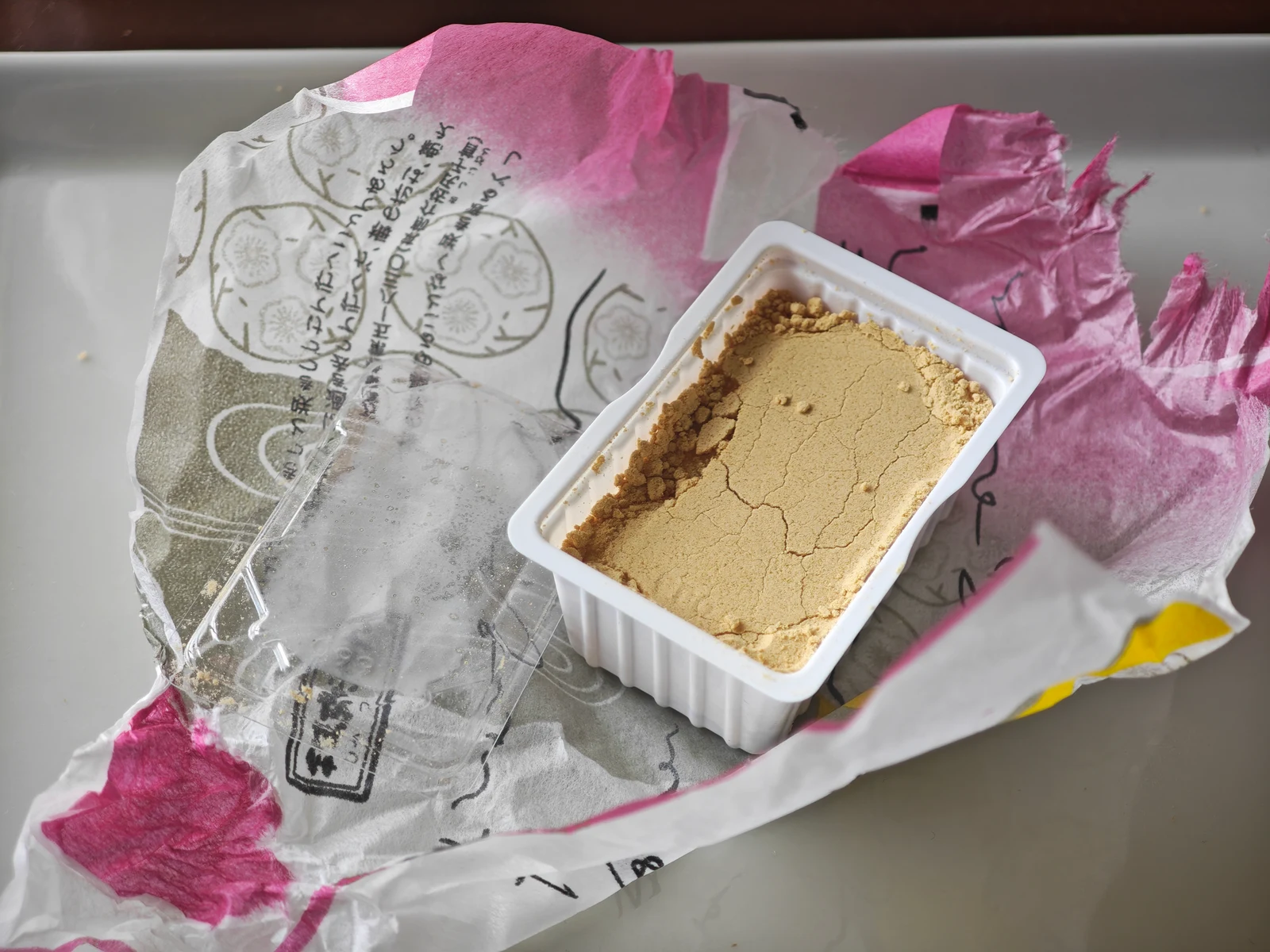
At home, this is convenient. On a Shinkansen tray table, it is close to essential. Kinako is delicious, light, dry, and apparently interested in visiting every nearby surface.
Next, use the included pick to disturb the compacted powder and lightly loosen the smooth upper surface around the mochi.
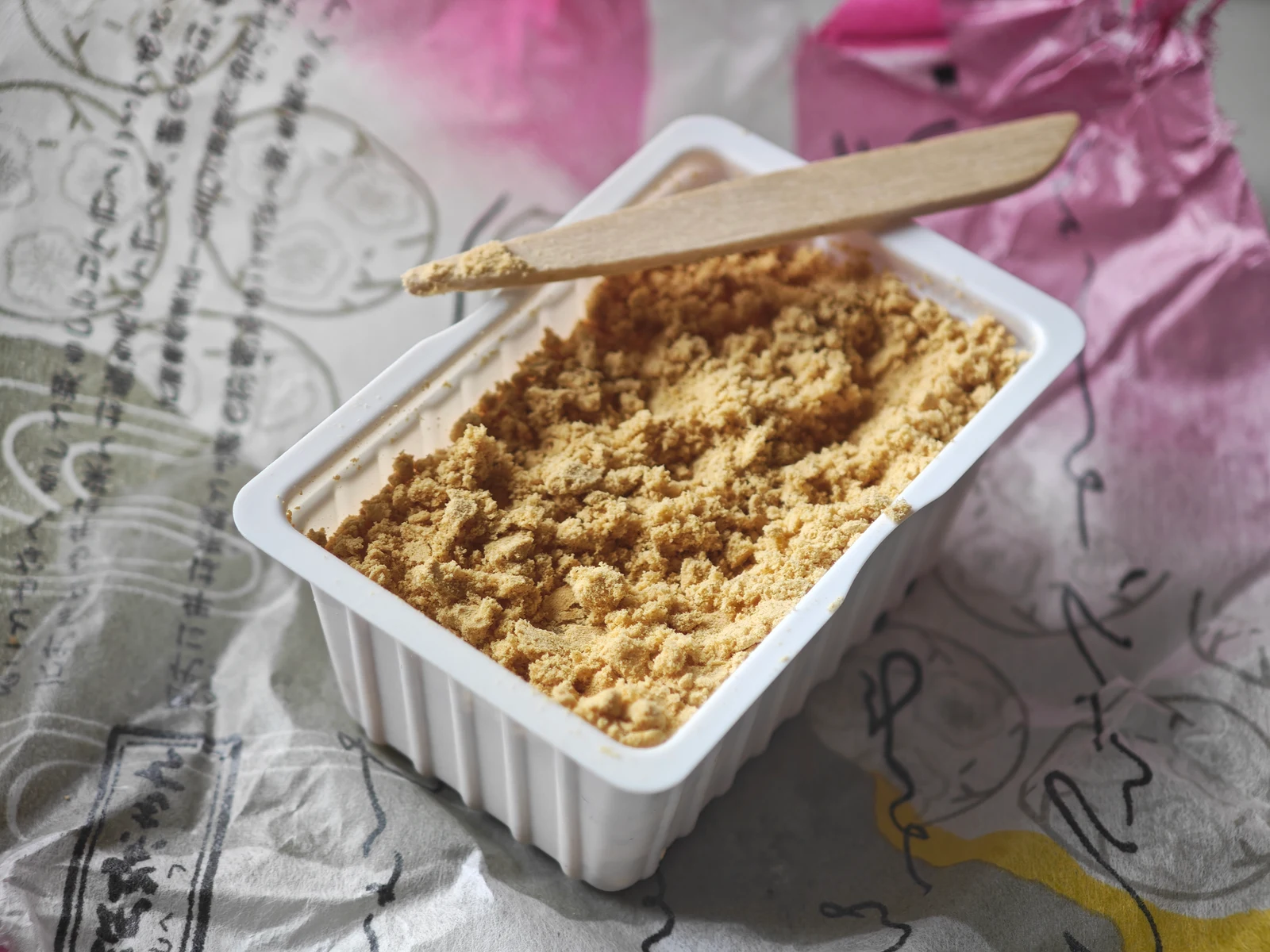
My preferred method is:
- Separate the three pieces slightly with the pick.
- Open narrow channels between them.
- Loosen a little kinako around the upper surface.
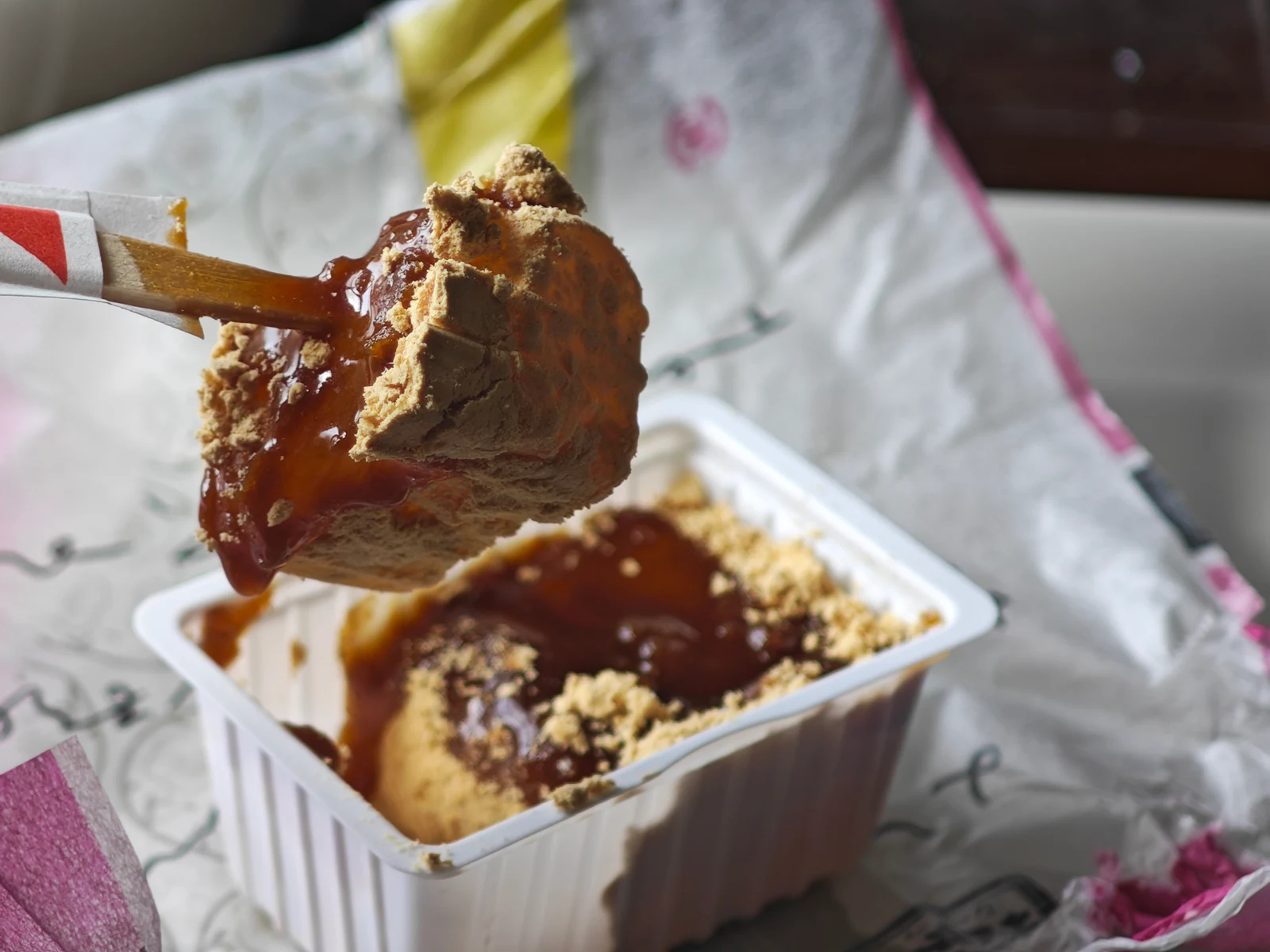
- Pour some kuromitsu into the gaps, not only across the top.
- Turn each piece through the syrup and lower kinako as you lift it.
The smooth pieces and compacted kinako can leave syrup pooling on top. Opening channels helps it travel downward.
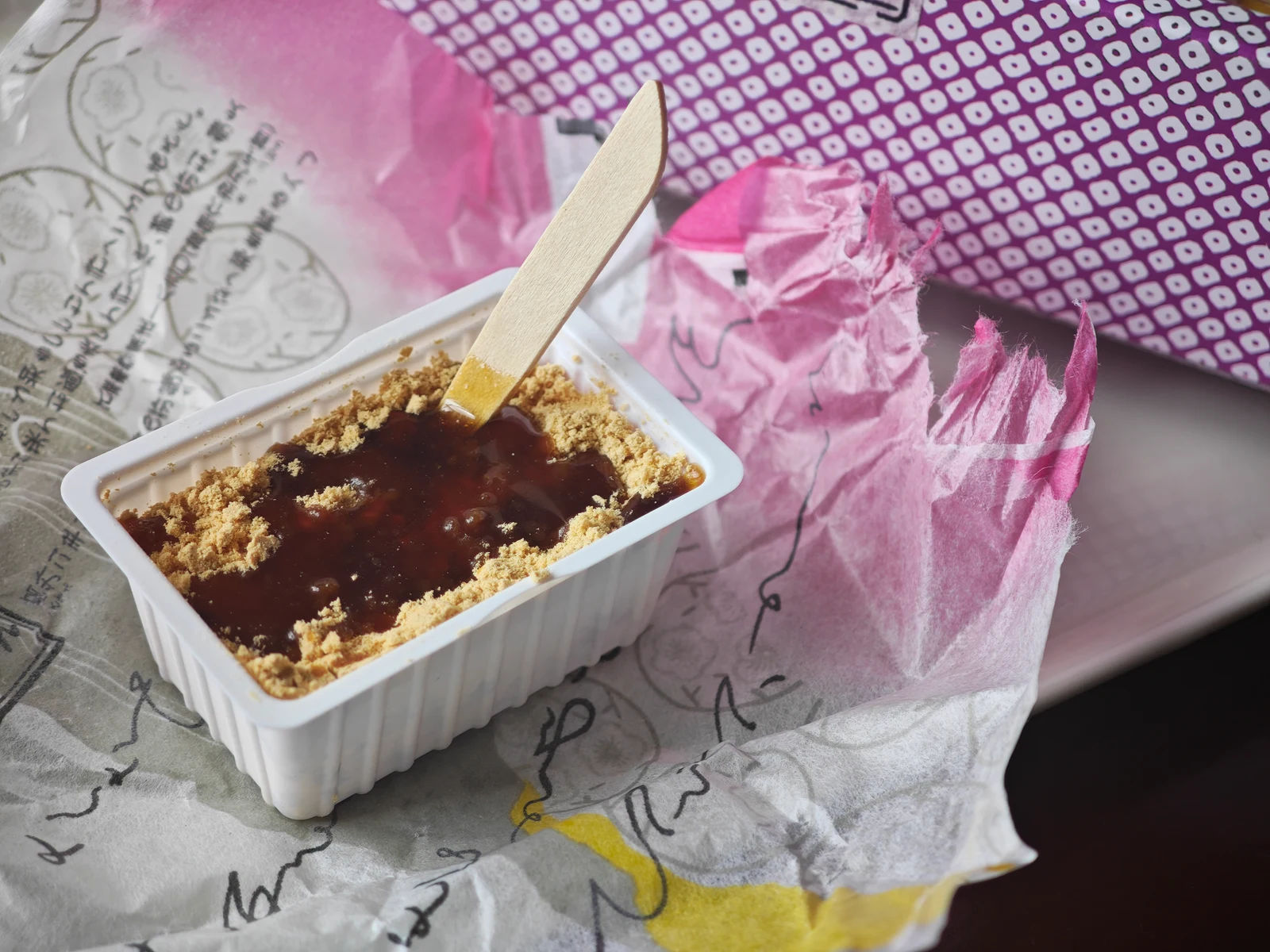
This is an owner-tested technique, not an instruction from Josuian. It simply uses the included tool to solve the tray’s edible engineering problem: valuable syrup above, valuable kinako below, mochi in the middle behaving like a small dam.
Josuian also presents an official alternative called the “Mitsu no Ike” (“syrup pond”) method: eat the center piece first, then pour the kuromitsu into the empty space. That method placed first in the maker’s 2025 serving-style vote. My narrow-channel method keeps all three pieces in the tray while directing syrup downward; both approaches begin with the same useful idea—make space before pouring.
The result brings all three elements together.
Taste and texture
Without much kuromitsu, the first impression is roasted kinako and gentle sweetness. Add the syrup and the flavor becomes deeper, darker, and rounder.
The mochi in my sample was:
- soft and sticky
- sweet, but not only sweet
- firm enough to offer a clear chew
- increasingly yielding as kinako and kuromitsu blended with it
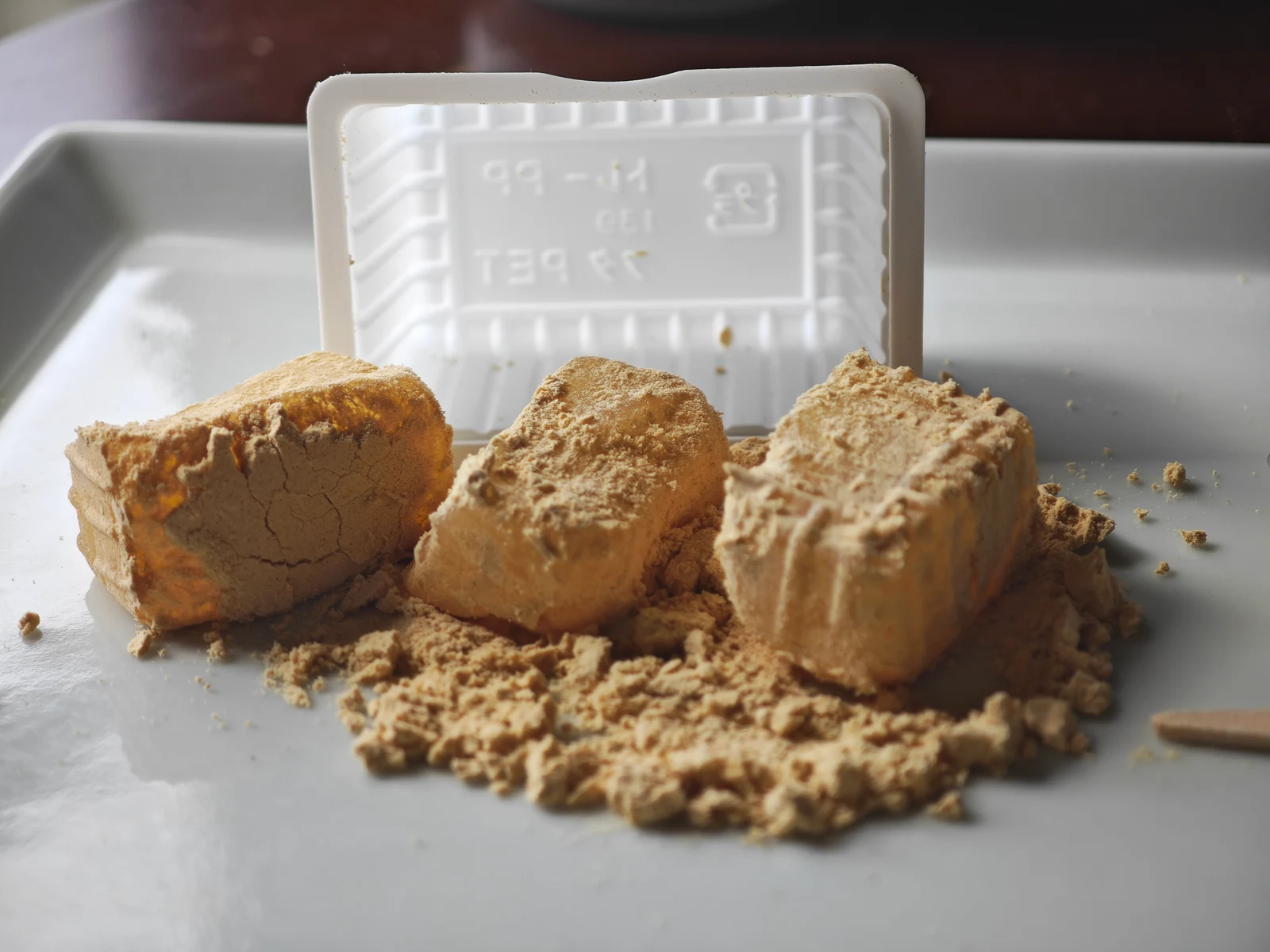
Compared with the Kikyo Shingen Mochi sample I had eaten, this Tsukushi Mochi felt less sticky but more clearly chewy. It resisted the first bite, then gradually loosened in the mouth as the syrup mixed through the mochi.
That comparison is personal and sample-specific. Freshness, temperature, and storage all affect mochi. It is not a national ranking issued by a committee in a powder-proof laboratory.
What the cross-section showed
For a closer look, I cut the mochi and washed the kinako from one section.
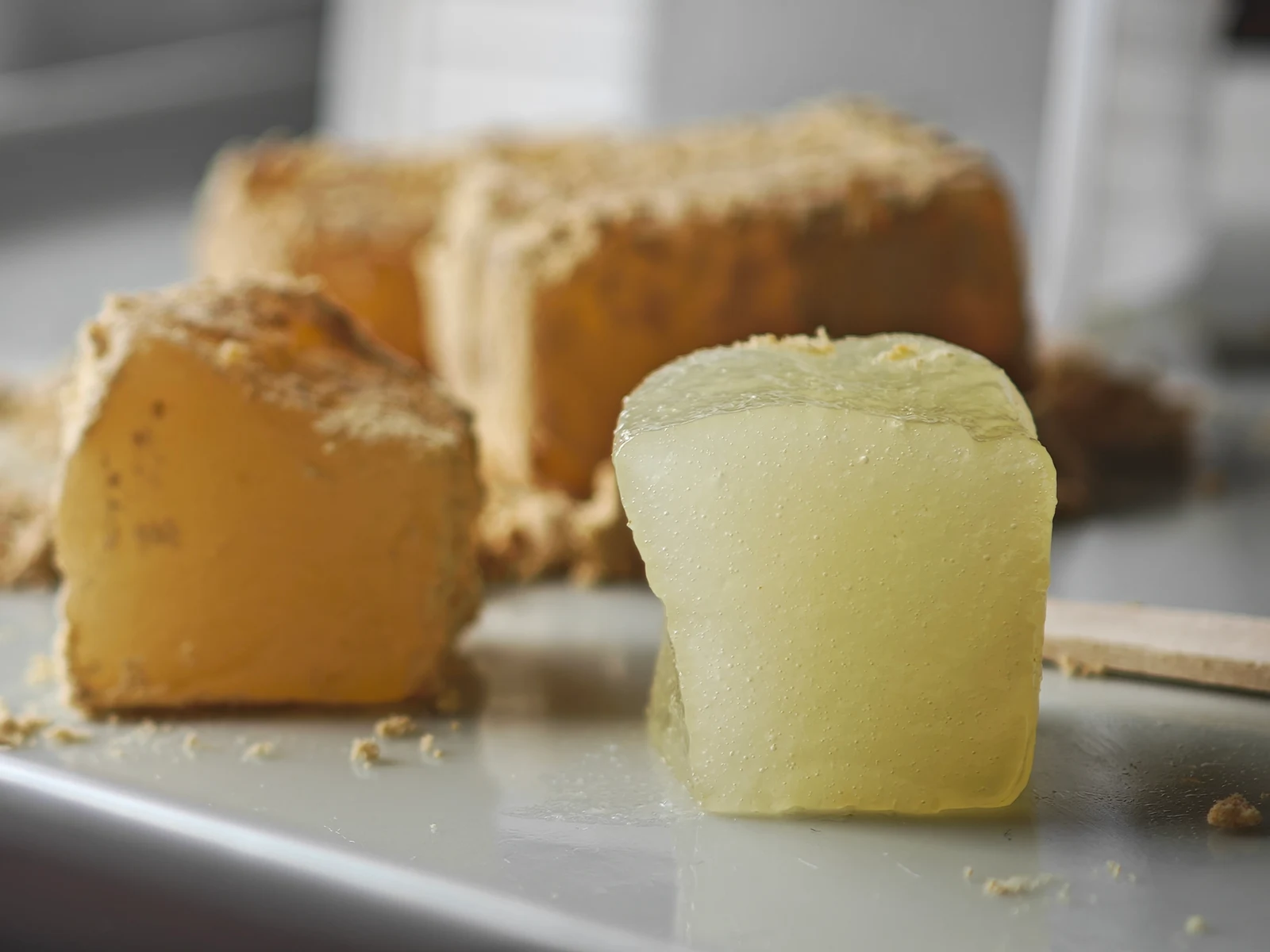
The exposed Tsukushi Mochi looked pale and translucent. In my earlier Oburoshiki sample from Tottori, the exposed mochi appeared more yellow and cloudy; that product’s ingredient list also included miso.
The visual difference is worth recording for a future comparison, but the photograph cannot prove that miso alone caused it. The recipes, surface treatment, lighting, age, and handling were also different.
What the image supports more directly is the texture I felt. Tsukushi Mochi holds a smooth, coherent body beneath the kinako. It is sticky, but it is not shapeless.
Tsukushi Mochi, Oburoshiki, and Shingen Mochi
These three sweets belong in the same conversation because each can combine small mochi pieces, kinako, and a separately added syrup. They should not be treated as interchangeable.
- Tsukushi Mochi: rice-blend mochi, dehulled Tamahomare kinako, kuromitsu, and a Manyoshu / Fukuoka identity
- Oburoshiki: notably elastic mochi with miso as a hidden seasoning and bright Tottori pear syrup
- Kikyo Shingen Mochi: the best-known Yamanashi reference point for many travelers, with its own mochi, kinako, and kuromitsu balance
In the owner’s tasted samples, Oburoshiki was the most elastic, Shingen Mochi the stickiest, and Tsukushi Mochi the clearest combination of firm chew followed by a gradual melt into kuromitsu. A dedicated side-by-side article will test that impression more carefully.
Regional Japanese sweets become more interesting when resemblance begins the question instead of ending it.
The wrapper mat is not optional if you value diplomacy
This is what can happen when kinako escapes the working area:
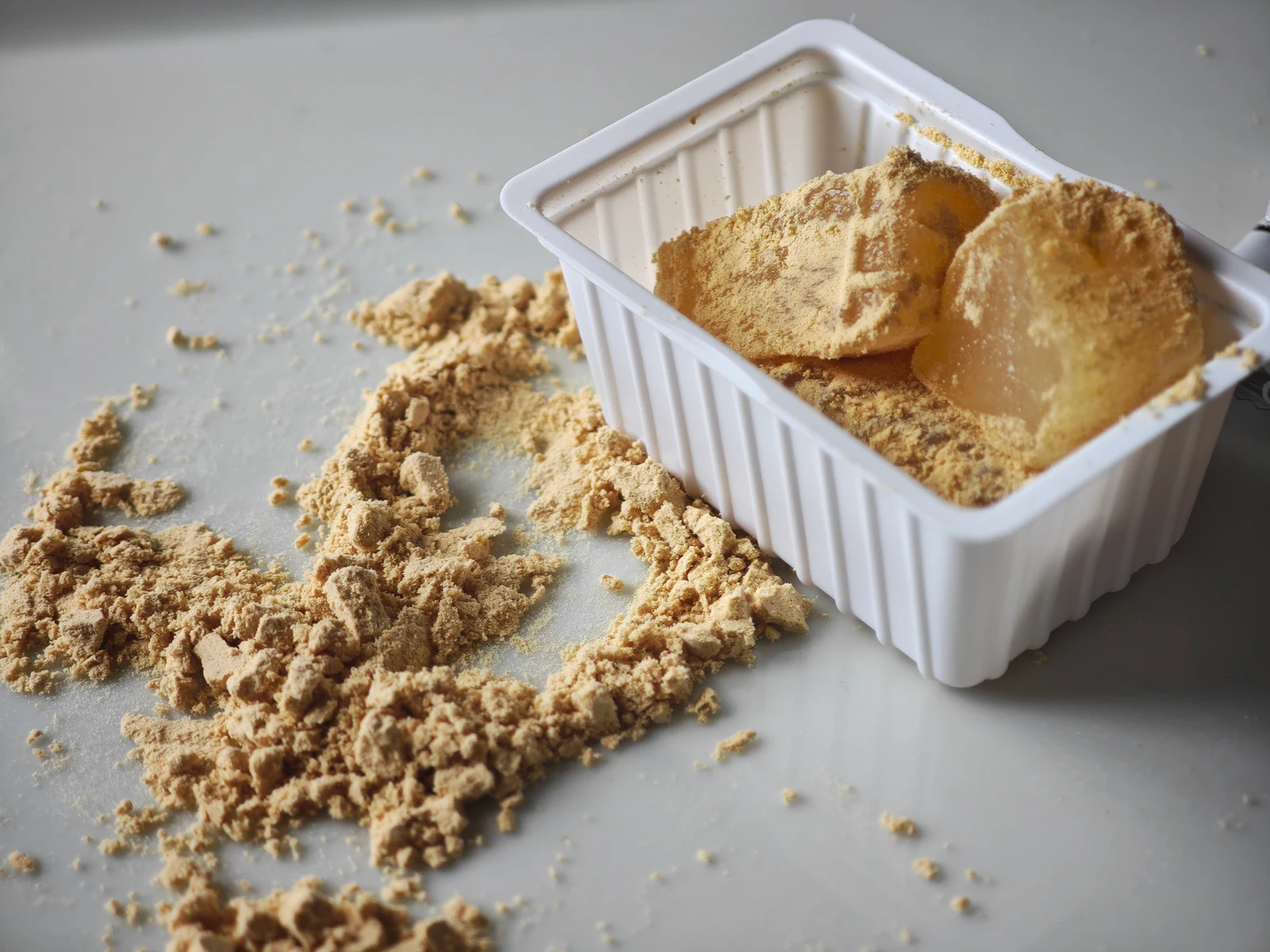
At home, the consequence is a cloth and thirty seconds. On a train, it is a negotiation with gravity, airflow, luggage, and the person wearing dark trousers beside you.
Use the wrapper as a mat. It is already there, it is large enough, and it converts loose powder from a public incident into a private administrative matter.
Finish neatly: the final part of the ritual
After the last piece, place the wooden pick inside the tray and replace the clear lid.
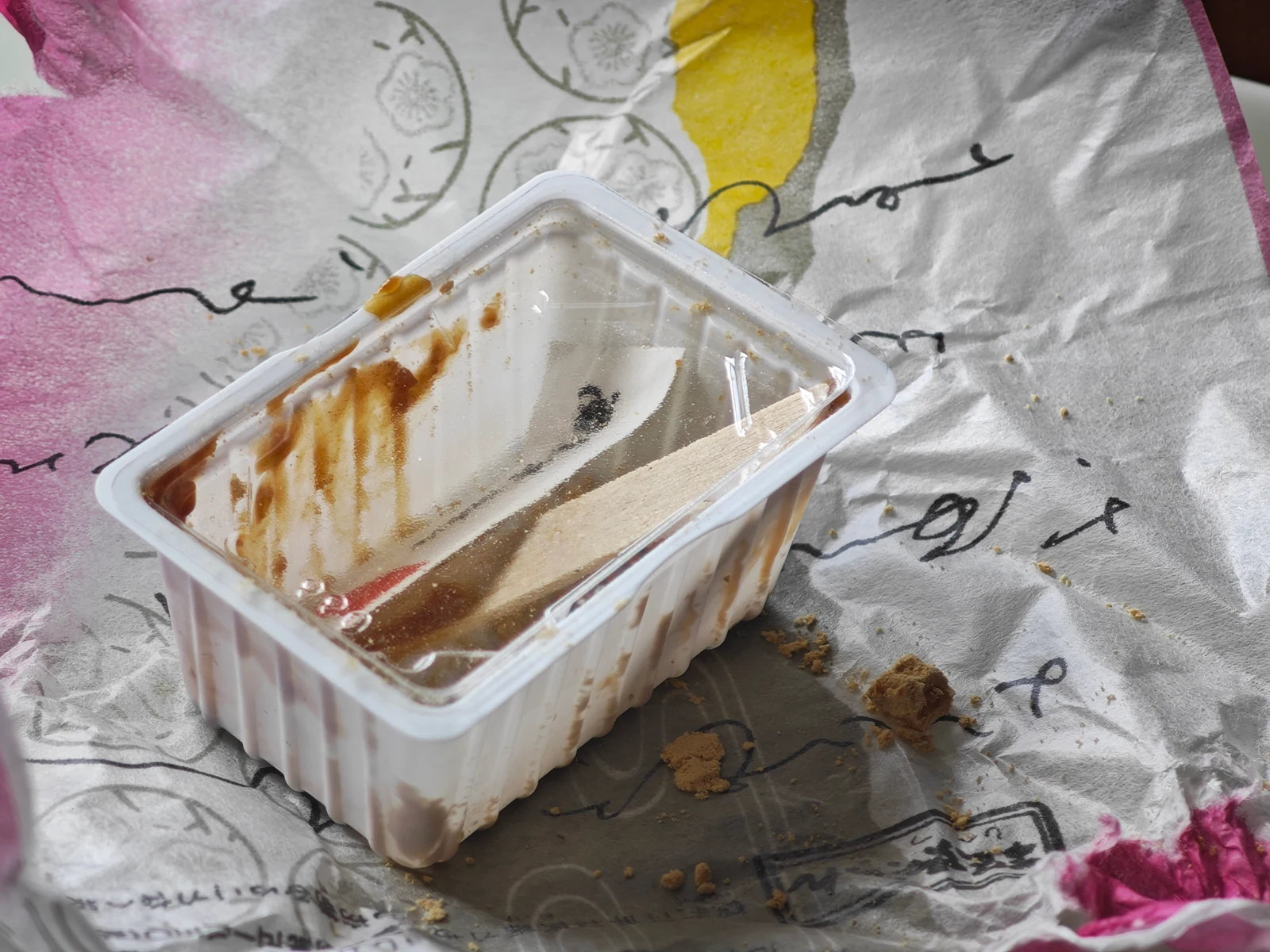
Then gather the wrapper around the compact tray.
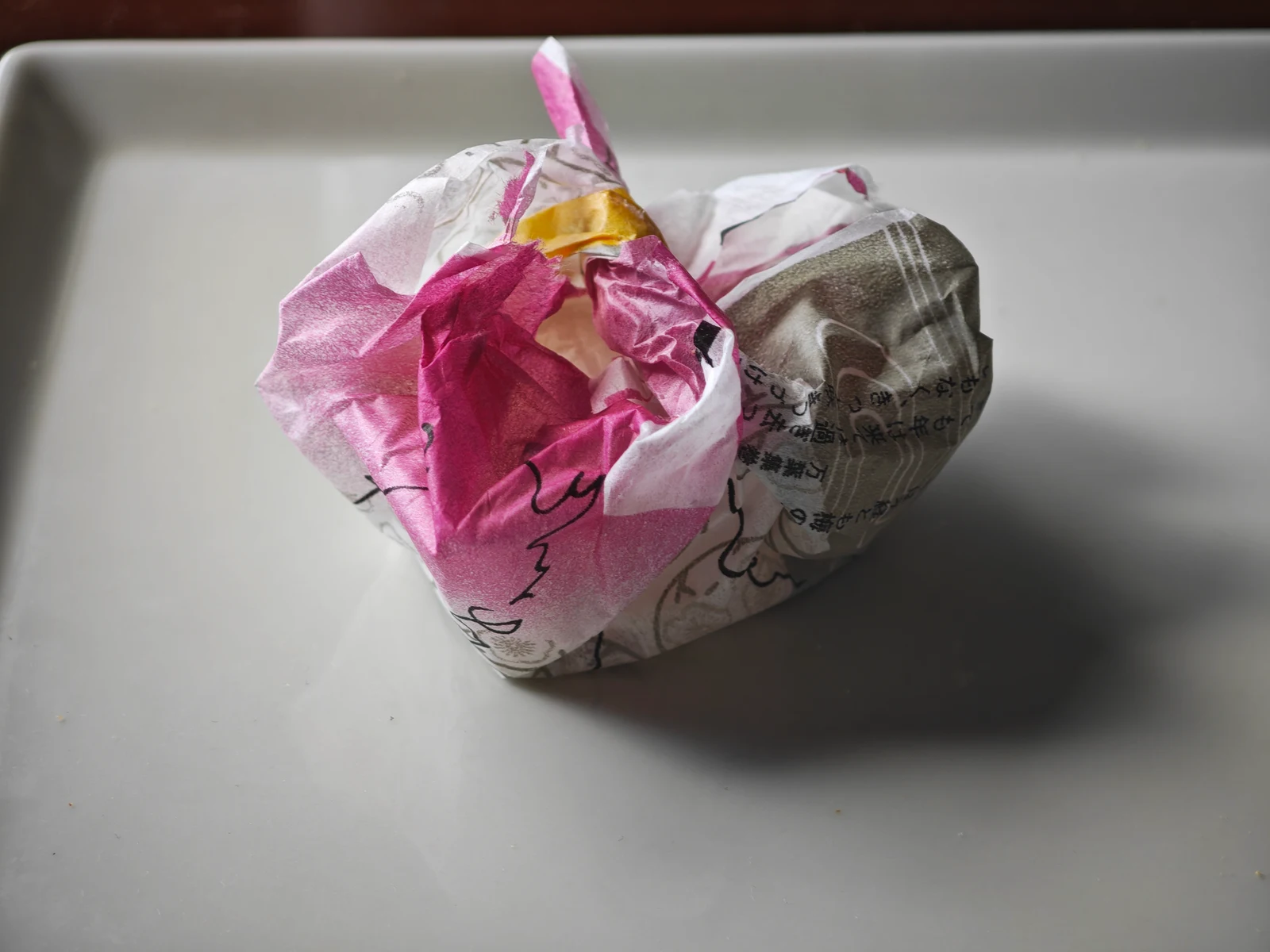
This is not a codified Japanese tea-ceremony rule. It is simply good travel behavior with a pleasing visual conclusion. The serving begins as a small wrapped gift and can end as a small wrapped parcel of waste.
Eat beautifully if possible. More importantly, leave beautifully. Kinako has already had enough excitement.
Ingredients, allergens, nutrition, and storage
The reverse of the photographed six-piece wrapping records the poems and the legal package information in the same visual field.
The closer label gives the details for this specific box.
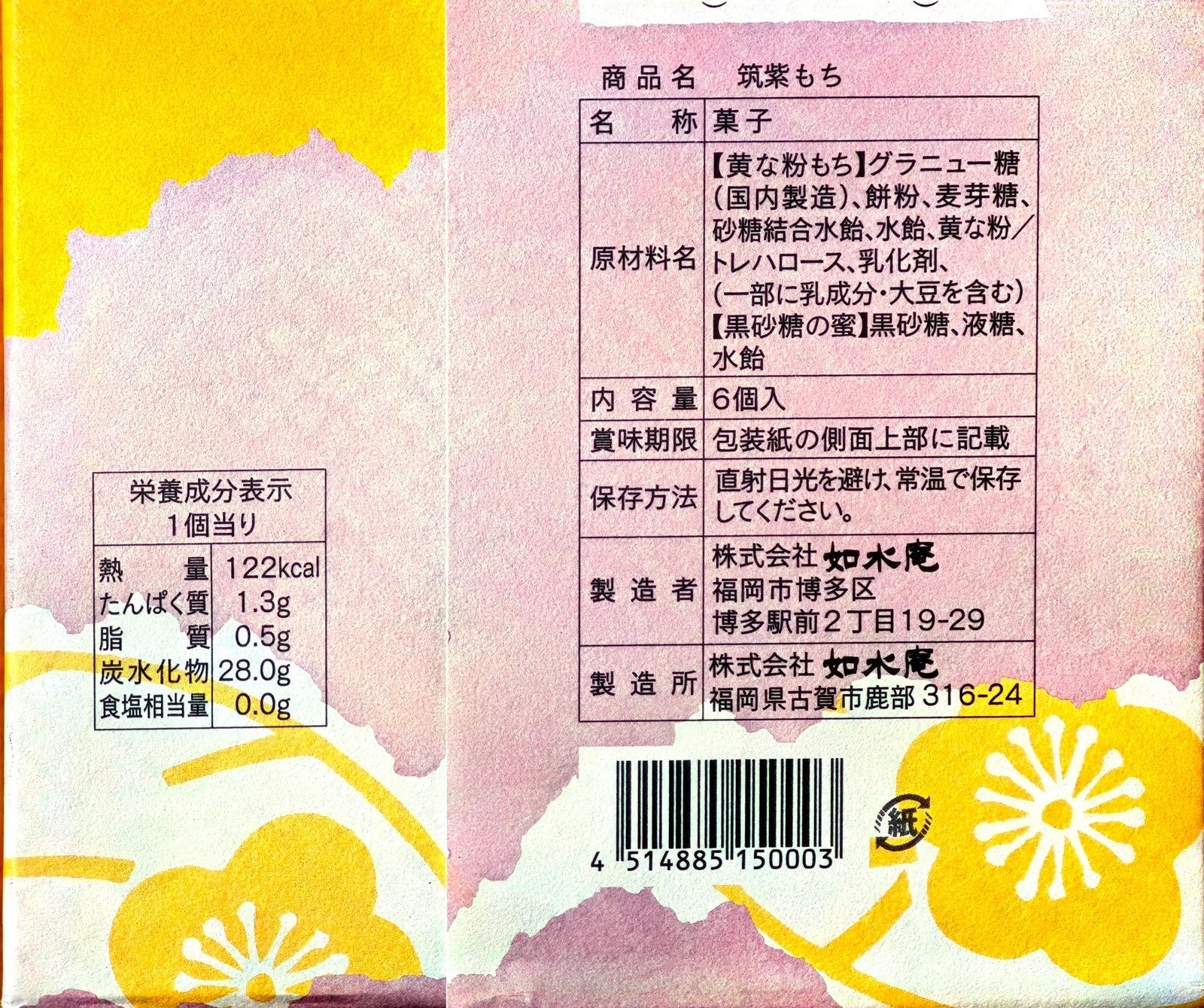
The photographed label lists the kinako-mochi ingredients as:
- granulated sugar made in Japan
- glutinous-rice flour
- maltose
- sugar-bound starch syrup
- starch syrup
- kinako
- trehalose and an emulsifier
The kuromitsu lists brown sugar, liquid sugar, and starch syrup.
Declared allergens are milk and soy. Josuian explains that the milk declaration relates to sodium caseinate used in an emulsifier preparation.
Nutrition per piece on the photographed package:
- Energy: 122 kcal
- Protein: 1.3 g
- Fat: 0.5 g
- Carbohydrate: 28.0 g
- Salt equivalent: 0.0 g
Store it at room temperature away from direct sunlight. The official product page gives a best-before guideline of about 20 days, but always follow the date and instructions on the package you actually buy. Josuian advises eating it by the following day once the outer bag or pack has been opened, regardless of the printed date. Avoid over-chilling it as well; the maker warns that the mochi becomes firm when kept too cold.
Awards and recognition
Josuian reports that Tsukushi Mochi received a Monde Selection Grand Gold Award in 2008 and had accumulated 11 Grand Gold awards by 2019. This is the maker’s documented award history, not a claim that an award can replace your own taste.
Where to buy Tsukushi Mochi in Fukuoka
JR Hakata Station is the easiest starting point for many travelers. Josuian’s official store list includes:
- Hakata Station Ming 1
- Hakata Station Ming 2
- Hakata Station Deitos
- Hakata Station Front Main Store
Josuian also says that some products are sold through station shops, airport shops, department stores, service areas, and the official online store. Not every outlet carries every package.
Before making a special journey, check the official Josuian store list and current inventory. The product is sold year-round according to the maker, but hours, prices, packaging, and stock can change.
Why Tsukushi Mochi is a useful Fukuoka souvenir
Tsukushi Mochi does not represent Fukuoka through one famous flavor such as mentaiko. It builds its regional identity through a wider network:
- a rice blend that includes Hiyoku rice from Kyushu
- rare Tamahomare soybeans prepared as fragrant, dehulled kinako
- an old regional name with two accepted pronunciations
- poems associated with Dazaifu
- a 1970s Shinkansen souvenir project
- one family memory of kinako mochi
- packaging that turns three small rice cakes into a gift ritual
The result is approachable enough for a first encounter with kinako and kuromitsu, but deep enough to reward anyone who reads the paper before throwing it away.
Frequently asked questions
What is Tsukushi Mochi?
Tsukushi Mochi is a Fukuoka souvenir made by Josuian. Each serving contains three small pieces of rice-blend mochi under Tamahomare kinako, with a packet of kuromitsu and an eating pick.
Should I say Tsukushi Mochi or Chikushi Mochi?
Both are accepted by the maker. Josuian chose Tsukushi Mochi as the official reading, while Chikushi Mochi reflects common local pronunciation.
What do the poems on the package mean?
They are two plum-blossom poems from the Manyoshu. One wishes that plum blossoms will continue blooming through countless generations. The other invites close companions to wear the blossoms in their hair while they are at their peak.
Is Tsukushi Mochi connected to the Reiwa era name?
Yes, but indirectly. Its package poems come from the group of 32 plum poems whose preface later supplied the source wording for Reiwa. The two printed poems themselves are not the direct source of the characters 令和.
What is the best way to add the kuromitsu?
Spread the wrapper under the tray, use the pick to loosen the surface and open gaps between pieces, then pour syrup into those channels. This helps it reach the kinako below. It is my serving recommendation, not an official rule.
Where can visitors buy it?
Josuian has several convenient stores at and around JR Hakata Station. Selected airport, station, department-store, and online outlets may also carry it. Confirm current stock before making a special trip.
Affiliate disclosure: Some links above may be affiliate links. If you buy through them, I may earn a commission at no extra cost to you.