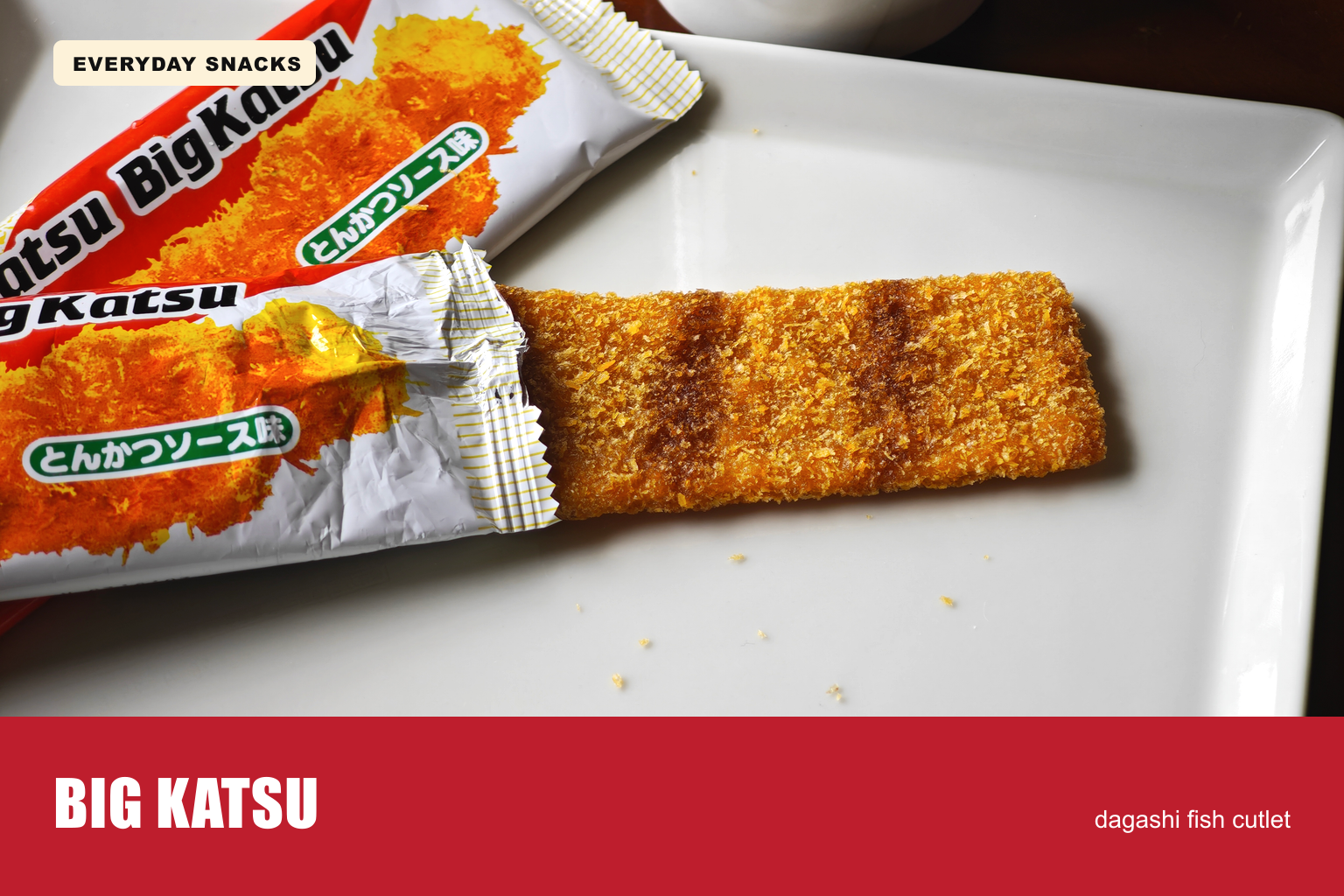
One flat sheet, a thick fried coat, and enough breadcrumbs to betray you in a quiet room.
That is Big Katsu (ビッグカツ): a fish-surimi “cutlet” you can buy for pocket money, hold in one hand, and tear with your teeth. It looks like toy tonkatsu. It eats like a childhood dare that somehow survived into adulthood.
Quick guide: Suguru launched Big Katsu first in 1978 and now develops a broad cutlet-snack family. Kadou followed in 1987 with a longer, curry-accented BIG Katsu that became another national dagashi standard. Buy by maker name, eat inside the bag to catch crumbs, and compare the two as different recipes.
Big Katsu in 30 seconds
- What is inside? Fish-surimi sheet—not pork—under fried breadcrumbs.
- Why “katsu”? The shape, coating, oil, and sauce recreate the idea of a cutlet at dagashi scale.
- Who came first? Suguru in 1978; Kadou in 1987.
- Fast taste choice: Suguru for even sauce and more variants; Kadou for bite-by-bite contrast and a subtle curry note.
- Best first purchase: One of each. The comparison teaches more than buying thirty identical bags.
- Clean-eating rule: Keep the lower half in its wrapper. Breadcrumbs travel farther than expected.
What is Big Katsu?
Big Katsu is a Japanese dagashi snack built from a fish-surimi sheet coated in breadcrumbs and fried, then seasoned in a tonkatsu-sauce direction. The pleasure is blunt and physical: hold the sheet, clamp with your molars, and rip through coating and layered fish paste together.
As a child, I loved exactly that beast-bite feeling—one hand gripping a big fish sheet, teeth locking on, tearing like a tiny wild animal. As an adult who can eat more politely, I still chase the same molar clamp. The fried crumbs go juwa in the mouth; sweetness spreads first; sauce arrives a beat later. That delayed chase is the harmony.
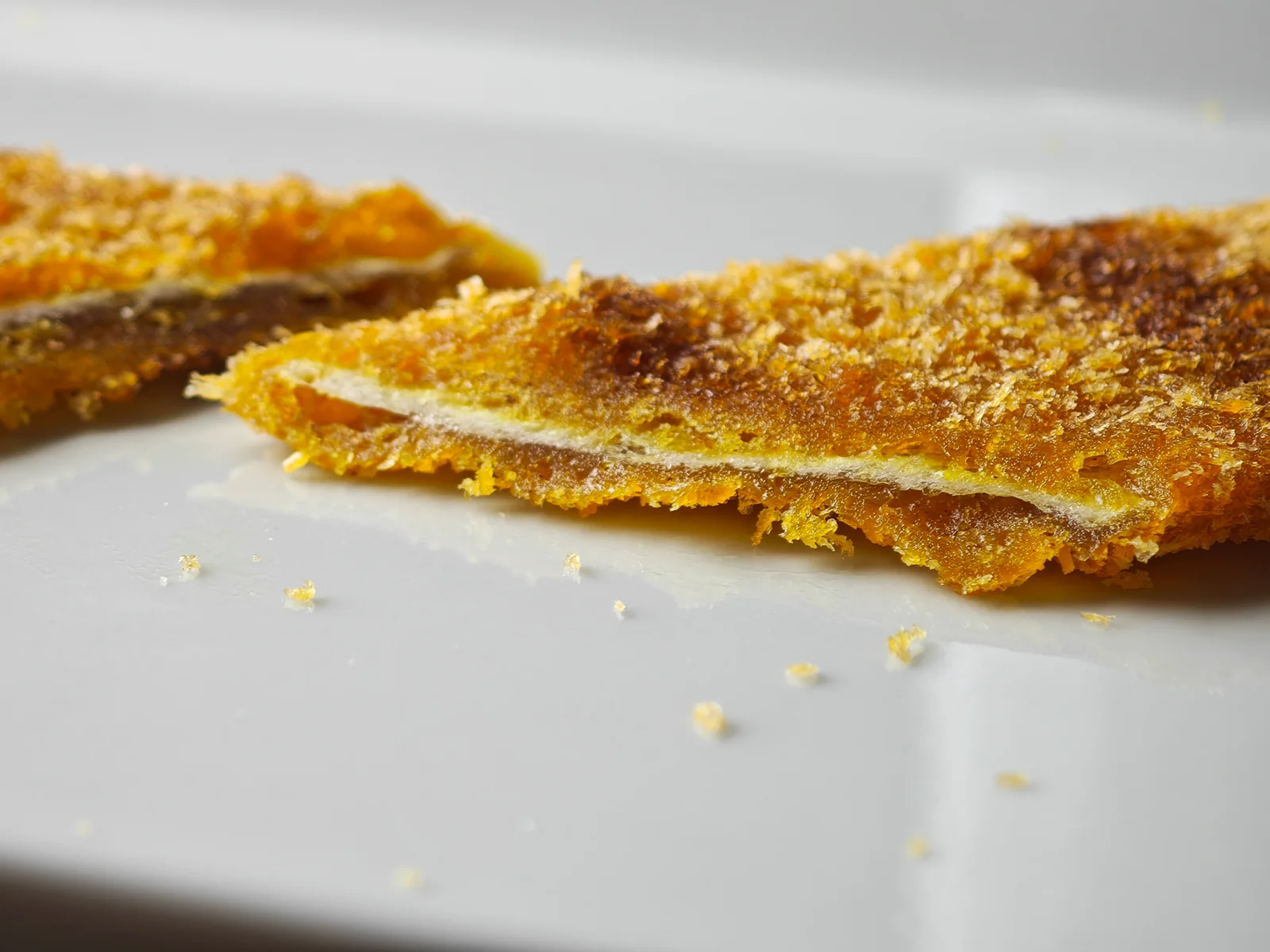
A cross-section makes the joke structural: a thin, layered surimi core wearing armor of fried crumbs. It is not pork. It never pretended to be restaurant tonkatsu. It is a dagashi invention that borrowed the cutlet silhouette and then optimized for pocket-money drama.
Warning: the crumb storm
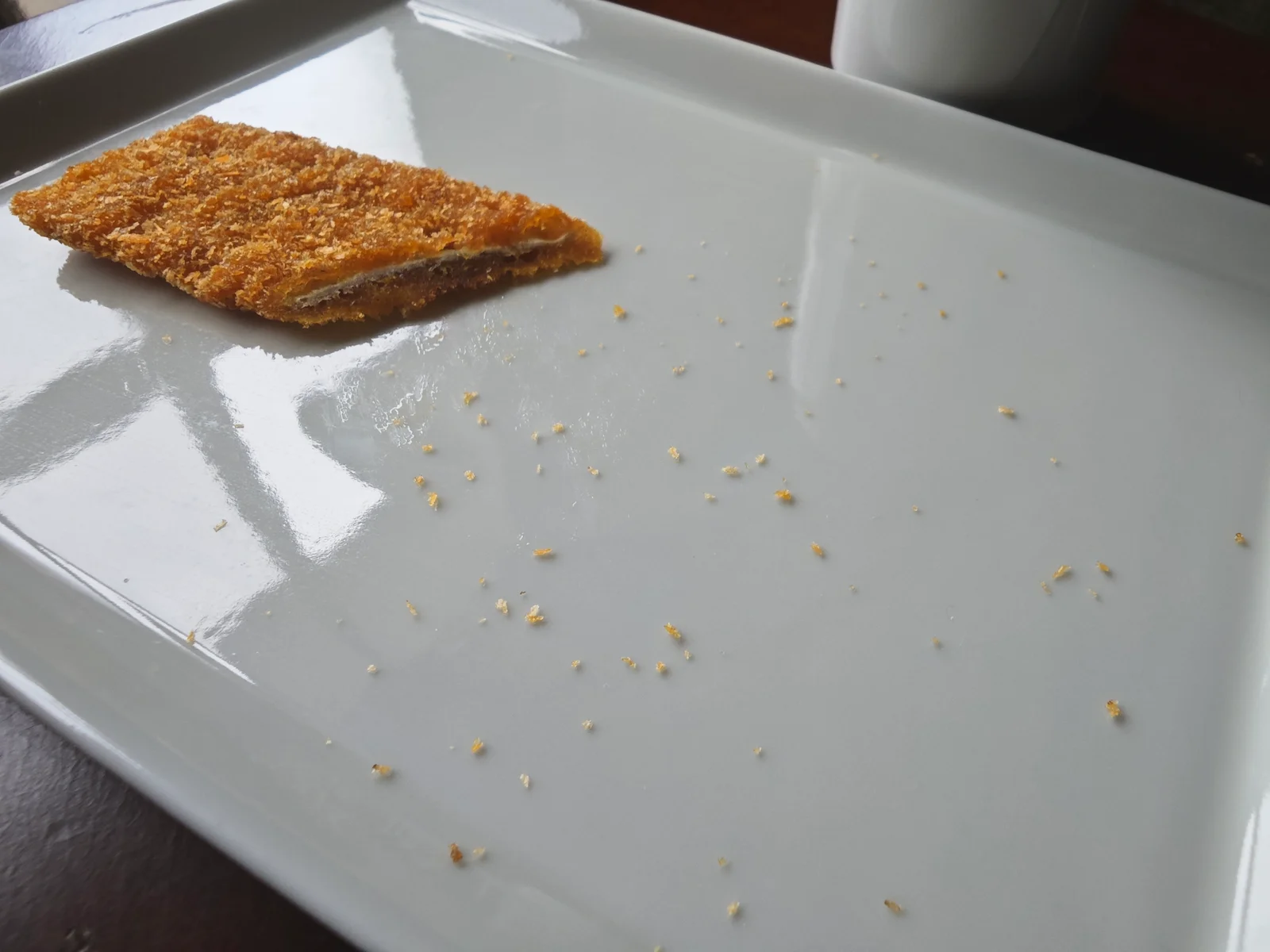
Big Katsu sheds. Aggressively. Eat it in a car, a museum, or someone else’s tidy room and you will leave evidence. My practical advice is simple: do not fully remove it from the bag. Bite from the opening and let the package catch the fallout. The snack stays freer; the floor stays safer.
My playful method: the Rasengan bite
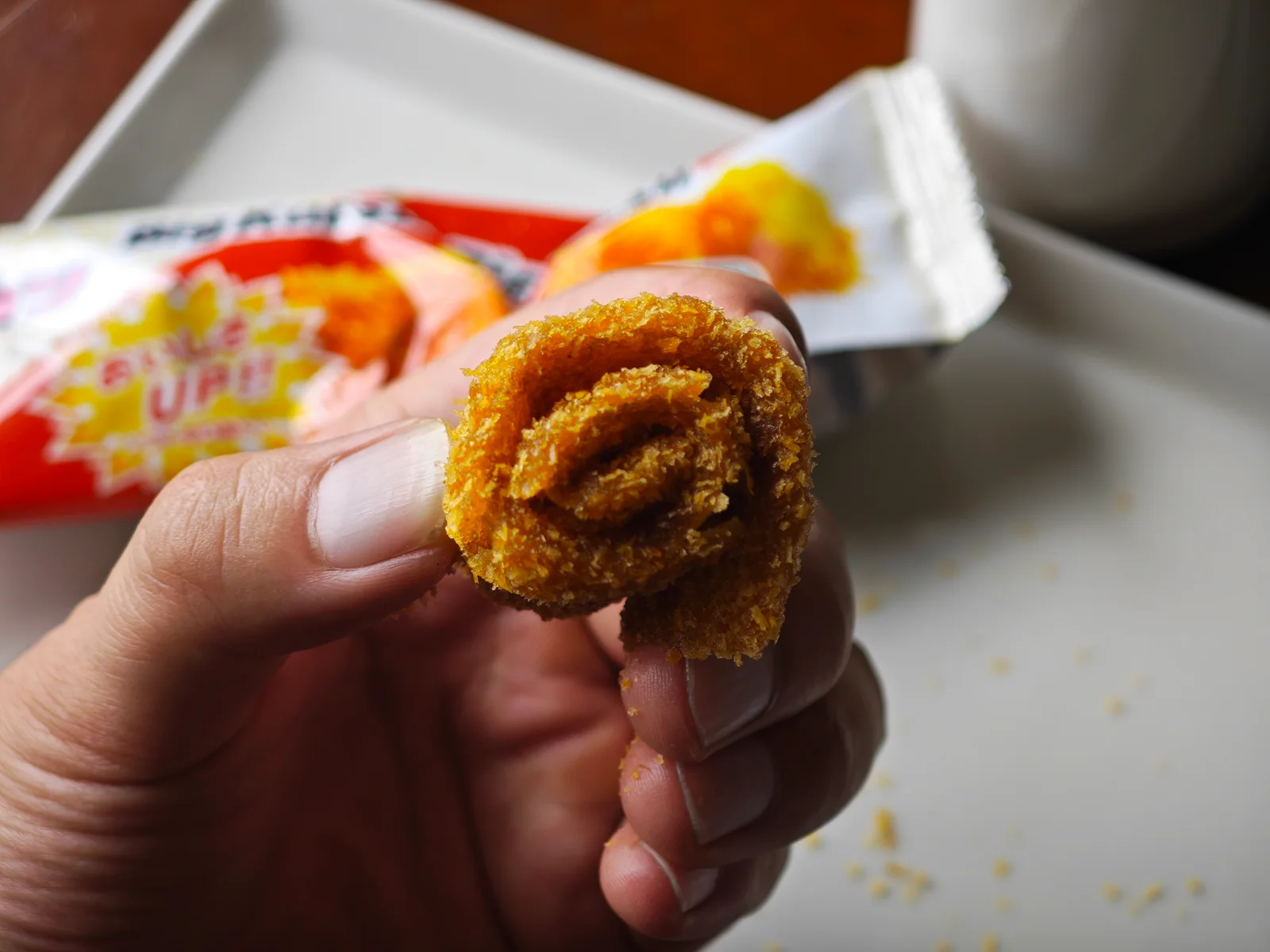
I have a habit with fish-surimi sheets: roll them tight, then chew hard so the layers explode at once. From that habit came a Big Katsu move I privately call Rasengan—yes, after Naruto’s spiraling sphere—because the rolled sheet looks like one.
Roll the cutlet into a spiral and take it in one cheek-filling bite. Suddenly your teeth have to break through many layers of tara-style fish sheet plus the thick coating in a single clamp. For a second I feel less like a polite snack reviewer and more like a beast again. I love that texture so much that I do this often.
If you try it, tell me what you think. No pressure—curiosity is enough.
Why are there two Big Katsus?
The short answer is historical, not dramatic.
Suguru developed its Big Katsu first, in 1978. Kadou launched a separate BIG Katsu in 1987. Both use the same ingenious dagashi grammar—fish sheet, fried coating, cutlet sauce, one affordable package—but they grew through different manufacturers and distribution routes.
This kind of overlap is part of Japanese snack culture. A useful product idea can become a category before overseas buyers ever learn which company name sits in the small print. Regional memory and store distribution then shape what each person considers “the familiar one.” The date matters: Suguru came first. But chronology does not make Kadou’s decades of shelf history disappear. The most informative approach is to keep the facts straight and taste the recipes separately.
Suguru Big Katsu — the 1978 origin and a whole cutlet family
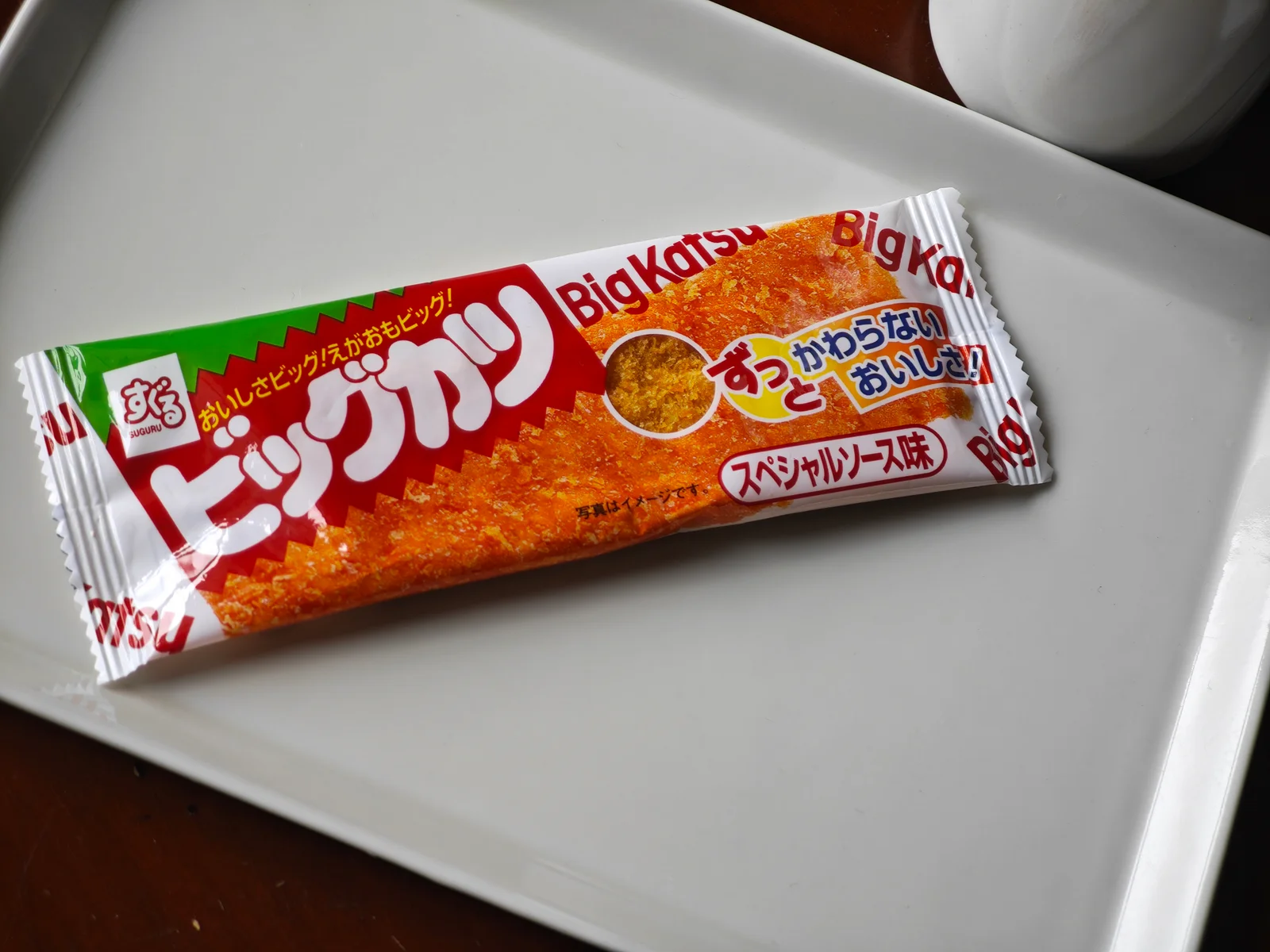
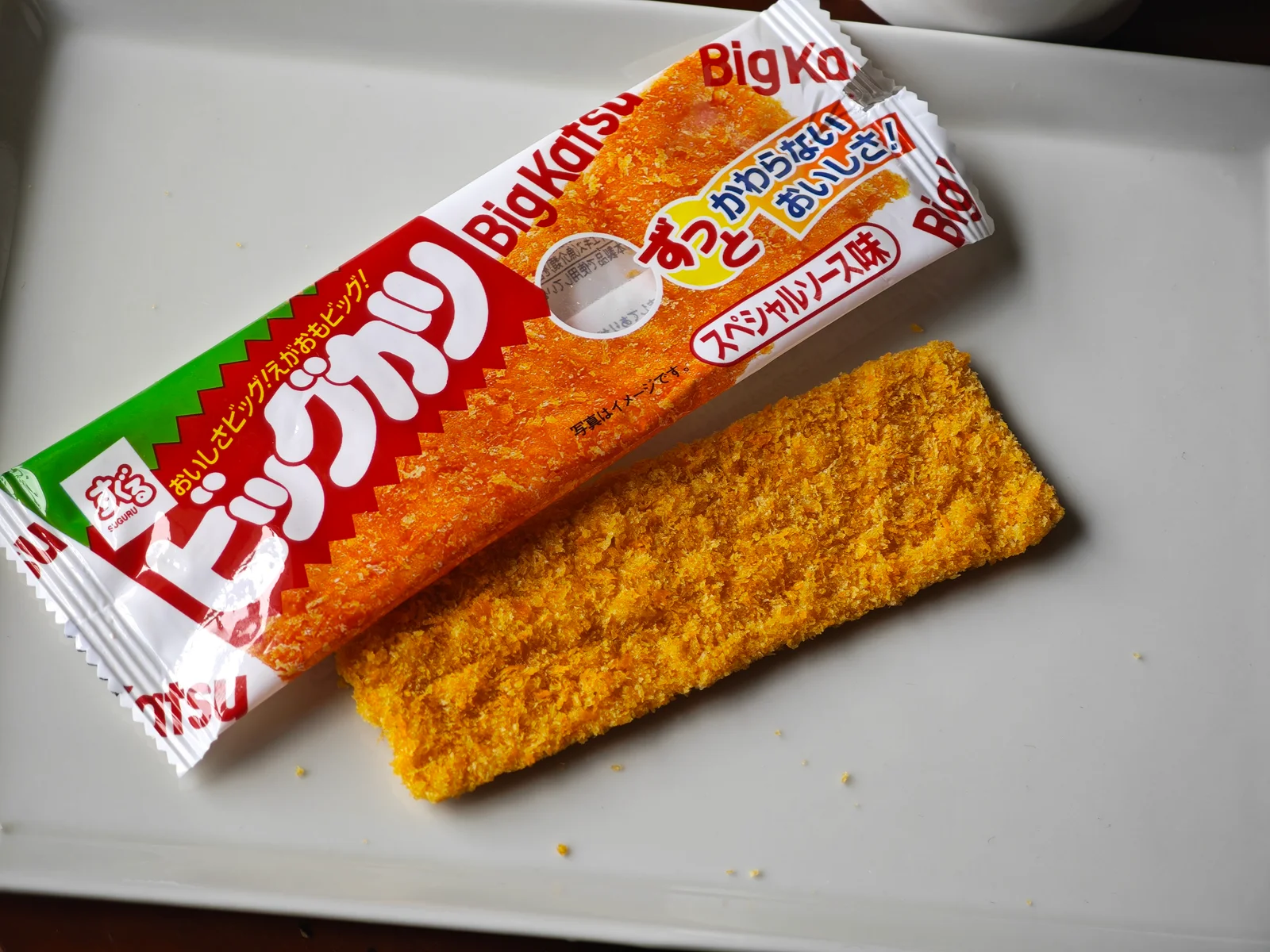
株式会社すぐる belongs to a Hiroshima fish-snack group with roots in squid and seafood processing. Its Big Katsu story begins with a crisis. In the 1970s, squid became difficult to secure. The company turned to a roasted sheet of fish surimi known in the trade as putchin, then asked a wonderfully practical question: if this material can become tempura-style snacks, could it also become a child-sized “cutlet”?
The first forms were related to an inexpensive skewered oyatsu katsu sold from pots. As supermarkets and convenience stores expanded, the product became larger and individually wrapped for barcode-era retail. Big Katsu launched in 1978. Founder Sueo Oshio reportedly traveled around Japan selling it himself; national distribution eventually transformed a survival idea into the company’s defining snack.
That background explains Suguru’s identity. It is not merely one sheet recipe. It is a fish-processing company continuing to test what a dagashi cutlet can become.
What Suguru tastes like
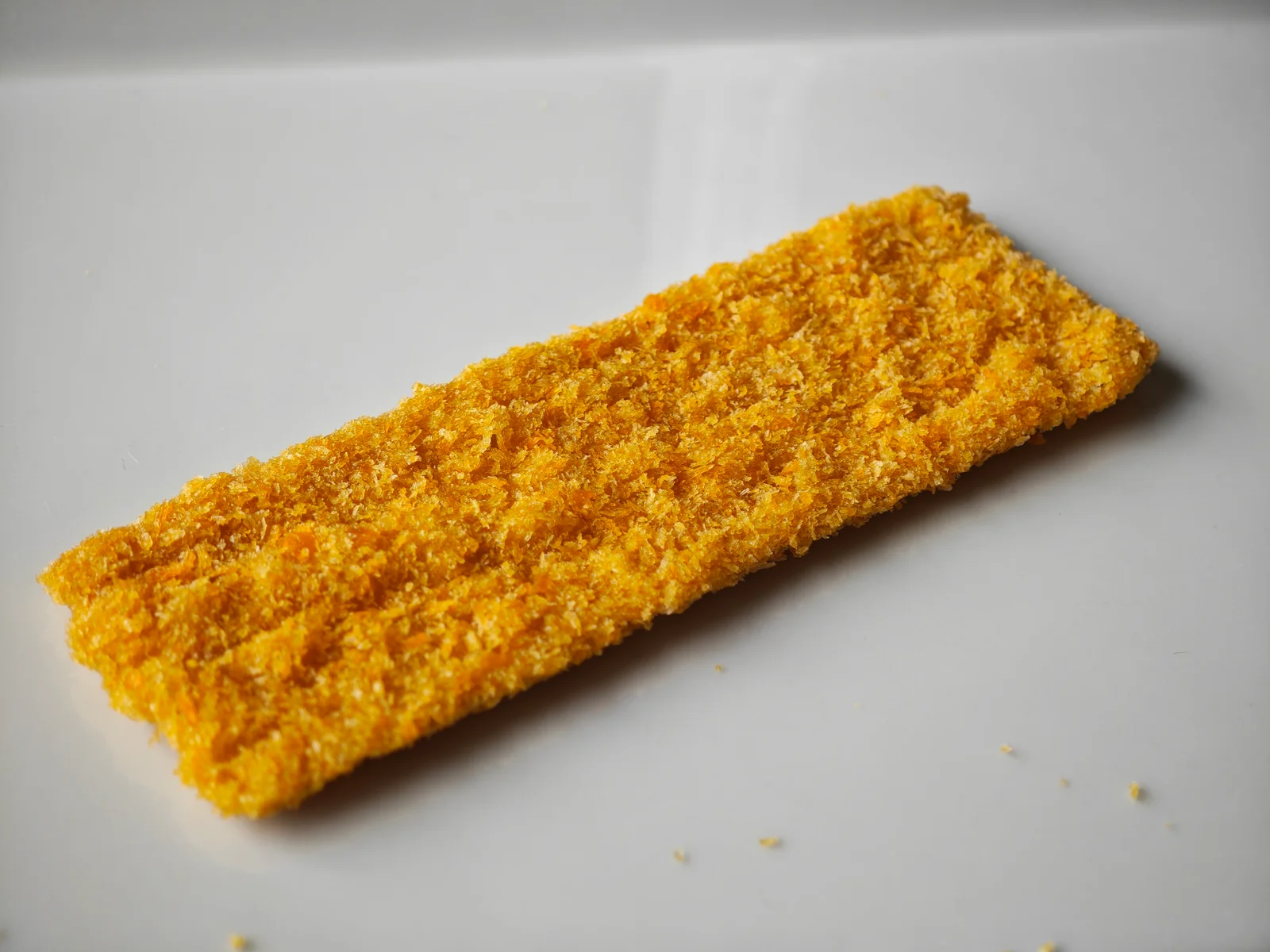
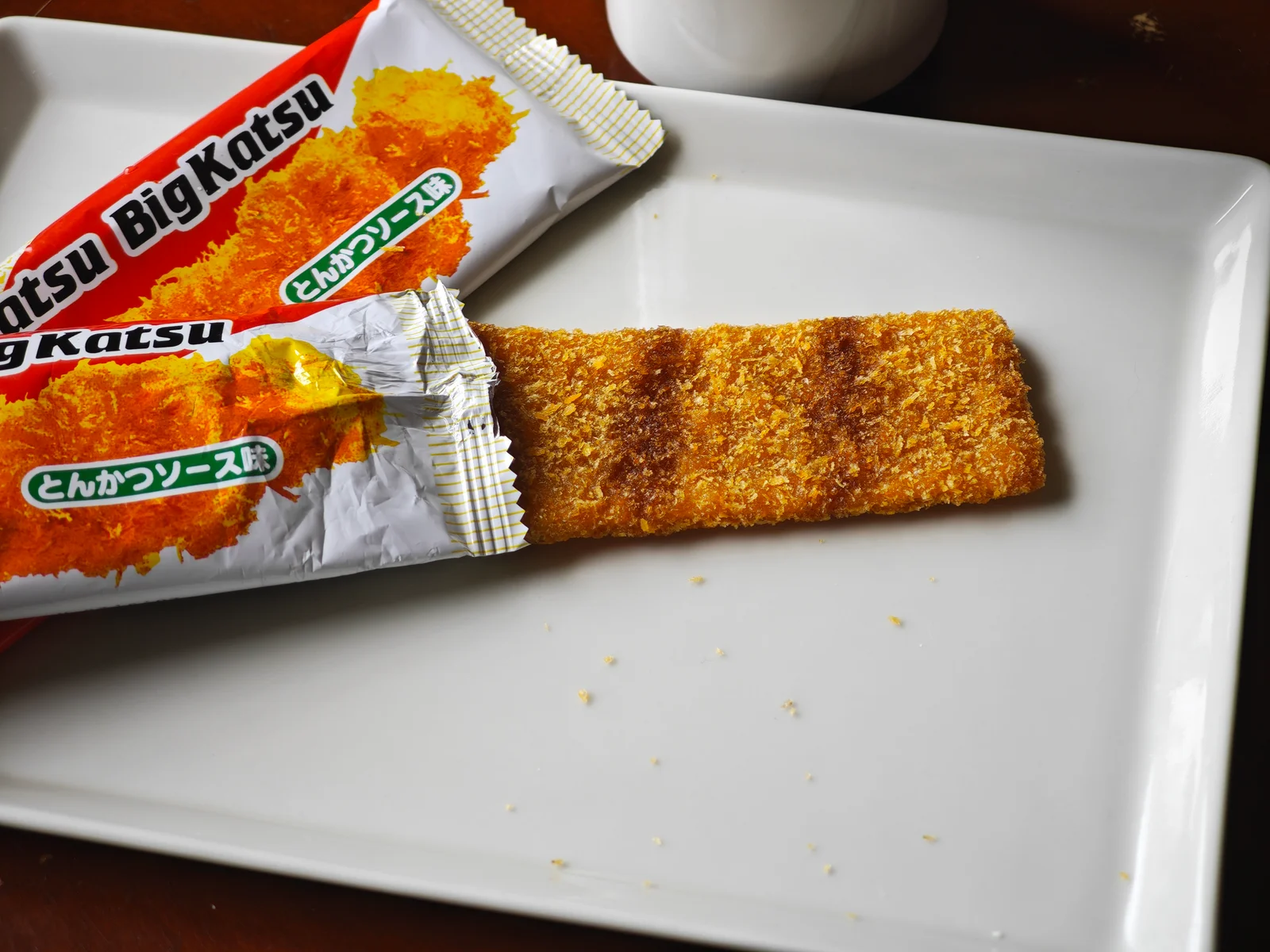
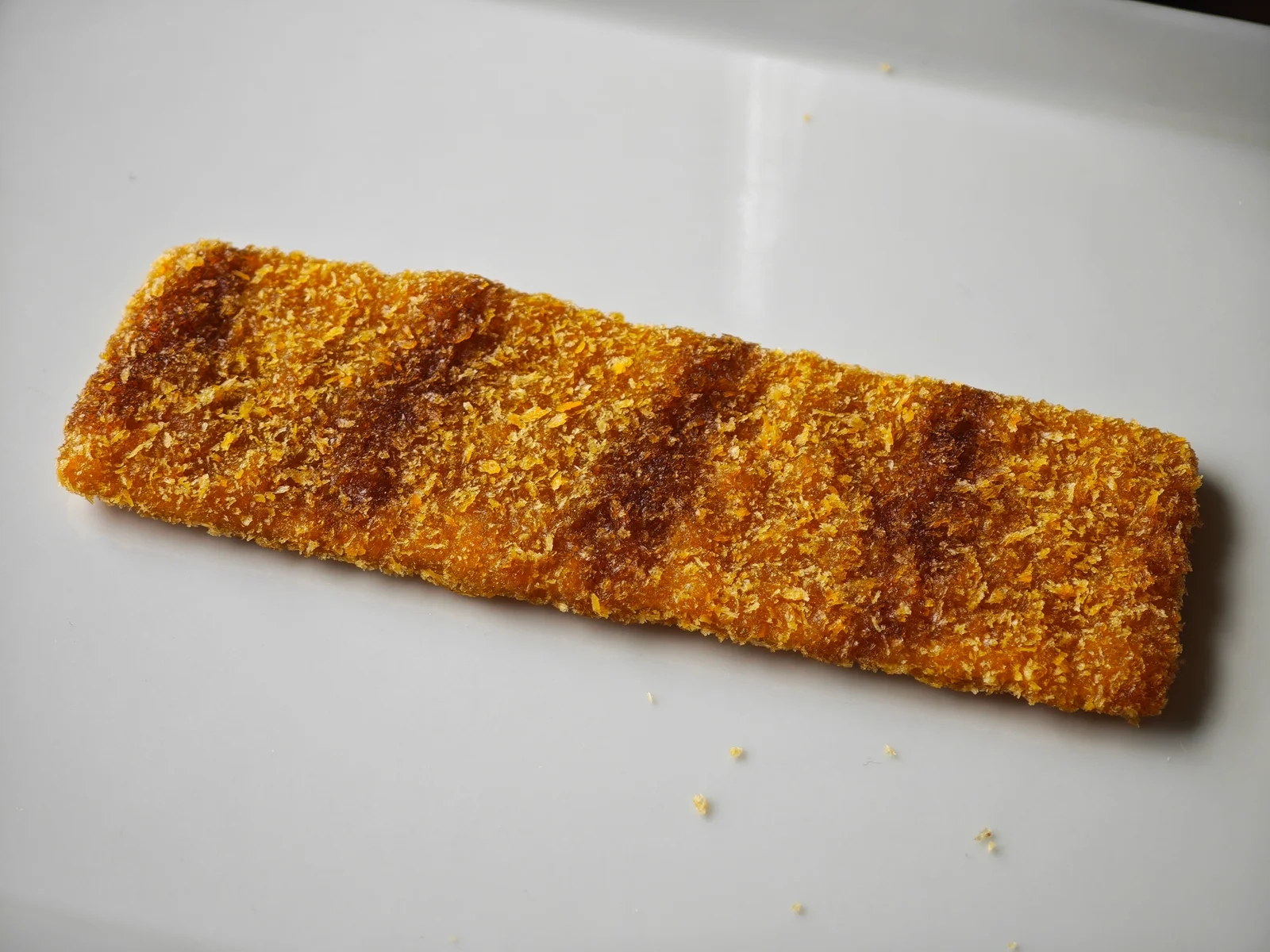
The photographed Suguru sheet has a slight thin bend. Its sauce does not look poured in isolated streaks; the flavor seems mixed through and absorbed across the coating. That visual impression matches the bite. Sauce arrives evenly, a little stronger to my tongue, then the fried coating releases its seasoning gradually across the mouth.
The consistency is the attraction. From first corner to final edge, the sheet follows a steady sauce-forward line. If you want to know approximately what the next bite will taste like, Suguru is reassuring.
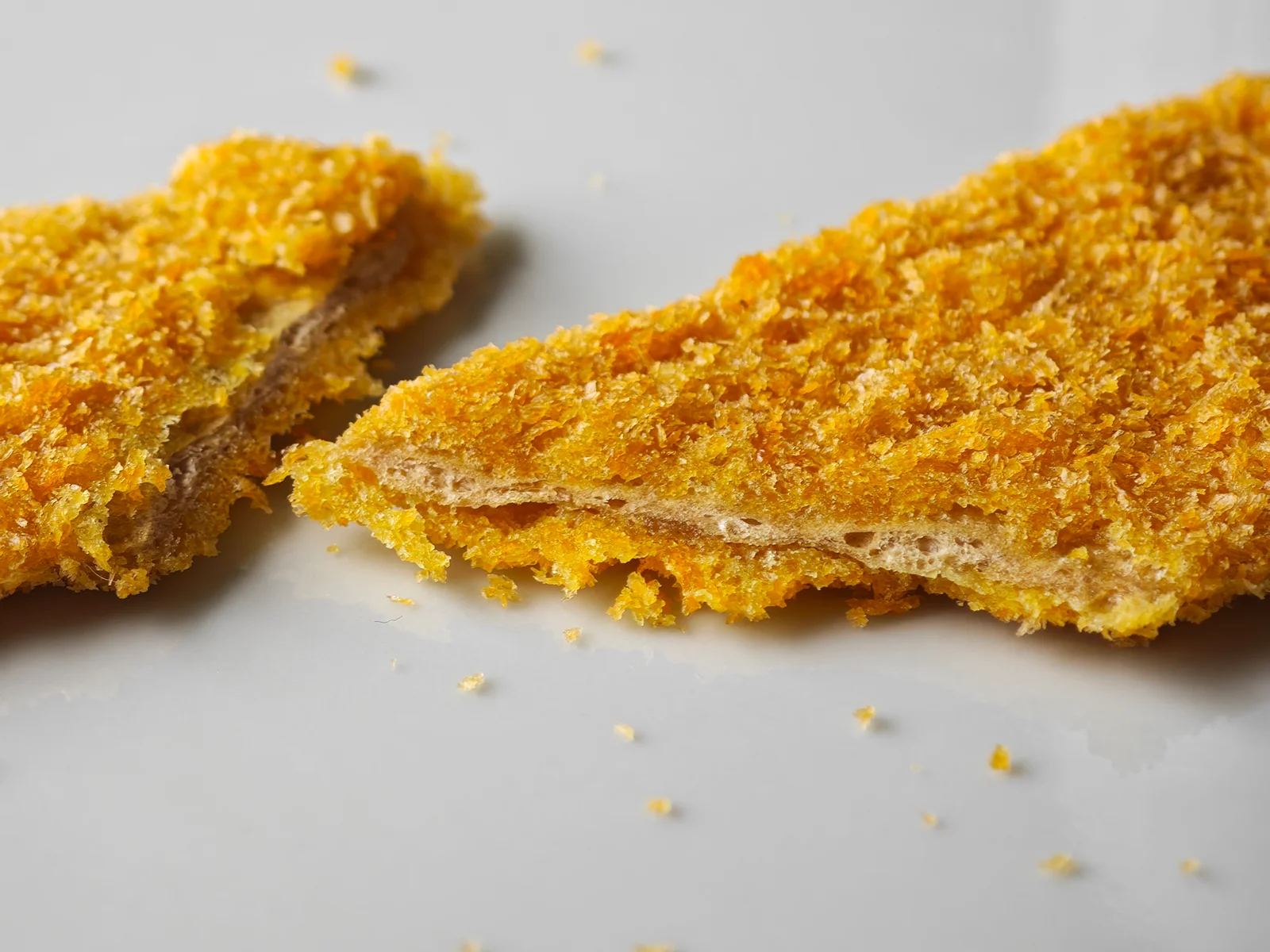
The cross-section is somewhat darker than Kadou’s photographed center. That is not evidence of lower quality. Fish-surimi color changes with the blend and processing; here it is simply another clue that the two products are not the same recipe under different wrappers.
Suguru’s flavor and format range
Suguru has turned Big Katsu into a family rather than freezing it at one sauce:
- SD Big Katsu: the core original-style sheet, with original sauce mixed into a soft coating and crisp crumbs.
- Miso Katsu Premium: a regional cutlet idea translated into dagashi seasoning.
- Ham Katsu-ya-san Premium / Ham Katsu flavor: fish sheet adjusted toward ham-like savory flavor.
- Premium Curry Katsu: curry powder in the coating plus a fond-de-veau-based curry sauce.
- Bite-size Sauce Katsu: smaller pieces for sharing and easier snacking.
- Super Big Katsu multipacks: the same family scaled for stocking up.
- Carp Katsu: a Hiroshima identity line tied to the local baseball culture.
This range is useful information for travelers: if you enjoy the regular Suguru sheet, you can continue exploring katsu as a flavor category—miso, curry, ham, sauce, and regional packaging—not just repurchase one bag.
Kadou BIG Katsu — the 1987 focused classic
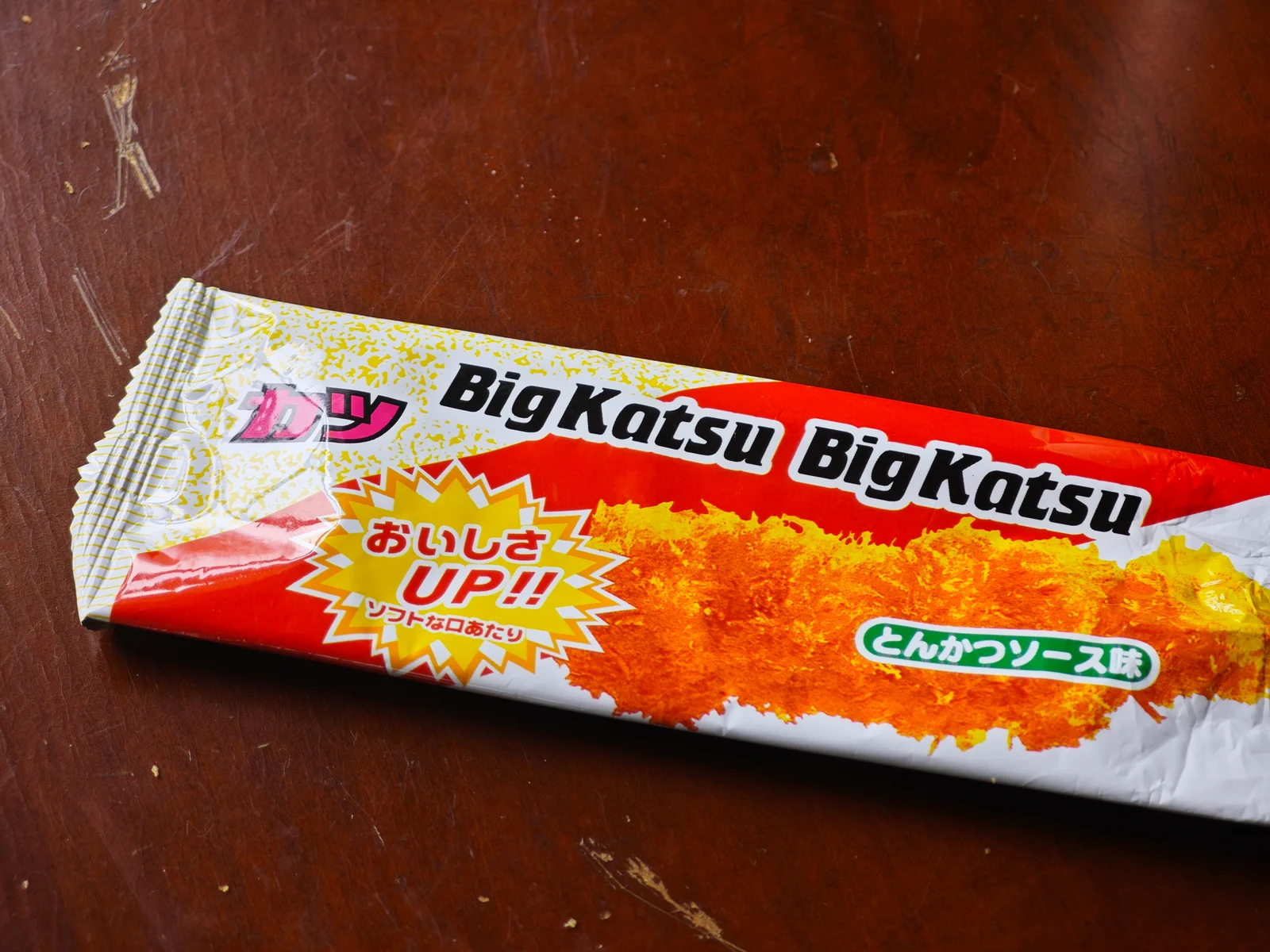
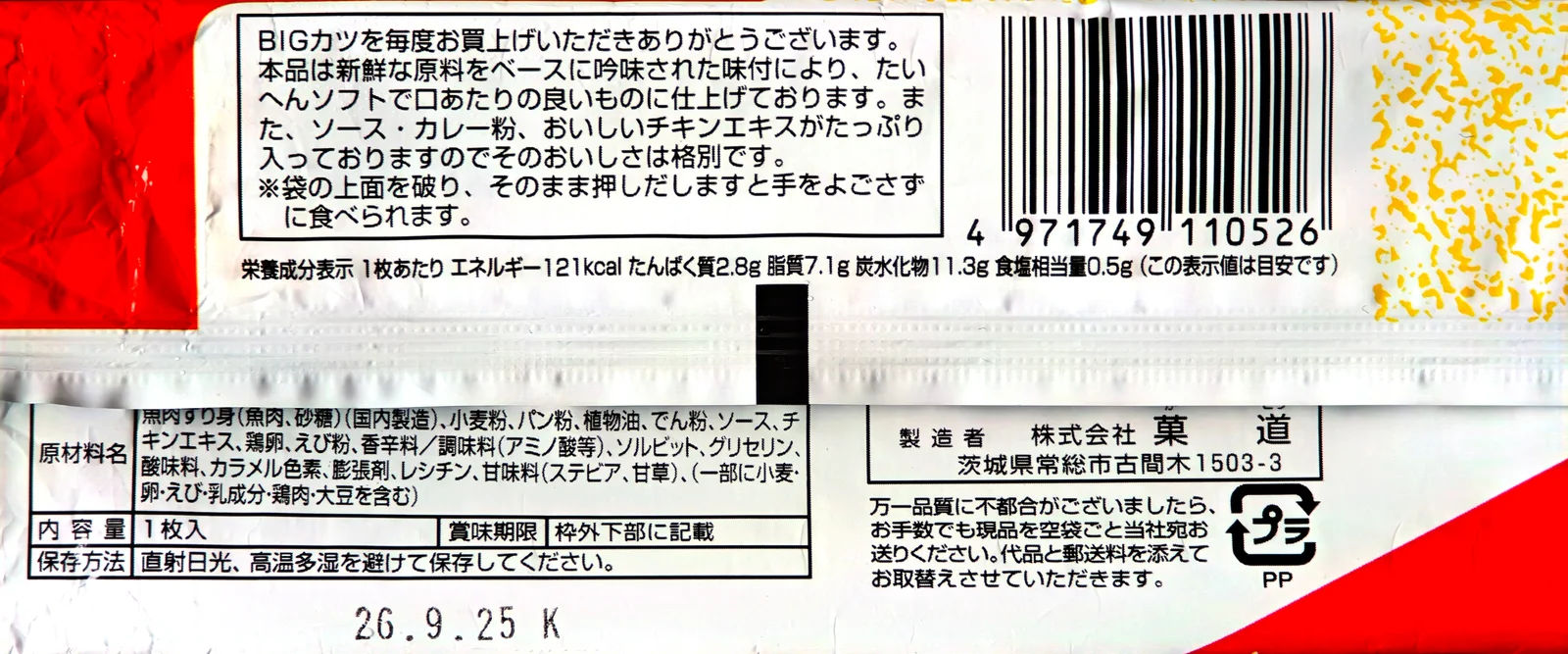
株式会社菓道 launched its BIGカツ in 1987. It is commonly encountered through Yaokin’s broad dagashi distribution network, which helps explain why many shoppers—especially those who remember long snack racks and mixed dagashi boxes—recognize this package immediately.
Kadou’s strength is focus. Rather than presenting the photographed BIG Katsu as one doorway into a large flavor family, the product concentrates several cues inside one long sheet: tonkatsu-style sauce, chicken extract, fried breadcrumb richness, and a hidden curry accent. Yaokin describes the flavor as juicy tonkatsu-like umami with curry melting out in the mouth.
What Kadou tastes like
The opened sheet is long and physically satisfying. Its fried coat feels substantial against the teeth, while the fish center contributes a compressed, layered resistance. This is the version that most strongly activates my childhood way of eating: grip, lock the teeth, and tear.
Its seasoning can feel more location-dependent than Suguru’s. One bite may lead with sweet fried crumb, another with sauce, another with curry-like spice after the oil warms in the mouth. The variation is not poor control; it is part of the fun. You can travel along one sheet and get small changes without changing packages.
Kadou’s official nutrition listing also makes the scale easy to understand: one long piece is listed at 121 kcal, with a published piece size of roughly 195 × 55 × 5 mm at the time checked. It is still dagashi, but it delivers the theatrical size promised by the name.
What Kadou offers beyond “the other Big Katsu”
Kadou’s identity is not built on matching Suguru’s number of katsu variants. It is built on keeping a distinctive, long-running single-sheet standard recognizable: long format, softer fish-board bite, sauce, chicken umami, and curry tucked into the finish.
That focused recipe is why it deserves equal space in a comparison. Suguru shows how one originating idea can expand into many flavors. Kadou shows how one later formula can become a durable national reference through repetition, distribution, and a highly recognizable bite.
Fair comparison: choose by experience, not legitimacy
Choose Suguru when you want:
- the earlier 1978 history;
- sauce distributed more evenly through the coating;
- a slightly thinner, gently flexible sheet;
- a path into miso, curry, ham-cutlet, bite-size, and regional variants.
Choose Kadou when you want:
- the long 1987 dagashi-rack classic;
- a thicker-feeling bite and stronger tear-through theater;
- sauce intensity that changes by location;
- curry and chicken umami hidden inside one focused recipe.
Buy both when you want the most efficient lesson. Taste half of each normally, compare the cross-sections, then use the remaining halves for the Rasengan roll. You will learn origin, coating strategy, surimi resistance, and sauce timing in one session.
I still do not need a champion. When I want place-by-place contrast, Kadou is exciting. When I want even sauce that blooms steadily, Suguru is satisfying. Both preserve the same physical joy: fried crumbs going juwa, sauce following after, and molars punching through layered fish sheet.
Where to buy Big Katsu
Look in dagashi corners, convenience stores, supermarket snack aisles, and Don Quijote (Donki). The products can sit far apart or appear under the same generic English listing, so check the Japanese maker line before paying:
- すぐる / SUGURU = the 1978 Hiroshima-origin line and wider flavor family.
- 菓道 / KADOU = the 1987 long-sheet recipe commonly listed through Yaokin.
For a first online order, the highest-information purchase is one box of each shared among friends. Multipacks are usually large, and a side-by-side tasting is more useful than choosing from package photos alone.
Buy the two-product tasting
- Amazon Japan — Suguru Big Katsu, special sauce, 30 bags: check price and availability
- Amazon Japan — Kadou BIG Katsu, 30 bags: check price and availability
Verify the maker and current lineup
- Official Suguru catalog: Big Katsu family and flavor variants
- Official Kadou listing via Yaokin: BIG Katsu ingredients, nutrition, and product size
Confirm allergens on the bag you buy—wheat, fish, egg, soy, and related notes are common on these fried sheets.
Affiliate disclosure: links above may be affiliate links. If you buy through them, I may earn a commission at no extra cost to you.
Frequently Asked Questions
Is Big Katsu real pork cutlet?
No. It is a fish-surimi sheet wearing a fried breadcrumb coat in the shape of a cutlet.
Why do packages look different?
Because Suguru and Kadou make separate products. Suguru’s line began in 1978; Kadou’s in 1987. Check すぐる or 菓道 on the package instead of assuming every Big Katsu is identical.
Does Suguru make other Big Katsu flavors?
Yes. Its official family includes regular sauce, miso katsu, premium curry katsu, ham-katsu styles, bite-size sauce katsu, and multipacks; availability changes by store and date.
What makes Kadou BIG Katsu distinctive?
It is a long, focused single-sheet classic with tonkatsu-style sauce, chicken umami, and a hidden curry note. Its seasoning can change slightly as you move along the sheet.
Should I take it fully out of the bag?
Only if you like cleaning crumbs. Bag-eating is the safer everyday method.
What is the Rasengan bite?
Roll the sheet into a spiral and bite once so layered surimi and thick coating hit together. It is the author’s playful method—curious eaters welcome.