
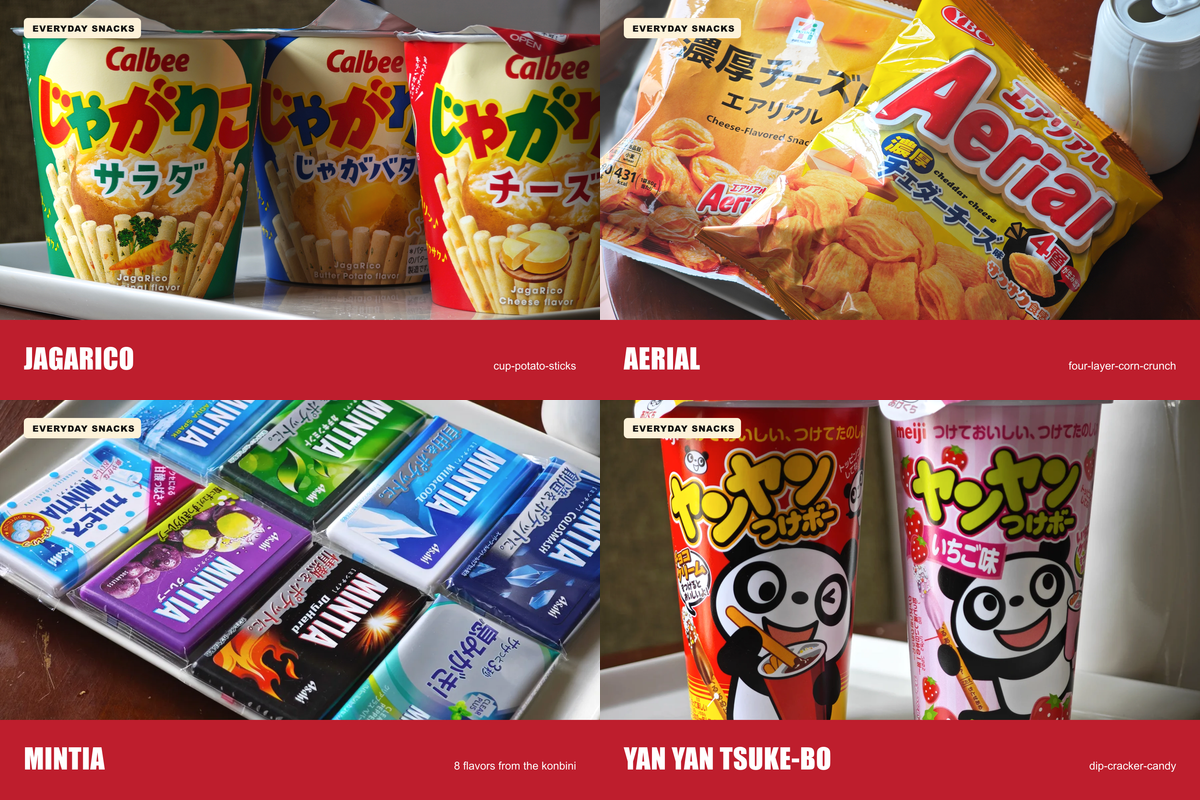
Japanese convenience stores make snack shopping easy, but the shelf can still be difficult to read. A first-time visitor does not need a list of everything in the building. You need a few dependable choices matched to the moment: something crisp for a train ride, something playful to share, something small for a suitcase, or something savory enough to feel like a real break.
Here is the short version:
- Best all-round first snack: Jagarico
- Best light, engineered crunch: Aerial
- Best pocket souvenir: MINTIA
- Best interactive snack: Yan Yan Tsuke-bo
- Best chocolate without messy fingers: Toppo
- Best miniature hot snack: Butamen
- Best low-cost flavor tasting: Umaibo
- Best savory dagashi challenge: Yocchan Ika
These are not universal winners. They are useful starting points supported by Nippon Snacks’ complete product profiles. Availability, formulas, pack sizes, and prices change, so treat the shelf label and the package in your hand as the final word.
Choose by situation
| Your situation | Start with | Why it works | Main caveat | |—|—|—|—| | One safe first purchase | Jagarico Salad | Clear potato flavor, firm sticks, easy cup | The cup takes more luggage space than a flat pack | | You want an unusual texture | Aerial | Four thin corn layers create several fractures | Large airy pieces crush easily | | You want a small souvenir | MINTIA | Flat, light, sealed, and sold in many flavors | Calpis contains milk; mint versions photographed for our profile declare gelatin | | You are sharing with children | Yan Yan Tsuke-bo | Crackers, dip, topping, and printed quizzes | Contains wheat, milk, and soy in the versions profiled | | You want chocolate on the move | Toppo | Chocolate is protected inside a pretzel tube | Chocolate still needs heat protection | | You want a warm snack | Butamen | Three minutes of miniature ramen ritual | Requires boiling water and a stable surface | | You want classic dagashi | Umaibo | Single sticks make flavor comparison easy | The airy puff softens after opening | | You want a savory drink snack | Yocchan Ika | Vinegar-bright squid and fish-surimi textures | Seafood flavor and chew are more polarizing |
The 14 best konbini snack choices
1. Jagarico: the easiest first recommendation
Jagarico is Calbee’s fried potato stick in a paper cup. The core experience is physical: a firm first crackle followed by a drier, lighter crunch. Unlike a thin chip, each stick can be taken one at a time without putting your whole hand into a bag.
Choose Salad for the clearest potato-and-oil baseline, Cheese for occasional cheddar pieces, or Jaga Butter for a sweet-salty butter finish. The common three-flavor comparison is more informative than chasing a limited edition first. Look in the regular snack aisle, not a souvenir display.
2. Aerial: for the most distinctive bagged crunch
Aerial is made from four thin, ridged corn sheets stacked into one airy shell. Those layers create air chambers and multiple break points, so an open piece can feel light while a compressed piece collapses more densely.
YBC’s Rich Cheddar gives a cheese-forward introduction. Seven-Eleven also carries retailer-specific Aerial versions at times, including different sizes and formulations. This is a good example of why chain matters: a Seven Premium bag and a maker-branded YBC bag can share the structure without being the same recipe.
3. MINTIA: the smallest practical souvenir
MINTIA is Asahi’s sugarless tablet candy in a flat sliding case. Strong mint versions, gentle peppermint, grape, soda-like Aqua Spark, and Calpis-style tablets can sit in the same small rack near the register.
Choose a mint version when you want breath refreshment and grape or Calpis when you mainly want candy. The product profile documents important label differences: Dry Hard lists caffeine, and Calpis MINTIA contains milk. That is a useful reminder that two cases with the same brand name may not share the same ingredients.
4. Yan Yan Tsuke-bo: a snack you assemble
Yan Yan Tsuke-bo separates crisp cracker sticks, thick cream, and a crunchy sugar topping into three compartments. Chocolate is the classic choice; strawberry is milder and less sharply tart.
It works well as a shared activity because every eater controls the ratio. It is less ideal when you need a completely clean, one-handed snack. The tidy method is to dip first, then sprinkle the topping over the peeled foil lid instead of pushing a wet stick into the dry topping well.
5. Toppo: chocolate protected by pretzel
Toppo puts chocolate inside a hollow baked pretzel rather than coating the outside. That gives a clean grip, a firm toasted snap, and chocolate through to the tip. A standard carton commonly contains two inner bags, which helps with sharing or saving half.
Classic chocolate is the neutral first choice. Strawberry changes the filling while preserving the same shell, and The Chocolat moves toward darker cocoa. If you want a chocolate snack for a train or desk, Toppo’s contained filling is more convenient than an exposed chocolate bar—but it is not immune to summer heat.
6. Pai no Mi: pastry first, chocolate second
Pai no Mi is Lotte’s hexagonal chocolate pie snack. Its laminated pastry is built from about 64 layers, baked with a maltose glaze, then filled with chocolate. The result arrives in sequence: glossy pastry snap, flaky collapse, then soft chocolate.
Choose it when you want a carton for sharing rather than a single stick. The box may include a reclose tab and rotating art inside the lid. It still needs careful storage: the package profiled by Nippon Snacks says to keep it below 28°C.
7. Caplico: ice-cream form without ice cream
Caplico looks like soft-serve, but the filling is aerated chocolate inside a wafer cone. Giant Caplico’s scale is the point: the bubbled chocolate collapses in a way that feels much larger than a small aerated chocolate piece.
Strawberry gives a gentle fruit direction; milk gives a calmer dairy-and-cocoa contrast. It is cheerful and easy to recognize, but it is one of the worst choices for a tightly packed suitcase. The cone and airy crown can crush, and the chocolate needs a cool environment.
8. Koala’s March: a familiar sharing biscuit
Koala’s March combines a hollow printed biscuit with chocolate inside. The individual koala designs make a box naturally social: open it, compare the prints, then eat.
Choose it when your group wants a mild chocolate biscuit rather than an intense flavor. The carton also belongs to Lotte’s tradition of making packaging part of the play. Like other chocolate products, it should be kept away from high heat even though the biscuit shell helps with handling.
9. Bourbon Choco Anpan: tiny bread-shaped chocolate bites
Bourbon Choco Anpan turns the shape of anpan—a Japanese sweet bun—into a bite-size packaged snack with chocolate filling. It is useful for visitors who want something visually Japanese but more familiar in flavor than red bean paste or seafood dagashi.
The small pieces suit sharing, and the character Anpan Ojisan gives the package a recognizable identity. Read the product profile before assuming it is actual bakery bread or traditional anpan; it is an everyday packaged confection built around the form.
10. Umaibo: build a five-flavor dagashi tasting
Umaibo is a hollow corn-puff stick sold in many illustrated wrappers. A strong first set is Corn Potage, Cheese, Mentai, Yasai Salad, and Takoyaki. They use the same airy tube but change seasoning and, in Takoyaki’s case, the surface texture.
Umaibo is ideal when you want low commitment and clear comparison. Individual flavors are not guaranteed at every branch, so a supermarket, dagashi shop, or Don Quijote may be more efficient than visiting several small konbini.
11. Butamen: ramen small enough to remain a snack
Butamen is miniature instant cup ramen rooted in dagashi culture. Tonkotsu is the original Butamen identity; shoyu gives a clearer chicken-and-soy direction. The photographed cups call for about 180 ml of boiling water and a three-minute wait.
Buy it when your hotel, office, or rest area provides safe hot-water access. Do not choose it for a moving train platform or crowded walk. It is still hot soup, even if the mascot and size make it look playful.
12. Big Katsu: cutlet theater made from fish surimi
Big Katsu is not pork tonkatsu. It is a breadcrumb-coated fish-surimi sheet, fried and seasoned in a cutlet-sauce direction. Suguru’s line began in 1978; Kadou’s separate BIG Katsu followed in 1987.
Check the maker name because the two products are different recipes. Suguru offers a wider family of variants, while Kadou’s long sheet has its own curry-accented character. Eat from the wrapper: crumbs are a defining feature, not a minor possibility.
13. Yocchan Ika: vinegar, squid, and two textures
Yocchan Ika—often printed as Cut Yocchan—mixes seasoned squid pieces with fish-surimi sheets. The classic red pack is the orthodox sweet-tart vinegar choice; white is gentler; sweet-spicy and chili tomato move in different directions.
This is one of the most specifically Japanese savory picks in the list. It is also a poor blind purchase for someone who dislikes seafood aroma, vinegar, or a persistent chew. For a curious eater, that distinctiveness is exactly the reason to try one small pack.
14. San Taro Series: five flat dagashi, two texture families
The San Taro Series uses seasoned fish-paste sheets in bright single-serve packs. Sudako and Noshiume form a softer, juicier family; Kabayaki, Yakiniku, and Wasabinori form a harder, jerky-like family.
Do not read the eel, octopus, yakiniku, plum, and wasabi illustrations as literal restaurant ingredients. The packages sell flavor stories around a fish-paste base. A mixed set is useful because texture family matters as much as the seasoning name.
Where to look inside the store
Konbini layouts differ, but a simple scan works:
- Near the register: MINTIA and other impulse-size tablets or gum.
- Main bagged-snack aisle: Jagarico, Aerial, chips, and larger corn snacks.
- Chocolate and biscuit aisle: Toppo, Pai no Mi, Koala’s March, Choco Anpan, and Caplico.
- Dagashi hooks or lower shelves: Umaibo, Big Katsu, Yocchan Ika, and San Taro.
- Small cup area: Butamen may sit with dagashi or instant foods, depending on the branch.
If the goal is breadth rather than convenience, compare a supermarket or Don Quijote after your first konbini visit. Convenience stores are excellent for singles and current chain-specific products; larger stores often make side-by-side flavor shopping easier.
Price and availability: use the shelf, not an old promise
There is no responsible single price list for these snacks. Retailers can set different prices, pack sizes change, and limited products disappear. Dagashi singles usually offer the lowest-cost experiment. Cups, cartons, and larger bags ask for more money and luggage space. Online listings often convert a single Japanese snack into a case of 10, 12, or 30.
For a tourist, the practical rule is:
- buy one single locally before committing to a multipack;
- compare the tax-included shelf label where shown;
- check whether a promotional flavor is replacing a regular one;
- read the current package for ingredients and allergens;
- protect chocolate from heat and layered snacks from crushing.
A balanced first konbini basket
For two people, a useful first basket is:
- one Jagarico Salad;
- one cheese or corn-potage Aerial;
- one classic Toppo or Pai no Mi;
- two different MINTIA cases;
- two or three individual Umaibo flavors;
- one challenging savory pack: Yocchan Ika, Big Katsu, or San Taro.
This basket compares potato, layered corn, baked chocolate, tablet candy, airy dagashi, and seafood-based savory snacking without turning the visit into a full meal. Add Butamen only when hot water and safe seating are available.
Buying these snacks outside Japan
Do not assume Amazon Japan is the automatic answer. A local Asian grocer may have lower landed cost and easier returns; a specialist importer may provide clearer English ingredient information; a domestic marketplace seller may have familiar delivery; and a Japan-based seller may offer the exact flavor but add forwarding, customs, and heat risk.
Use the central guide to buying Japanese snacks online to choose by country, compare total cost, evaluate forwarding, and check allergens and customs. This page stays focused on choosing the snack; the buying guide handles the commercial decision.
Affiliate disclosure: this article may contain affiliate links. If you buy through them, I may earn a commission at no extra cost to you. Recommendations are based on fit and documented product details, not commission.
Frequently Asked Questions
What are the best convenience store snacks in Japan for a first-time visitor?
Start with Jagarico for potato crunch, Aerial for layered corn texture, Toppo or Pai no Mi for chocolate, MINTIA for a pocket-size candy, and Umaibo for classic dagashi. Add one more adventurous savory choice such as Yocchan Ika or Big Katsu.
Which Japanese convenience-store snacks travel well?
MINTIA, Toppo, Umaibo, Big Katsu, and San Taro are compact when sealed and protected. Aerial and Caplico crush easily. Pai no Mi, Toppo, Caplico, Koala’s March, and Choco Anpan contain chocolate, so heat remains a concern.
Does every convenience store carry the same snacks?
No. Branch size, chain, region, season, and retailer-specific agreements affect the shelf. Core brands may be widespread without every flavor being available. Check a supermarket or Don Quijote when comparison matters more than speed.
Are these snacks suitable for people with food allergies?
That depends on the exact product and formula. Common ingredients across this list include milk, wheat, soy, fish, squid, gelatin, and other allergens. Never rely on a category description or this guide alone; read the current package and ask the manufacturer when needed.
How much should I budget?
Use current shelf labels. Individual dagashi sticks and sheets are generally low-commitment purchases; cups, cartons, and large bags cost more. Online prices are not good proxies for a Japanese single because they often include multipacks, seller margin, and shipping.
Can I buy the same flavors online after my trip?
Sometimes, but availability is country- and seller-specific. Record the Japanese product name, maker, flavor, net weight, and a package photo. Then compare local importers, domestic marketplaces, and Japan-based options using the online buying guide.