
There is no single best store for buying Japanese snacks online. The best route changes with your country, the exact product, the weather, and how much uncertainty you are willing to accept.
A local Asian grocer may beat Japan-direct shipping after tax and freight. Amazon Japan may show the right flavor yet reject your address. Forwarding can close that gap, but its fees can make a cheap snack expensive.
The honest short answer is:
- Buy locally first when the product is mainstream and the price is reasonable.
- Use a specialist importer when you value clear delivery, English support, and food-focused packing.
- Test Amazon Japan or an official Japanese shop when you need a specific current SKU.
- Use forwarding last, for a product important enough to justify added cost and import work.
This guide gives you a repeatable way to make that choice without pretending that a listing available in one country today is available everywhere.
Quick decision tree
Are you currently in Japan?
- Yes: buy single packs in convenience stores, supermarkets, drugstores, dagashi shops, Don Quijote, stations, or airports. Use online ordering mainly for cases, gifts, or products you cannot find nearby.
- No: continue below.
Do you need an exact flavor, package, or limited release?
- No: start with a local Asian grocer, specialist importer, or domestic marketplace. Compare total cost and remaining shelf life.
- Yes: check the maker’s current product page, then test Japan-based sellers with your destination address.
Does the Japanese seller ship the exact item to your country?
- Yes: compare the full checkout total, delivery window, tax treatment, and temperature risk against local options.
- No: decide whether the item is worth a proxy or forwarding service.
Is the snack fragile, melt-sensitive, short-dated, refrigerated, or restricted by ingredients?
- Yes: local stock or a food-specialist importer is usually the safer route. For fresh or chilled products, do not assume normal parcel forwarding is suitable.
- No: a consolidated Japan-direct order may make sense if the numbers work.
Buying snacks while you are in Japan
Online shopping is often unnecessary for travelers already in Japan. The retail channel should match the job:
- Convenience stores: fast single-pack trials and some chain-specific products.
- Supermarkets: broader standard ranges and better side-by-side flavor comparison.
- Drugstores: useful for mainstream candy, chocolate, and tablet products such as MINTIA.
- Dagashi shops: individual low-cost classics such as Umaibo, Butamen, and San Taro sheets.
- Don Quijote: wide, variable assortments and multipacks, especially useful when gathering souvenirs.
- Stations, airports, and department stores: convenient for boxed gifts and regional products, but not automatically the lowest-price channel.
Buy one local single before ordering a case. Jagarico is easy to try by the cup in Japan, while an online listing may be a 12-cup case. Big Katsu may look like one generic product online, but Suguru and Kadou make separate versions. A physical shelf lets you confirm the maker, flavor, size, and packaging before making a larger commitment.
If you plan to carry snacks home, keep original packaging and ingredient labels. Check your destination’s import rules before buying products containing meat, dairy, egg, seafood, fresh fruit, or other regulated ingredients. "Sold legally in Japan" does not mean "admitted by every destination."
Buying from overseas: compare four routes
1. Local Asian grocers and Japanese supermarkets
This is the least glamorous route and often the most sensible. The goods have already entered your country through a commercial importer. You can inspect the label, see the best-before date, avoid international parcel fees, and use familiar consumer protections.
The trade-off is selection. Export versions may differ from Japanese domestic packaging, and a shop may stock only the most established flavors. That is not a reason to reject the route. If you want a standard Pocky, Hi-Chew, Koala’s March, or rice cracker rather than a collectible Japan-only package, local stock can be the best-value answer.
2. Specialist Japanese-snack importers
A good specialist understands that food is not ordinary merchandise. Look for:
- a real destination-country business address and contact route;
- ingredient and allergen information;
- remaining-shelf-life policy;
- temperature or summer-shipping policy;
- damage and refund terms for edible goods;
- exact pack count and net weight;
- a clear statement of where the item ships from.
Curated boxes are useful for discovery but poor for exact-product shopping. A subscription may promise a theme or number of items without guaranteeing one flavor. Use a single-product retailer when the exact SKU matters.
3. Domestic marketplaces in your country
Amazon, eBay, and other marketplaces can be convenient because checkout and delivery are familiar. The marketplace name is not the seller, however. Compare the merchant, fulfillment location, recent food-related reviews, return policy, and listing photos.
Watch for mixed packs that use a popular product image but say that contents may vary. That can be acceptable for discovery and unacceptable for a flavor-specific purchase. Also calculate the price per gram or per individually wrapped unit; a visually large assortment can contain many very small dagashi pieces.
4. Japan-direct shops, Amazon Japan, and Japanese marketplaces
Japan-direct buying offers the widest path to domestic products, but it shifts more work to you. Product descriptions may be Japanese-only, export eligibility varies, and checkout can introduce international shipping, import deposits, conversion fees, and delivery restrictions.
Rakuten Ichiba and official brand shops are useful discovery sources, but many merchants are set up for domestic delivery. A product appearing in search results is not evidence that it can reach your address.
Amazon Japan is useful, not universally easiest
Amazon Japan can be straightforward when Amazon or a marketplace merchant ships the exact item internationally. It can also stop at the address screen.
Use this test:
- Set the delivery destination to your actual country and postal code.
- Confirm the exact flavor, Japanese product name, net weight, and case count.
- Identify the seller and who fulfills the order.
- Check whether the page says the item can ship to the selected address.
- Review the delivery estimate and any import-fee information shown.
- Continue far enough into checkout to see the real shipping total, without placing the order.
- Compare that landed estimate with local and specialist options.
Do not treat "in stock" as "exportable." A listing can be visible and purchasable for a Japanese address but unavailable for an overseas address. Two sellers on the same product page may have different export policies. Food can also lose eligibility without the ASIN disappearing.
Amazon Japan listings commonly bundle everyday snacks by the case. That can make sense for sharing or a known favorite. It is inefficient for first tasting and can create a shelf-life problem if you cannot finish the quantity.
Forwarding and proxy buying
A forwarder gives you a Japanese delivery address, receives your parcel, and sends it abroad. A proxy buyer purchases from the domestic seller on your behalf and may also consolidate and export the order. Services differ, so read their food restrictions rather than assuming every snack is accepted.
The cost stack can include:
- domestic Japanese postage;
- purchasing or handling fees;
- warehouse storage;
- consolidation or repacking;
- international freight based on actual or dimensional weight;
- optional insurance;
- destination tax, duty, or carrier fees.
Forwarding is strongest when you need several Japan-only items from compatible sellers and can consolidate them. It is weakest when you want one ordinary low-value snack. Air-filled bags such as Aerial and cup products such as Jagarico can create high dimensional weight. Fragile chocolate cones such as Caplico may arrive crushed if repacking removes protection.
You also become responsible for understanding import rules. A forwarder moving the parcel does not guarantee that customs will admit every ingredient. Ask whether the service will export food, how it declares contents, whether it removes invoices or packaging, and what happens if customs rejects or destroys the parcel.
Customs, tax, and country differences
Rules change, and personal-use exemptions are not universal. Before payment, check two official sources for your destination:
- the government food, agriculture, or biosecurity authority for ingredient restrictions;
- the customs or tax authority for declarations, thresholds, tax, and carrier collection.
Do not rely on a seller’s general "worldwide shipping" banner. The destination authority makes the final decision.
United States test
Check current guidance from U.S. Customs and Border Protection and the relevant USDA/APHIS or FDA pages for personal food imports. Test the actual ingredient list, especially meat, poultry, egg, dairy, fresh fruit, and seeds. Then verify whether the carrier or marketplace collects tax or fees and whether the seller’s English label information is sufficient for your needs.
United Kingdom test
Use current GOV.UK guidance for bringing or receiving food from abroad, then check customs/VAT treatment for the parcel value and seller arrangement. Pay close attention to products containing meat or dairy and to whether VAT is collected at checkout or by the carrier. Do not assume rules for personal luggage and postal imports are identical.
Australia test
Australia applies strict biosecurity controls. Check the Department of Agriculture, Fisheries and Forestry’s current BICON guidance using the product ingredients and processing type. Declare goods when required. Meat, egg, dairy, seeds, fruit, and insufficiently described foods deserve particular care.
Singapore test
Check current Singapore Food Agency guidance for personal imports and Singapore Customs for tax and clearance. Confirm whether quantity still looks like personal consumption, whether the category has specific controls, and whether the courier requires additional information.
These are research steps, not claims that a particular snack is currently admissible. Save the official page, access date, and conclusion in your order notes.
A country-aware availability test
Use the same framework for the US, UK, Australia, Singapore, or any other market. Run it on the day you plan to publish or buy:
| Check | Record | |—|—| | Product identity | Maker, Japanese name, flavor, net weight, package version | | Local option | Retailer, country, stock status, price, best-before information | | Specialist option | Ships from, delivery estimate, temperature policy, returns | | Domestic marketplace | Seller, fulfillment location, ratings, exact contents | | Japan-direct option | Export eligibility to the test postal code, seller, case count | | Forwarding option | Domestic shipping, service fee, parcel weight, export restrictions | | Import check | Official authority, ingredient concern, access date, conclusion | | Landed cost | Item + all shipping + tax/duty + handling + conversion | | Risk | Heat, crushing, short date, customs, unclear allergens |
Mark a product available only when it can be added for the destination, the seller is identified, the exact item is clear, and a checkout total is visible. Mark it unconfirmed when search results do not verify shipping or stock. Never turn a search result into a current-listing claim.
Allergens and label limits
Japanese allergen labeling is designed for Japan. An importer may add a local-language sticker, but marketplace photos can show an older package or omit the side panel.
Before buying:
- request a current ingredient and allergen photo;
- compare the maker’s current product page;
- note shared-equipment or cross-contact statements;
- do not infer safety from a flavor name;
- recheck every flavor in an assortment.
The public snack profiles show why. Calpis MINTIA contains milk, while the mint cases photographed for the MINTIA guide declare gelatin. Yan Yan Tsuke-bo chocolate and strawberry versions profiled contain wheat, milk, and soy. Yocchan Ika combines squid and fish-surimi materials. Similar packaging does not guarantee similar allergens.
If an allergy is serious, unclear marketplace photos are a stop sign. Contact the manufacturer or importer and do not depend on machine translation alone.
Heat, humidity, crushing, and shelf life
Chocolate and filled biscuits
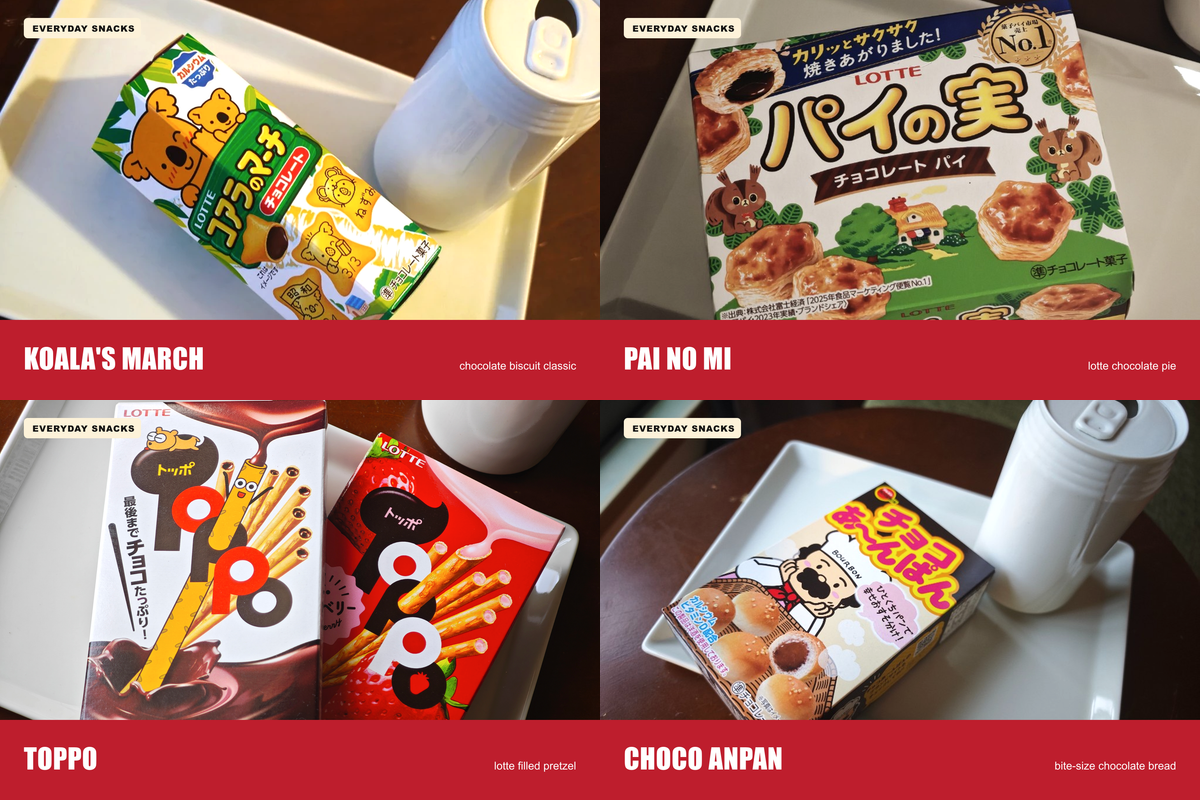
Toppo, Pai no Mi, Koala’s March, and Bourbon Choco Anpan handle more cleanly than an exposed bar, but their chocolate can still soften or bloom. Insulation reduces risk only for a limited time. Express shipping can help; waiting for cooler weather can help more.
Airy and fragile snacks
Aerial, Caplico, and Umaibo depend on air-filled structures. Cushioning matters. A cheap repack that minimizes parcel size can destroy the texture you paid to experience.
Soft cakes and fresh wagashi
Short-dated cakes, cream-filled sweets, and refrigerated wagashi are not good beginner imports. A listing needs a clear production or best-before date, storage requirement, dispatch schedule, and appropriate shipping method. If those details are missing, choose a shelf-stable alternative or buy the fresh item in Japan.
Rice crackers and dry dagashi
Dry products often tolerate transit better, but humidity and broken packaging still matter. Look for sealed inner packs and protective cartons. Seafood-based dagashi may be physically durable while presenting more customs or allergen questions.
Calculate landed cost, not item price
Use:
landed cost = item price + domestic Japan shipping + service fees + international shipping + tax/duty + carrier fees + currency conversion
Then divide by the number of usable units. A low Japanese shelf price can become a poor overseas deal after a 30-piece case, dimensional freight, and fees. A higher-priced local importer can be cheaper after all costs and easier to resolve if the food arrives damaged or too close to its best-before date.
Also price the risk. If a summer chocolate parcel has a meaningful chance of melting, the apparent saving is not a saving.
What a ten-product US check found
On August 15, 2026, Nippon Snacks checked ten products against Amazon.com, Amazon Japan’s international-shipping filter, and a US-facing retailer or importer.
- Strong Amazon.com signal: MINTIA multipacks, the US-market Yan Yan format, Jagarico, Umaibo, and Caplico Mini.
- Exact Amazon.com pages but unstable stock: Koala’s March, Pai no Mi, Toppo, and Choco Anpan.
- No stable exact Amazon.com result: Kamome no Tamago.
- Amazon Japan: none of the ten exact foods appeared as an eligible food result after applying the International Shipping Eligible filter. A checkout test with a US street address was not performed, so this is a warning—not proof that every offer is permanently blocked.
The practical order for a US reader is therefore: an exact in-stock Amazon.com offer, an official US maker store or US-based Japanese retailer, a Japan-based importer that clearly serves the US, then Amazon Japan only after the exact seller shows delivery eligibility and total cost.
Examples of first-party or US-facing routes include Glico USA for Caplico, Nijiya Market for Jagarico, and Meiji America’s Yan Yan range. These are research links, not affiliate recommendations, and stock can change.
Final buying checklist
Before paying, confirm:
- exact maker, product, flavor, and net weight;
- seller and fulfillment country;
- current stock for your delivery address;
- package count and unit price;
- ingredient and allergen photos;
- best-before date or seller shelf-life policy;
- shipping speed and temperature policy;
- packaging for crushing and moisture;
- destination-country import rules;
- tax, duty, handling, and conversion fees;
- refund policy for melted, crushed, expired, or incorrect food.
The goal is not to force every purchase through Japan. It is to get the right snack, in edible condition, at a total cost you understand. Sometimes that means a Japan-direct case. Often it means buying one box from a shop already operating in your country.
For product selection before shopping, use the best convenience-store snacks in Japan comparison or browse Everyday Snacks.
Frequently Asked Questions
What is the best way to buy Japanese snacks online?
Start locally. Compare an Asian grocer or specialist importer with a domestic marketplace. Test Japan-direct shipping only when you need a particular product, then use forwarding only when that item justifies the extra fees and import responsibility.
Does Amazon Japan ship Japanese snacks worldwide?
No. Eligibility varies by item, seller, destination, and date. Set the delivery country and postal code, identify the seller, and continue to the pre-payment checkout stage to see shipping and fees. A visible listing is not proof of export eligibility.
Is a forwarding service cheaper?
Not automatically. Domestic postage, handling, consolidation, international freight, tax, and carrier fees can exceed the snack value. Forwarding works best for a planned consolidated order of products that are allowed by both the service and destination country.
Will I pay customs duty or tax?
Possibly. The answer depends on destination, parcel value, product category, seller setup, and current rules. Check the destination customs authority and note whether tax is collected at checkout or on arrival. Budget for carrier handling as well as government charges.
How do I verify remaining shelf life?
Look for a photographed best-before date or a written minimum-shelf-life policy. Ask the seller for the date on the batch they will actually ship. For cases and short-dated products, calculate whether you can use the quantity in time.
Can I import snacks containing meat or dairy?
Sometimes, but restrictions vary sharply. Check the exact ingredient list against current destination guidance before purchase. Do not assume a processed or powdered ingredient is exempt, and do not assume a seller’s willingness to ship means customs will admit it.
How do I protect chocolate in summer?
Prefer local stock, wait for cooler weather, or choose a seller with a clear seasonal temperature policy and fast shipping. Insulated packaging and cooling packs can reduce risk but cannot guarantee a cold parcel through a long delay.